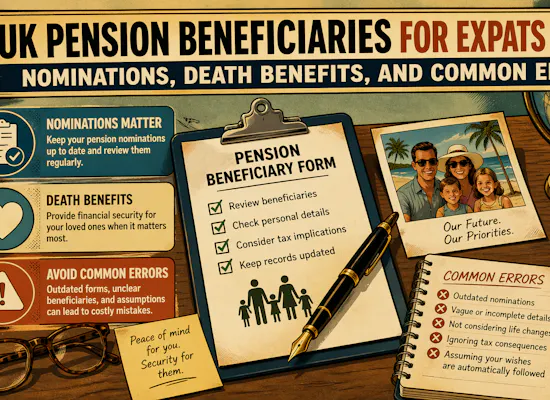
UK Pension Beneficiaries for Expats: Nominations, Death Benefits, and Common Errors
For most UK pensions, your nomination or expression of wish is important but not always binding. Trustees or providers will usually consider it carefully, but they often retain discretion over who receives death benefits. For expats, that matters even more because divorce, remarriage, children in different countries, and future inheritance tax changes can all affect the outcome.
People also ask
- Who gets my UK pension if I die abroad?
- Is a pension expression of wish legally binding?
- Do I need to update my pension nomination after divorce?
- Can my children inherit my UK pension if I live overseas?
- Will my UK pension death benefits be subject to inheritance tax?
- What mistakes do expats make with pension beneficiaries?
At a glance
- For many UK pensions, a nomination or expression of wish is important but not usually binding. Trustees or providers will often decide who receives death benefits using their discretion, though they usually consider the member’s wishes carefully.
- Old nomination forms are one of the biggest risks. Divorce, remarriage, new children, stepchildren, and cross-border moves can all leave your paperwork pointing at the wrong person.
- Expats should not assume their will overrides their pension nomination. In many schemes, pension death benefits sit outside the estate process and are dealt with separately.
- If trustees retain discretion, pension death benefits have usually sat outside the estate for inheritance tax purposes, but the UK government has announced legislation intended to bring unused pension funds and death benefits into the estate from 6 April 2027.
- Death benefit decisions are often where cross-border family complexity becomes visible: ex-spouses, cohabiting partners, children from different relationships, and beneficiaries living in multiple countries can all slow things down.
- The practical rule is simple: if your family situation has changed and your pension nominations have not, you are relying on luck.
Most expats think pension beneficiary planning is a paperwork task.
It is not.
It is a family-outcome task.
The difference matters because the person you think will receive your UK pension after death is not always the person who actually will. That gap usually appears because of one of four things: an old nomination form, a will that does not control the pension, a trustee decision that follows a different path, or a family structure that changed faster than the paperwork did.
This is why pension beneficiaries matter so much for expats.
A British family living in Dubai, Abu Dhabi, Doha, Riyadh, Muscat, or Bahrain often has more moving parts than a domestic UK household. There may be a former spouse in one country, a current partner in another, children in school abroad, stepchildren, elderly parents, and a retirement plan that spans more than one jurisdiction. In that kind of setup, a stale expression of wish is not a minor admin issue. It is a serious estate-planning weakness.
That is also why this topic is frequently misunderstood. People assume that naming someone on a pension form makes the outcome automatic. Sometimes it points strongly in that direction. Often it does not. HMRC and MoneyHelper both explain that for many schemes trustees or providers retain discretion, even though they will usually consider the member’s wishes.
So the right question is not just:
“Who have I nominated?”
It is:
“Would the right people actually receive the right benefits, in the right way, if I died tomorrow?”
What are UK pension beneficiaries?
In everyday language, your pension beneficiaries are the people who may receive benefits from your pension after you die.
That might include:
- a spouse or civil partner
- a long-term partner
- children
- stepchildren
- financial dependants
- other nominated people or trusts, depending on the scheme rules
But the technical point matters more than the label.
For many UK pensions, especially defined contribution arrangements and drawdown plans, you are often asked to complete a nomination form or expression of wish form. MoneyHelper says providers or trustees will usually pay attention to that form, but they do not always have to follow it because many schemes operate on a discretionary basis.
That is why the nomination matters, but also why it is not the whole story.
If the scheme uses trustee or provider discretion, the form helps guide the decision. If the scheme uses a direction-based approach, the effect can be more binding. MoneyHelper explains this distinction directly and notes that where the provider uses direction rather than discretion, inheritance tax treatment can differ.
For expats, the planning lesson is clear:
You need to know not just who you named, but how the scheme actually makes death benefit decisions.
Why nominations matter more than many expats realise
A lot of people treat pension nominations as “one of those forms I did years ago”.
That is exactly the danger.
A nomination form becomes high-risk the moment your life changes and the form does not.
Common trigger events include:
- getting married
- divorcing
- separating
- having children
- entering a new long-term relationship
- leaving the UK
- building assets across multiple countries
- becoming financially responsible for different people over time
The problem is not just that old forms become inaccurate. The deeper problem is that old forms often continue to look valid until someone dies.
The Pensions Ombudsman has repeatedly dealt with disputes where an old expression of wish, an estranged spouse, a newer partner, or informal family expectations all collided after death. In one Ombudsman case, a previous nomination for a former wife remained relevant enough that trustees had to consider it, but it was still not binding because the trustees retained discretion.
That is exactly how real-life beneficiary problems arise.
Not from obscure tax theory. From old paperwork meeting new families.
Is an expression of wish legally binding?
Usually, not completely.
That is one of the most important answers in the whole article.
HMRC says that most UK pension schemes allow members to nominate beneficiaries, but these are generally not binding nominations. They are normally letters of wishes. Where trustees or providers retain discretion and the member could not compel them to pay a particular person, the benefit has generally not been treated as part of the estate merely because the trustees followed the member’s wishes.
HMRC’s pensions tax manual says something very similar: members are normally asked to nominate who they would like to receive a benefit, but trustees or providers are generally not required to follow those wishes, even though they will consider them.
MoneyHelper says much the same in consumer language. Providers will usually choose those listed on the expression of wish form, but they do not have to.
So the practical answer is:
- your expression of wish is usually highly relevant
- it is often very influential
- but it is not always legally binding
That is also why updating it matters so much. If trustees are exercising discretion, they need a clear and recent indication of what you wanted, especially if your family structure is no longer straightforward.
Your will versus your pension nomination
This is one of the most common areas of confusion.
People assume their will controls everything when they die.
For pensions, that is often not true.
Where trustees or providers have discretion over pension death benefits, the pension usually sits outside the normal estate path. That means the will may be relevant background evidence, but it does not automatically override the nomination form or the trustee decision-making process. The Ombudsman case law reflects this reality. In one case, the deceased had both an expression of wish and a handwritten will referring to pension benefits, but the provider still had to exercise its process in line with the scheme’s rules.
For expats, that matters even more because many assume a UK will, a DIFC will, or another estate document has already solved everything.
It has not.
A will can be excellent estate planning.
A stale pension nomination can still blow a hole in it.
Spouses, partners, children, and ex-spouses
This is where cross-border families often get exposed.
Current spouse
A current spouse is often the obvious intended beneficiary, but trustees still need the paperwork and evidence trail to align with that expectation.
Long-term unmarried partner
This is where people get caught. The member assumes everyone knows who their partner is. The paperwork still points to an old spouse or parent. The scheme then has to investigate.
Children and stepchildren
Children may be straightforward in theory and complicated in practice, especially if there are children from different relationships, dependent children abroad, or children with different financial needs.
Ex-spouses
This is one of the most common errors. Divorce does not always magically clean up pension nominations. If the old form still names the ex-spouse, trustees may need to look at it seriously, even if they eventually decide differently. The Ombudsman cases show how messy this can become.
The emotional mistake here is assuming your current family story automatically replaces your old paperwork.
It does not.
Five worked examples with numbers
Example 1: UAE expat with old nomination
David lives in Dubai and has a £620,000 SIPP. His nomination form still names his ex-wife from 2014. He is now remarried with two children. If he dies now, the provider will need to investigate the family circumstances. The current wife may still receive benefits, but the process is now slower, more stressful, and more uncertain than it should be.
Example 2: Qatar-based couple, no updated paperwork
Emma and James live in Doha. Emma has a £410,000 defined contribution pension and assumes James would “obviously” receive it. She never completed an expression of wish after joining the scheme. That is avoidable uncertainty. The provider may still pay James, but there is no clear instruction from Emma supporting that outcome.
Example 3: Former Shell employee with children in two countries
Tom has £780,000 across two UK pensions. He has one child in the UK and one child living abroad from an earlier relationship. His nomination form only names his current spouse. That may still reflect his wishes, but if it does not, the problem is not tax. It is that his paperwork no longer reflects his family reality.
Example 4: Retired expat in Bahrain with drawdown
Sarah lives in Bahrain and has £950,000 in drawdown. She wants her adult children to inherit flexibly, but her nomination form still splits everything between an old spouse and one child. This is the classic “I thought I sorted that years ago” error.
Example 5: Return-to-UK couple with blended family
Mark and Helen lived in Abu Dhabi and are moving back to the UK. Mark has £540,000 in pensions and two children from a first marriage. His current spouse assumes she is fully protected. The children assume they will receive an equal share. Mark has not updated any forms since 2018. This is exactly the sort of case where disputes and delay start.
Common mistakes
Not updating nominations after divorce or remarriage
This is the big one.
Assuming your will controls your pension
Often it does not.
Forgetting children from previous relationships
Cross-border families often have more than one natural beneficiary group.
Not checking how your scheme actually pays death benefits
Discretionary scheme or direction-based setup matters.
Treating pensions as an afterthought in estate planning
They are often one of the largest assets outside the property and business.
Leaving old providers untouched for years
Old workplace pensions are especially prone to outdated nomination forms.
Common objections
Objection
“My spouse will obviously get it.”
Emotional logic
The family reality feels obvious.
Practical risk
Providers and trustees still need current paperwork and may have to investigate if the form is stale or conflicting.
Next step
Check every pension’s nomination form, not just your assumptions.
Objection
“I already have a will.”
Emotional logic
The will feels like the master document.
Practical risk
Pension death benefits often sit outside the estate process and may be handled separately.
Next step
Treat pension nominations as a separate estate-planning task.
Objection
“I filled the form in years ago.”
Emotional logic
A completed form feels like a solved problem.
Practical risk
Old forms are one of the biggest sources of family conflict and administrative delay.
Next step
Review after every major life change, especially marriage, divorce, children, or relocation.
People also ask
Who gets my UK pension if I die abroad?
Usually the people nominated on your expression of wish form will be strongly considered, but trustees or providers may still retain discretion depending on the scheme rules.
Is a pension expression of wish legally binding?
Often no. It is usually influential rather than binding, unless the scheme works on a direction basis.
Do I need to update my pension nomination after divorce?
Yes. This is one of the most important times to review it. Ombudsman disputes often involve outdated nominations after relationship breakdown.
Can my children inherit my UK pension if I live overseas?
Potentially yes, depending on scheme rules, your nomination, and trustee decisions. Children can be included, but do not assume the scheme will guess your intentions.
Will my UK pension death benefits be subject to inheritance tax?
Up to April 2027, discretionary pension death benefits have generally been outside the estate, but the government has announced legislation to bring unused pension funds and pension death benefits into the estate from 6 April 2027.
What mistakes do expats make most often?
Not updating nominations after family changes, assuming the will controls the pension, and forgetting that cross-border family structures create more room for confusion.
You may also like
US Situs Assets Explained (2026): What Triggers Estate Tax Exposure and What to Check
How Probate Works When You Own Assets in Multiple Countries
DIFC Guardianship Will Explained (2026): What It Does and Why Families Need It
Estate Planning for Expats (2026): Wills, Guardianship, Assets
Conclusion
Pension beneficiary planning is one of the easiest parts of estate planning to postpone and one of the most expensive to leave stale.
For expats, that risk is higher because family structures, countries of residence, and estate complexity tend to change faster than the paperwork does.
The right question is not just “who did I nominate years ago?”
It is “would the right people actually receive the right pension benefits, in the right way, if I died tomorrow?”
If you want help reviewing your pension nominations, family position, and wider cross-border estate plan, book a cross-border estate and retirement planning call with Josh Clancey.
FAQ
Quick definitions
Expression of wish
A nomination form stating who you would like to receive pension death benefits. It is often influential rather than binding.
Trustee discretion
The provider’s or trustees’ power to decide who receives death benefits under the scheme rules.
Direction
An approach where the provider may be required to pay the benefits to the nominated person, rather than exercising discretion.
Do UK pension nominations override my will?
Usually they operate separately. Your will may be relevant background, but it does not automatically control the pension.
Can I name children and a spouse together?
Often yes, depending on scheme rules and how you want the death benefits considered.
Should I update my nomination after moving abroad?
Yes, especially if your family setup, residence, or intended beneficiaries have changed.
What if I have several old UK pensions?
Review every scheme separately. Old workplace pensions are especially prone to stale nomination forms.