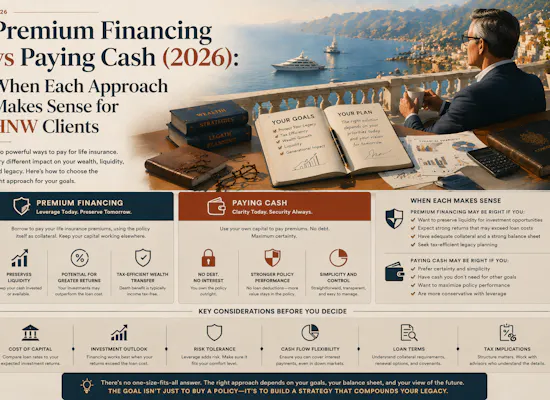
Premium financing means borrowing to fund life insurance premiums rather than paying them directly. It can make sense for HNW clients with strong liquidity, robust collateral, disciplined monitoring, and a clear exit plan. Paying cash is usually cleaner when simplicity, certainty, and control matter more than preserving capital or balance sheet flexibility.
People also ask
- What is premium financing for life insurance?
- When does premium financing make sense?
- What are the risks of premium financing?
- Is paying cash better than financing premiums?
- What triggers collateral calls?
- How do rising rates affect premium finance?
At a glance
- Premium financing is borrowing to pay premiums, typically with the policy and other assets pledged as collateral.
- The core appeal is liquidity preservation. The core trade-off is leverage, lender control, and ongoing monitoring.
- The biggest risks are usually interest-rate risk, collateral call risk, liquidity risk, refinancing risk, and execution risk.
- Paying cash is often the stronger route when the client values certainty, low complexity, and no lender dependency. This is an inference from how wealth-lending risks operate rather than a regulatory rule.
- Premium financing tends to fit best where the client is liquid, investment-rich, and highly governable, not merely wealthy on paper. This is an inference from the mechanics of collateralised lending and margin-call risk.
- In 2026, this decision should be analysed against a backdrop of floating-rate risk, with SOFR benchmarks still published daily by the New York Fed and supervisors continuing to emphasise interest-rate and liquidity resilience.
Is premium financing sophisticated?
Premium financing is often sold as sophistication.
Sometimes it is.
Sometimes it is just leverage wrapped in elegant language.
That distinction matters.
For a high-net-worth client, the decision is not simply whether financing looks more efficient than paying premiums directly. The real question is whether the client is buying useful balance-sheet flexibility or importing a second risk system into what was meant to be a protection or estate planning strategy.
That is the right frame.
Because life insurance can already be complex enough. Add debt, floating rates, collateral, lender covenants, renewal terms, and cross-border balance-sheet issues, and a clean planning decision can become an ongoing liquidity-management exercise. That is not automatically bad, but it does mean the funding method is now part of the risk profile, not just an implementation detail.
For many HNW families, paying cash is underrated precisely because it is boring. It removes leverage, margin-call risk, refinancing dependence, and lender behaviour from the structure. For other families, especially those who are asset-rich, opportunity-cost sensitive, and reluctant to sell productive assets, premium financing can be entirely rational. The key is knowing which camp the client is actually in.
What premium financing actually is
At its simplest, premium financing means using a loan to fund insurance premiums rather than paying those premiums outright. Market participants describe these arrangements as loans secured by the underlying policy and often additional collateral, with repayment structured over time.
That sounds straightforward, and structurally it is.
But the planning consequences are bigger than the definition suggests.
The client is no longer just deciding whether to own the policy. The client is deciding whether to hold the policy inside a leveraged funding structure that may need monitoring for years. That changes the conversation from “Can the client afford the premium?” to “Can the client afford the premium strategy under stress?” That is an inference from the published risk factors around wealth lending, collateral fluctuation, variable rates, and margin calls.
Why HNW clients consider premium financing
There are usually four reasons.
Preserve liquid capital
The client may not want to tie up substantial cash in premiums if that cash is needed for investment opportunities, business working capital, family lending, property acquisitions, or tax reserves.
Avoid forced asset sales
A client with concentrated holdings, private business interests, or embedded capital gains may prefer borrowing over selling appreciated assets to fund large premiums.
Match long-term insurance with broader balance-sheet planning
Some HNW clients see financing as a way of keeping their long-term asset allocation intact while still putting cover in place.
Use leverage deliberately
This is the most misunderstood reason. Sometimes the client is explicitly trying to create a better internal economic outcome by keeping capital invested and financing premiums at a lower cost than expected asset returns. That logic can work. It can also fail quite badly if rates rise, collateral falls, or the exit plan slips.
Why paying cash still deserves more respect
Paying cash lacks glamour, but it solves a remarkable number of problems in one move.
No floating loan cost.
No collateral monitoring.
No margin calls.
No renewal negotiation with a lender.
No risk of needing to top up security during a difficult market year.
No awkward question about whether the policy should be unwound because the financing no longer works.
That matters.
A funding strategy should ideally reduce complexity around a protection need, not increase it. Paying cash usually does exactly that. It turns the insurance decision back into an insurance decision, rather than a hybrid of insurance, credit, liquidity, and behavioural governance. This is a planning inference, but it is strongly supported by the published wealth-lending risks around variable rates, liquidity stress, collateral fluctuation, and forced liquidation.
The real trade-off
This is the cleanest way to think about it:
Paying cash trades liquidity today for simplicity and certainty tomorrow.
Premium financing preserves liquidity today but creates a future obligation that must remain manageable across markets, rates, and family circumstances.
Neither is inherently superior.
The stronger approach is the one whose downside the client can actually live with.
That is the point many illustrations skip. They model the economics of the happy path. Sophisticated planning starts with the unhappy path. Supervisory and market publications are clear that variable-rate lending, collateral value fluctuation, liquidity strain, and forced liquidation risk are not theoretical issues.
The five questions that matter most
- Is the client truly liquid, or just wealthy?
A large net worth is not enough. The collateral pool has to be real, accessible, diversified, and emotionally usable. - What happens if rates stay higher for longer?
Standard Chartered’s wealth-lending paper notes that portfolio loans often have variable interest rates and that rising rates increase borrowing costs. The New York Fed continues to publish SOFR averages daily, underscoring that floating-rate benchmarks remain central to loan economics. - What happens if collateral falls at the wrong time?
Published wealth-lending material is clear that falling collateral values can trigger margin calls and forced liquidation if the borrower cannot top up promptly. - What is the exit plan?
A premium-finance arrangement should not rely on vague future optimism. There should be a defined repayment route and a fallback route. - Would the client still choose this structure after a bad year?
If the answer is no, it was probably the wrong funding method from the start.
When premium financing usually makes sense
Premium financing is usually at its strongest where the client has all or most of the following characteristics.
Strong surplus liquidity
Not just enough assets to qualify on paper. Enough true liquidity to handle interest servicing, collateral top-ups, and timing slippage without destabilising the wider plan.
High opportunity cost of using cash
If paying premiums directly would require selling productive assets, interrupting business growth, crystallising large gains, or using capital with a clearly higher strategic use, financing can be sensible.
Clear need for large cover
This is especially relevant in estate liquidity planning, shareholder or succession planning, and some long-term family-protection structures where the amount of insurance is material relative to annual cashflow preferences.
Good governance
Premium financing is rarely a set-and-forget strategy. It needs monitoring. That means the client, adviser, and sometimes trustee or family office need a review process, not just an illustration.
A robust exit plan
Examples might include planned repayment from liquidity events, maturing assets, earmarked surplus cashflow, or a deliberate unwind timetable. The point is not that one route is perfect. The point is that the route exists before the loan is taken.
When paying cash usually makes more sense
Paying cash is often better where one or more of the following apply.
The client values certainty over optimisation
Some families do not need a more efficient-looking spreadsheet. They need fewer moving parts.
Collateral is illiquid or psychologically untouchable
Property-heavy families, founder-led business owners, and clients with concentrated holdings often say they are comfortable posting collateral until markets wobble. Then the assets they were “happy to pledge” suddenly become untouchable. That is a red flag.
The premium size is manageable
If the client can comfortably fund premiums without distorting the rest of the balance sheet, cash often wins by default.
Cross-border complexity is high
Globally mobile clients already deal with tax residence changes, currency mismatches, banking friction, and legal-structure complexity. Adding financed insurance can make the whole setup more fragile.
The client will not monitor the arrangement properly
This one matters more than people admit. A technically viable strategy can still be unsuitable if the household will not govern it properly. Wealth-lending papers explicitly flag liquidity, currency, rate, and collateral risks. Those risks do not disappear because the client is wealthy.
Five worked examples with numbers
Example 1: Property-rich family, light on liquid assets
- Net worth: £18 million
- Liquid portfolio: £2.2 million
- Private business and property: £15.8 million
- Annual premium need: £300,000 for 8 years
- Desired cover: estate liquidity for a future IHT or succession problem
On paper, this client looks very financeable.
In reality, they may be a poor premium-finance candidate.
Why? Because the liquid pool is not especially deep relative to the potential duration of premiums, interest, and collateral stress. If equities drop 20% and the lender tightens collateral terms, the family may need to inject fresh liquidity precisely when they least want to. Paying cash may feel less elegant, but it can be the more robust answer if the liquid balance sheet is not comfortably above the minimum needed to support the structure. This conclusion is an inference grounded in published collateral value fluctuation and margin-call risks.
Example 2: Founder preserving business liquidity
- Business owner with annual surplus cashflow of AED 4 million
- Investable personal portfolio: AED 15 million
- Annual premium need: AED 500,000
- Strong desire not to extract additional cash from the business during a growth phase
This is a more plausible financing case.
The owner has meaningful outside liquidity, the premium need is modest relative to liquid net worth, and preserving business capital may have genuine economic value. But the test is whether business risk and collateral risk are segregated. If the same market shock that hurts the business also weakens the pledged portfolio, financing can create a double-pressure scenario. If the owner can meet that stress comfortably, financing may be reasonable. If not, paying cash from surplus liquidity may still be cleaner.
Example 3: Cross-border client with currency mismatch
- Earns in AED
- Borrowing facility priced in USD floating terms
- Collateral portfolio in USD and GBP
- Possible move back to the UK within 3 years
- Annual premium: $250,000
This is where things get subtle.
The client is not just taking rate risk. They may be taking funding-currency risk, collateral-currency risk, and future-residence risk all at once. Standard Chartered explicitly notes that wealth lending can be affected by adverse FX movements, rising borrowing costs, and changing collateral eligibility. For a globally mobile family, paying cash may be the stronger answer simply because it removes one variable from an already cross-border planning problem.
Example 4: Ultra-high-liquidity family office case
- Liquid portfolio: $80 million
- Annual premium need: $1.2 million
- Strong investment discipline
- Formal family-office governance
- Ability to pre-fund collateral and service interest without strain
Here, premium financing may genuinely make sense.
Not because it is fashionable, but because the family has what most borrowers do not: deep liquidity, institutional-style monitoring, diversified collateral, and the temperament to manage the facility without panic. In that context, financing can be a deliberate treasury decision rather than an act of optimism. This is an inference from the mechanics of collateralised lending and risk management, not a regulatory endorsement.
Example 5: HNW client who simply dislikes complexity
- Net worth: £12 million
- Liquid portfolio: £6 million
- Annual premium: £180,000
- No business pressure
- No need to preserve a specific asset
- Strong preference for clean structures
This client can afford to finance.
That does not mean they should.
If the premium is manageable and the client gains no strategic balance-sheet advantage from borrowing, paying cash often wins. The main benefit is behavioural. Clean structures are easier to maintain, easier to explain to family, and less likely to unravel because of shifting lender terms or market stress. The fact pattern does not require leverage, so adding it may be more clever than useful.
The risks advisers should push harder on
Interest-rate risk
This is obvious, but still underappreciated. Floating-rate facilities can look acceptable at one rate level and much less attractive after a reset cycle. Standard Chartered explicitly flags variable-rate exposure as a risk that can erode returns, and the New York Fed’s daily SOFR publication remains a reminder that benchmark-rate movement directly matters to borrowing economics.
Collateral call risk
This is the big one.
If the value of pledged assets falls, the borrower may be required to add collateral or reduce the loan. Published wealth-lending guidance is clear that failure to do so can lead to forced liquidation at unfavourable prices. That is often the exact opposite of what the client thought the financing strategy would achieve.
Liquidity risk
A client can be solvent and still be in trouble.
That is the whole issue. Premium financing fails not when the client stops being wealthy, but when they stop being liquid enough at the wrong time.
Refinancing and lender risk
Even if the economics looked reasonable on day one, the structure may still depend on future lender behaviour. Terms can change. Appetite can change. Eligible collateral can change. Standard Chartered highlights regulatory and collateral-eligibility changes as real lending risks.
Behavioural risk
This is rarely written down, but it is real. A strategy that requires disciplined monitoring can break if the client, trustee, or family office becomes distracted, overconfident, or unwilling to act during stress.
A decision framework that works in practice
Use this six-step screen.
- Define the real objective
Is the goal estate liquidity, family protection, business continuity, or preserving capital for a better use? - Separate wealth from liquidity
Count only assets the client would genuinely use for collateral support. - Model a double-stress year
Assume higher rates and lower collateral values at the same time. - Define the primary and backup exits
If the plan needs one perfect future outcome, it is not robust enough. - Assess governance capacity
Who will review the facility, when, and against what triggers? - Only then compare with cash funding
The comparison is not “Which is more sophisticated?” It is “Which is more robust for this client?”
Common objections
Objection
“Financing is more efficient because my assets should earn more than the borrowing cost.”
Emotional logic
This feels like sensible balance-sheet management and a higher-return use of capital.
Practical risk
Expected returns are not guaranteed, but borrowing costs, collateral rules, and lender rights are real. If rates rise or collateral falls, the elegant spread story can disappear quickly.
Next step
Stress-test the structure with higher rates and lower collateral before comparing it to the happy-path illustration.
Objection
“I am wealthy enough, so collateral calls are not a real concern.”
Emotional logic
Large net worth feels like a sufficient safety margin.
Practical risk
Margin calls are a liquidity event, not a net-worth event. Property, private equity, and business interests do not solve a short-notice collateral demand if they cannot be monetised cleanly.
Next step
Measure usable liquidity, not paper wealth.
Objection
“Paying cash feels unsophisticated.”
Emotional logic
Clients often associate leverage with sophistication and cash funding with missed opportunity.
Practical risk
In planning, sophistication is not about complexity. It is about robustness. A clean, fully funded policy can be superior if it removes unnecessary risk from a core protection need.
Next step
Judge both options by downside control, not by how advanced they sound.
Objection
“We can always refinance later.”
Emotional logic
Future flexibility sounds reassuring.
Practical risk
Refinancing is easiest when you do not need it. If markets, lender appetite, or collateral values are weaker, future flexibility may be much worse than expected. Standard Chartered specifically notes regulatory and collateral-eligibility changes as lending risks.
Next step
Treat refinancing as a possible tool, not the core plan.
FAQ
Quick definitions
Premium financing
Borrowing to pay insurance premiums rather than paying them directly, usually with the policy and other assets pledged as security.
Collateral call / margin call
A lender demand for additional collateral or partial repayment if pledged asset values fall or lending conditions require more support.
SOFR
The Secured Overnight Financing Rate, a benchmark rate published by the New York Fed, commonly relevant to floating-rate lending economics.
What is the main advantage of premium financing?
The main advantage is preserving capital for other uses while still putting cover in place. That can be valuable where liquidity has a higher strategic use than paying premiums outright.
What is the main disadvantage of premium financing?
The main disadvantage is that it introduces leverage, lender dependency, floating-rate exposure, and collateral-call risk into a structure that might otherwise be simple.
Is premium financing only for ultra-high-net-worth clients?
It is mainly associated with HNW and UHNW cases because the structure usually works best where there is meaningful liquid collateral, strong cashflow resilience, and ongoing governance capacity. This is an inference from how collateralised lending operates.
When is paying cash usually better?
Paying cash is usually better when the premium is affordable, simplicity matters, collateral is not genuinely spare, or the client gains little strategic advantage from borrowing.
How do higher rates change the decision?
Higher floating rates make financing less attractive because the cost of carry rises, narrowing or reversing the expected economic benefit of borrowing. Standard Chartered explicitly notes this in its wealth-lending risk discussion.
What kind of client should avoid premium financing?
Clients with illiquid wealth, weak monitoring discipline, fragile business cashflow, cross-border fragility, or no credible exit plan should be very cautious.
Self-diagnostic
Total possible points: 12
Score 1 point for each “yes”.
- Do you have liquid assets well above the likely collateral requirement?
- Could you meet a collateral top-up without selling core assets?
- Would a higher floating rate still leave the plan comfortable?
- Do you have a primary exit strategy already identified?
- Do you have a backup exit if markets disappoint?
- Is the premium large enough that preserving cash has genuine strategic value?
- Is your collateral diversified rather than concentrated?
- Are business and personal liquidity clearly separated?
- Are currency mismatches understood and manageable?
- Is there a review process with named decision-makers?
- Would the structure still feel acceptable after a bad market year?
- Are you choosing financing for a real planning reason, not just because it sounds efficient?
Green: 9 to 12
Premium financing may be worth serious consideration, subject to detailed product, lending, and tax review.
Amber: 5 to 8
Proceed carefully. The case may be viable, but only with conservative assumptions and tight governance.
Red: 0 to 4
Paying cash is likely the cleaner and safer route, or the insurance amount and design may need to be revisited first.
What happens next
Clarify the purpose of the policy
Do not discuss funding before the role of the insurance is clear.
Map usable liquidity
Separate genuine collateral capacity from assets that are illiquid, pledged elsewhere, or emotionally off-limits.
Stress-test the finance case
Model higher rates, lower collateral values, and a delayed exit.
Compare against the cash case honestly
Cash is not the lazy option. In many cases it is the more robust one.
Decide whether leverage improves the plan or just complicates it
That is the real decision.
Conclusion
Premium financing is not automatically smarter than paying cash.
It is simply a different trade.
For the right HNW client, it can preserve flexibility, avoid premature asset sales, and fit neatly into a wider wealth plan. For the wrong client, it turns an insurance solution into a leverage problem dressed up as optimisation.
That is why the best question is not “Can this be financed?”
It is “Should this protection need be financed, given this client’s liquidity, collateral, temperament, and future plans?”
If you want help reviewing whether premium financing genuinely improves your estate, protection, or business-continuity plan, or whether paying cash would actually be the more intelligent move, book a strategy call with Josh Clancey.
You may also like
Premium Financing Life Insurance Explained (2026): Risks and Uses
Universal Life Insurance Explained for Expats in the Middle East
Key Person Insurance Explained (2026): Cost, Cover, Payouts
Financial Planning for Middle East Business Owners 2026