UAE Leaves OPEC: What It Means for Expats, Investors and Financial Planning
The UAE leaving OPEC will make headlines as an oil story.
For expats, the more useful question is different:
What does it reveal about the assumptions inside your financial plan?
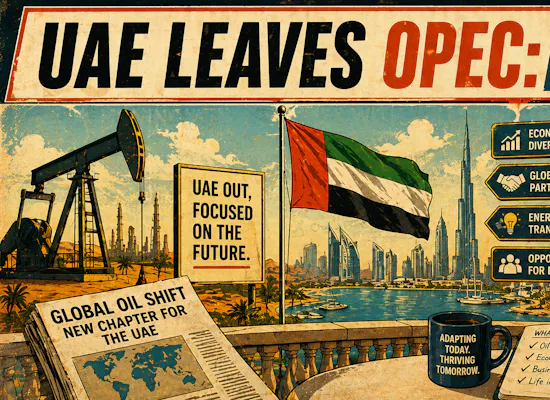
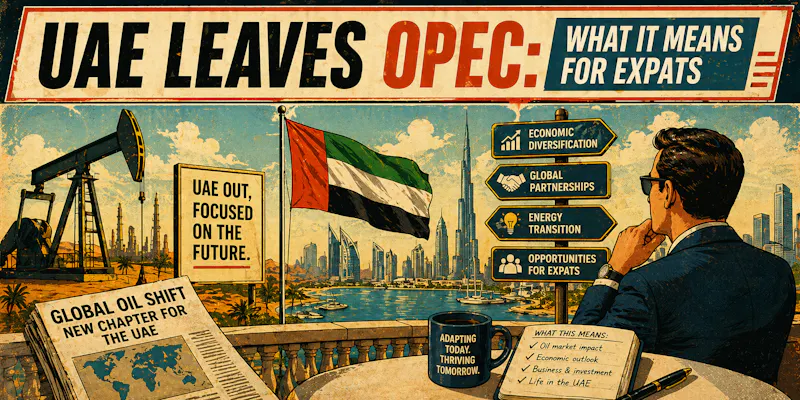
The UAE has announced that it will leave OPEC and the wider OPEC+ alliance from 1 May 2026, ending more than five decades of membership. The decision is widely being viewed as a major shift in Gulf energy policy, driven by production capacity, quota tensions and the UAE’s desire for greater strategic flexibility.
But this is not a reason to trade oil.
It is not a reason to panic.
And it is not a reason to rebuild your portfolio overnight.
It is better understood as a stress test.
For UAE-based expats, the financial planning chain is rarely simple. You may earn in AED, hold investments in USD, have UK pensions in GBP, own property in another country, and plan to retire somewhere else entirely.
That means a major energy-market shift is not just something for traders, economists and policymakers.
It is a reminder that your financial plan may be exposed to oil prices, inflation, interest rates, currencies, employment income, investment markets and retirement assumptions at the same time.
The question is not:
What will oil do next?
The better question is:
Would my financial plan still work if oil, inflation, interest rates or currencies moved sharply?
That is the planning issue.
People also ask
Why did the UAE leave OPEC?
The UAE appears to have left OPEC mainly to gain more control over its own production strategy. The country has invested heavily in production capacity and has previously been constrained by collective quota arrangements. Leaving OPEC gives the UAE more freedom to produce according to its own economic and strategic priorities.
Will the UAE leaving OPEC lower oil prices?
Not necessarily. The short-term impact may be limited by regional disruption and shipping constraints. Longer term, the UAE’s ability to produce outside OPEC+ limits could affect supply discipline, market-share competition and pricing dynamics.
What does this mean for expats in the UAE?
For most expats, the effect is indirect. The move may influence inflation expectations, interest rates, currencies, investment markets, regional business confidence, employment conditions and retirement planning assumptions.
Should expats change their investments because the UAE left OPEC?
Not automatically. This is not a trading signal. It is a prompt to review whether your portfolio, pensions, cash, currency exposure and retirement plan are robust under different market conditions.
At a glance
- The UAE is leaving OPEC and OPEC+ from 1 May 2026.
- The decision gives the UAE more freedom over oil production strategy.
- The short-term market effect may be limited, but the longer-term impact on OPEC+ discipline could be meaningful.
- Oil-market shifts can affect inflation, interest rates, currencies, bonds, equities, property markets and retirement planning assumptions.
- For Gulf-based expats, the bigger issue is not the oil price itself. It is whether your financial plan can cope with macro uncertainty.
- This is not a reason to panic. It is a reason to review.
What actually happened?
The UAE has announced that it will leave both OPEC and OPEC+ from 1 May 2026.
OPEC is the long-standing group of oil-producing countries that coordinates production policy among members. OPEC+ is the wider alliance that includes additional producers working with OPEC on supply policy.
The UAE’s departure matters because it has been one of the group’s most capable and strategically important producers. It has strong infrastructure, meaningful production capacity and the ability to increase output over time.
The move weakens OPEC+ influence over the oil market, although the remaining group is expected to hold together for now.
That distinction matters.
This is a serious blow to the perception of OPEC unity.
But it is not the same as saying OPEC disappears.
Saudi Arabia remains highly influential. Iraq, Kuwait and other producers remain inside the group. OPEC+ still matters.
The difference is that one of the UAE’s biggest strategic advantages is now outside the collective quota system.
That advantage is flexibility.
What this does not mean
Before looking at the financial planning implications, it is worth being clear about what this does not mean.
It does not mean oil prices automatically fall.
It does not mean UAE residents should suddenly change their investment portfolios.
It does not mean every expat in Dubai or Abu Dhabi is directly exposed.
It does not mean OPEC has no influence left.
It does not mean energy stocks will definitely rise or fall.
It does not mean you should treat one headline as a full investment thesis.
This is important because macro news often creates the wrong type of investor behaviour.
People see a big headline and feel they should “do something”.
But good financial planning is rarely about reacting to headlines. It is about understanding whether your current plan is resilient enough if the world changes.
The UAE leaving OPEC is exactly that kind of event.
It is a useful stress test, not a personal investment instruction.
Why did the UAE leave OPEC?
The short answer is production freedom.
The UAE has spent years investing in oil production capacity. The country has meaningful spare capacity and has been expanding its ability to produce more over time.
That creates an obvious strategic tension.
If a country invests heavily in the ability to produce more oil, but remains limited by collective quotas, the economic logic becomes harder to justify.
From the UAE’s perspective, the question is simple:
Why build capacity if you cannot fully use it?
Leaving OPEC gives the UAE more freedom to decide:
- how much it produces
- when it produces
- which buyers it prioritises
- how it responds to market shortages
- how it monetises capacity investment
- how it positions itself against other producers
That does not mean the UAE will flood the market immediately.
It means it now has the option.
In energy markets, optionality matters.
The real story: strategic independence
The UAE’s decision should also be seen in a wider context.
The UAE has spent years positioning itself as a globally connected, strategically independent economic hub.
It has built strength across finance, logistics, aviation, real estate, tourism, family offices, artificial intelligence, technology and global wealth management.
Energy policy now appears to be following the same direction.
For decades, OPEC membership gave producers collective influence.
The UAE now appears to believe it may have more strategic freedom outside the group than inside it.
That is the bigger message.
This is not simply about barrels of oil.
It is about control, flexibility and national economic strategy.
For expats, that matters because the UAE is not just where many people live. It is where they earn, save, build businesses, raise families and accumulate wealth.
When the country makes a major strategic shift, it is worth asking how that shift could filter into your own financial life.
Why this matters for Gulf-based expats
Many expats in the UAE have financial lives that look something like this:
- income in AED
- savings in AED or USD
- UK pensions in GBP
- offshore investments in USD
- property in the UK, Europe, South Africa or Australia
- school fees in AED
- family support obligations across borders
- future retirement plans in another country
That creates complexity.
The UAE leaving OPEC does not automatically change your financial plan.
But it can affect the assumptions behind that plan.
The most relevant areas are:
- Inflation assumptions
- Interest-rate assumptions
- Currency assumptions
- Portfolio volatility
- Employment and bonus risk
- Regional business confidence
- Long-term retirement income planning
- Liquidity and protection planning
That is why the key question is not:
What will happen to oil?
The better question is:
What parts of my financial plan are sensitive to oil, inflation, rates, currencies or income disruption?
That is a much more useful question.
The planning chain expats should understand
Macro events do not affect your finances in a neat straight line.
They move through a chain.
For expats, that chain often looks like this:
- Oil supply expectations change
A major producer gains more freedom over production. - Oil price expectations adjust
Markets reassess supply discipline, spare capacity and future competition. - Inflation expectations shift
Energy prices can affect transport, shipping, food distribution, business costs and consumer prices. - Interest-rate expectations move
Central banks may keep rates higher for longer if inflation is sticky, or cut sooner if price pressure eases. - Currencies react
USD, GBP, EUR, ZAR and other currencies may move as markets reassess rates, growth and risk appetite. - Portfolios and pensions respond
Bonds, equities, cash, pension values, property and retirement assumptions may all be affected. - Your real-life plan is tested
The issue becomes practical: income, school fees, mortgages, retirement spending, liquidity, protection and estate planning.
That is why the UAE leaving OPEC is not a standalone investment headline.
It is a reminder to check whether your financial plan can absorb change.
Oil prices, inflation and your real cost of living
Oil prices affect the economy through transport, shipping, food distribution, airline costs, manufacturing inputs and business margins.
When energy prices rise, inflation can become more persistent.
When energy prices fall, inflation pressure may ease, but not always quickly and not always evenly.
For expats, inflation is not one neat number.
Your personal inflation rate depends on:
- where you live
- where your family lives
- what you spend money on
- which currencies you use
- where you plan to retire
- how your assets are structured
A British expat in Dubai might be affected by:
- UAE rent
- school fees
- flights back to the UK
- UK property costs
- GBP pension planning
- USD-linked investments
- future retirement spending in another country
That is why headline inflation rarely tells the whole story.
If your financial plan assumes a smooth, low-inflation future, it may be too optimistic.
A small difference in inflation assumptions over 20 or 30 years can materially change how much you need for retirement.
This is especially important for expats because the country where you build wealth may not be the country where you spend it.
Oil, interest rates and pension planning
Oil prices do not control interest rates by themselves.
But they can influence inflation expectations.
Inflation expectations influence central banks.
Central banks influence interest rates.
Interest rates affect almost everything in a long-term financial plan.
That includes:
- bond prices
- cash returns
- mortgage costs
- annuity pricing
- equity valuations
- pension transfer values
- property markets
- retirement income assumptions
For UK expats, this can matter in several ways.
Defined contribution pensions are affected through underlying portfolio values.
Defined benefit transfer values can be sensitive to discount rates, gilt yields and scheme assumptions.
Drawdown planning can be affected by sequencing risk, market volatility and inflation.
Cash may look more attractive when interest rates are high, but inflation can still erode real spending power.
Bonds may provide diversification, but duration risk matters when rates move.
So when a major oil-market event affects inflation and interest-rate expectations, it can eventually feed into retirement planning.
Not always directly.
Not always immediately.
But often enough to matter.
The AED/USD peg matters
This is one of the biggest points expats often miss.
The UAE dirham is pegged to the US dollar.
That means UAE-based expats earning in AED are effectively living in a USD-linked currency environment.
This can be helpful if your investments or savings are also in USD.
But it can create planning problems if your future liabilities are in GBP, EUR, ZAR, AUD or another currency.
For example:
- you earn in AED
- your pension is in GBP
- your investments are in USD
- your property is in the UK
- your children may study in Europe
- your family may need support in South Africa
- you may retire somewhere other than the UAE
That is a currency mismatch.
It may not feel urgent today because your income is strong.
But it can become very real when you start drawing income, buying property, paying school fees, supporting family or relocating.
Oil-market shifts can influence global risk sentiment, interest-rate expectations and currency movements.
For an expat, the issue is not whether you can predict currencies.
You cannot.
The issue is whether you have a sensible currency strategy.
What this means for investment portfolios
The UAE leaving OPEC should not trigger a knee-jerk investment decision.
It should trigger a portfolio resilience review.
That means asking whether your portfolio still makes sense under different market conditions.
Not just one forecast.
A proper review should consider:
- equity exposure
- bond exposure
- cash levels
- currency exposure
- geographic diversification
- sector concentration
- liquidity needs
- time horizon
- retirement withdrawal strategy
- tax and estate planning context
There is also an important distinction between commodity exposure and equity exposure.
Oil prices can rise while energy shares fall.
Energy shares can rise while the wider market struggles.
A diversified fund may still have significant US dollar exposure.
A “global” portfolio may still be concentrated in US equities.
A bond fund may behave very differently depending on duration, credit quality and interest-rate sensitivity.
That is why fund names are not enough.
You need to understand what you actually own.
The better question is not:
Should I buy energy stocks?
The better question is:
Would my portfolio still make sense if inflation stays higher, rates remain volatile, or currencies move against me?
That is a planning question.
Sequence of returns risk for near-retirees
This is especially relevant if you are close to retirement.
Sequence of returns risk is the risk that poor investment returns arrive at the wrong time, particularly just before or just after you start drawing income.
Two investors can earn the same average return over time, but have very different outcomes depending on when losses occur.
If markets fall early in retirement while you are withdrawing income, your portfolio may have less time to recover.
That is why near-retirees need to be especially careful about:
- cash buffers
- withdrawal strategy
- portfolio risk
- currency matching
- income sustainability
- inflation assumptions
- tax treatment of withdrawals
- pension access rules
A macro event like the UAE leaving OPEC does not automatically cause a market fall.
But it is another reminder that retirement planning should not be built on smooth-line assumptions.
Markets do not move in straight lines.
Neither does expat life.
Why this matters for expats working in the Gulf
For some expats, the connection is more direct.
If you work in energy, construction, aviation, logistics, banking, real estate, professional services, infrastructure or government-linked projects, oil-market dynamics can affect business confidence and regional liquidity.
That does not mean your job is at risk because the UAE left OPEC.
But it does mean your income, bonus, sector outlook or employer profitability may be indirectly exposed to regional macro conditions.
This creates a common expat planning problem.
Your income, savings, property, career and investment portfolio may all be more connected than you think.
For example:
- your salary comes from a Gulf-based employer
- your bonus depends on regional activity
- your property exposure is in the UAE or UK
- your investments are heavily global equity-based
- your emergency fund is too small
- your protection planning is incomplete
That may feel fine when income is high and markets are calm.
It feels very different when conditions tighten.
This is why good planning starts with risk mapping.
Not product selection.
Five worked examples with numbers
Example 1: British expat in Dubai with AED income and UK pensions
James earns AED 75,000 per month in Dubai.
He has:
- £420,000 across two UK pensions
- $300,000 in offshore investments
- AED 250,000 in cash
- a UK property with a mortgage
- plans to retire partly in the UK and partly overseas
On paper, James is doing well.
But his plan has several moving parts.
His income is AED/USD-linked. His pensions are GBP. His investment account is USD. His property is in the UK. His retirement spending may be partly in GBP and EUR.
If oil-market volatility affects inflation, rates and currencies, James may feel the impact across several areas:
- UK pension values
- GBP/USD exchange rates
- UK mortgage costs
- future retirement income assumptions
- portfolio volatility
The issue is not that James should change everything.
The issue is that he needs a joined-up plan across currencies, pensions, investments and future spending.
Example 2: South African expat with USD investments and future ZAR spending
Nadia lives in Abu Dhabi and holds $600,000 in a global investment portfolio.
She expects to retire partly in South Africa.
Her mistake is assuming that a strong USD portfolio automatically solves the retirement question.
It may not.
If her future spending is partly in ZAR, her plan needs to consider:
- exchange-rate risk
- tax treatment
- estate planning
- offshore access
- income sequencing
- local spending needs
Oil-market shifts may not be the central issue, but they are another reminder that currencies can move sharply.
The question is not whether Nadia has investments.
The question is whether those investments match her future life.
Example 3: Energy-sector executive with hidden concentration risk
Mark works for an energy-related business in the UAE.
He has:
- a high salary
- a large annual bonus
- company shares
- a property in Dubai
- most investments in global equities
- limited life and critical illness cover
He thinks he is diversified because he owns several funds.
But his wider life is not diversified.
His income, bonus, company equity, property exposure and regional career prospects are all linked to the same broad economic environment.
That does not mean he is doing anything wrong.
It does mean he needs to understand concentration risk properly.
A diversified portfolio is useful.
A diversified life plan is better.
Example 4: Family with school fees and a retirement target
A British couple in Dubai spends AED 150,000 per year on school fees.
They also want to retire between 60 and 65 with the equivalent of £6,000 per month in today’s money.
Their biggest planning risk is not one oil headline.
It is whether their plan accounts for:
- education costs
- inflation
- pension growth
- currency risk
- protection needs
- emergency cash
- retirement spending
- moving back to the UK or retiring elsewhere
Macro events matter because they stress-test assumptions.
If the plan is too tight, inflation or currency movement can quickly expose the gap.
Example 5: Business owner with cash trapped in the company
A UAE-based business owner has strong profits but keeps most wealth inside the business.
He has limited personal investments, no clear retirement plan and no estate plan.
Oil-market shifts may affect business confidence, client demand, input costs or liquidity.
The planning issue is not whether oil rises or falls.
It is whether personal wealth is too dependent on one business, one country and one economic environment.
A good plan separates business liquidity from personal long-term security.
What expats should check now
You do not need to become an oil analyst.
You do need to understand how exposed your financial plan is.
Start with these checks.
1. Currency exposure
Write down the currencies you:
- earn in
- save in
- invest in
- owe debt in
- will spend in retirement
- may need for family support
If those currencies do not match, you need a plan.
2. Pension structure
Review where your pensions are held, how they are invested, what currency exposure they contain and how they fit into your future retirement income.
For UK expats, this is particularly important if you have old workplace pensions, SIPPs, defined benefit schemes or multiple small pots.
3. Investment resilience
Check whether your portfolio is genuinely diversified or simply spread across several funds that all behave similarly.
Diversification is not about owning lots of things.
It is about owning the right mix of things.
4. Inflation assumptions
Your retirement plan should not assume that costs stay conveniently low.
Inflation risk is one of the biggest threats to long-term retirement income.
5. Liquidity
If income stops, bonuses fall, markets drop or you need to relocate, how long could you cope?
Cash is not exciting.
But for expats, liquidity is a major part of financial security.
6. Protection planning
If your income supports a spouse, children, mortgage, school fees or future retirement plan, life and critical illness cover should not be an afterthought.
Market volatility is not the only risk.
Human risk matters too.
7. Estate planning
If your assets, pensions, beneficiaries and family members sit across more than one country, estate planning needs to be joined up.
A will in one country may not solve every cross-border issue.
Common objections
“I don’t work in oil, so this does not affect me.”
Emotional logic
Oil feels like someone else’s industry.
Practical risk
Oil-market moves can affect inflation, rates, currencies, regional confidence and investment markets.
Next step
Do not trade the headline. Review the assumptions inside your financial plan.
“My income is in AED, so currency risk is not a problem.”
Emotional logic
The AED feels stable because it is pegged to the US dollar.
Practical risk
Your future spending may not be in AED or USD. If your retirement is in GBP, EUR, ZAR or AUD, currency risk still matters.
Next step
Map your current currencies against your future liabilities.
“My investments are global, so I am diversified.”
Emotional logic
Global funds feel automatically safe.
Practical risk
You may still be heavily exposed to the same equity markets, same currencies or same economic assumptions.
Next step
Review the underlying exposures, not just the fund names.
“I have a good income, so I can deal with volatility.”
Emotional logic
High income makes risk feel manageable.
Practical risk
High income can hide poor structure, weak liquidity, underinsurance and unclear retirement planning.
Next step
Build the plan around what happens if income changes, not just if it continues.
“This is just news. It has nothing to do with retirement.”
Emotional logic
Retirement feels separate from daily market headlines.
Practical risk
Retirement plans are affected by inflation, interest rates, currencies, investment returns, employment income and withdrawal timing.
Next step
Use the news as a stress test, not as a forecast.
The real lesson for expats
The UAE leaving OPEC is a major strategic move.
But the personal lesson is much simpler.
Expats should not build financial plans that only work when everything stays stable.
Because expat life is rarely stable forever.
You may move country.
Your tax position may change.
Your pension rules may change.
Your currency needs may change.
Your family circumstances may change.
Your employer may change.
Your retirement destination may change.
Your investment assumptions may change.
That is why cross-border planning matters.
A portfolio is not enough.
A pension is not enough.
A bank balance is not enough.
You need a plan that connects your income, investments, pensions, protection, tax position, currencies and estate planning.
Otherwise, every major headline becomes a source of uncertainty.
What to do next
Do not make a knee-jerk decision because the UAE has left OPEC.
Instead, use it as a prompt to ask better questions:
- Is my income too dependent on one country, sector or employer?
- Are my investments too exposed to one currency or market?
- Do my pensions match my retirement goals?
- Have I stress-tested inflation properly?
- Do I have enough liquidity if income or markets change?
- Is my protection planning strong enough?
- Would my spouse or family understand the plan if something happened to me?
- Is my retirement plan based on realistic assumptions?
If the answer to any of those questions is unclear, the issue is not simply the UAE leaving OPEC.
The issue is that your current financial plan may not yet be joined up.
Conclusion
The UAE leaving OPEC is not just an oil story.
It is a reminder that macro events can expose weaknesses in personal financial plans.
For expats in the Middle East, the connection is especially important because wealth is often spread across countries, currencies, pensions, properties and investment platforms.
You might earn in AED.
You might invest in USD.
You might hold pensions in GBP.
You might plan to retire somewhere else entirely.
That combination can work very well, but only if it is properly joined up.
The key is not to predict oil prices.
The key is to build a financial plan that can cope with uncertainty.
If you are not sure how this impacts your current financial plan, book an introductory call with Josh Clancey.
FAQ
What does the UAE leaving OPEC mean?
It means the UAE will no longer be part of OPEC or OPEC+ from 1 May 2026. This gives the country more freedom to set its own oil production strategy.
Why did the UAE leave OPEC?
The main reason appears to be strategic flexibility. The UAE has invested heavily in production capacity and wants more freedom over how and when that capacity is used.
Will oil prices fall because the UAE left OPEC?
Not automatically. Short-term effects may be limited by regional export constraints, while longer-term effects depend on UAE production decisions and how other OPEC+ members respond.
Does this affect expats in Dubai and Abu Dhabi?
Indirectly, yes. It may affect inflation, interest rates, regional confidence, investment markets and currency assumptions, all of which can feed into personal financial planning.
Should I change my investments?
Not based on this headline alone. It is better to review whether your investments remain suitable for your time horizon, risk profile, currency needs and retirement objectives.
Why does the AED/USD peg matter?
Because many UAE expats earn in AED, which is linked to USD, while their future liabilities may be in GBP, EUR, ZAR, AUD or another currency. That can create currency mismatch risk.
What should expats review first?
Start with currencies, pensions, investment allocation, inflation assumptions, liquidity, protection and estate planning.
Is this mainly relevant for energy-sector employees?
No. Energy-sector employees may feel the connection more directly, but all expats can be affected indirectly through inflation, interest rates, currencies, investment markets and regional economic confidence.