What Happens to My HSA When I Retire Overseas?
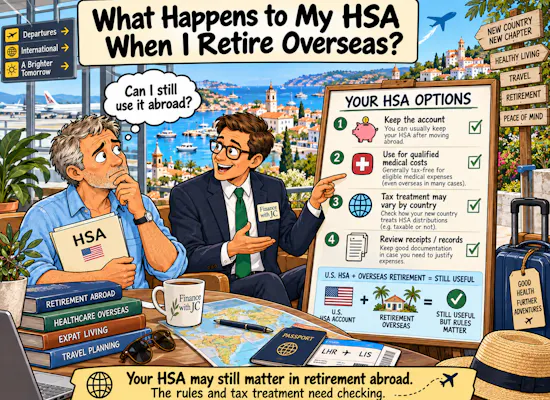
Your HSA does not normally disappear when you retire or move outside the United States.
The money remains yours.
There is no requirement to cash the account out simply because you:
- retire
- leave your employer
- move abroad
- stop being covered by your old health plan
- stop making contributions
The IRS describes an HSA as portable. It stays with you if you change employers or leave the workforce, unused balances carry forward, and earnings remain sheltered within the account under US federal rules.
That can make an HSA a valuable retirement asset.
But retiring overseas changes how you should think about it.
You need to separate four questions:
- Can I keep my HSA?
- Can I continue contributing?
- Can I use it for medical expenses outside the US?
- How will my new country treat the account?
Those are not the same question.
For Americans building a retirement outside the United States, the HSA should therefore be reviewed alongside 401(k)s, IRAs, Roth IRAs, Social Security, investments, healthcare and future tax residence. Finance with JC's Retirement Planning for Americans Abroad page looks at that wider cross-border picture.
People also ask
Can I keep my HSA if I move abroad?
Generally, yes. An HSA belongs to you and does not disappear when you leave employment or retire. The balance can remain in the account until you decide to use it.
Can I use my HSA for medical expenses overseas?
Potentially, yes. HSA distributions can be tax-free under US federal rules when used for qualified medical expenses meeting the US tax definition. The key question is whether the expense qualifies under Internal Revenue Code section 213(d), not simply where the treatment occurs. You should retain proper evidence of the expense.
Can I continue contributing to my HSA while living abroad?
Only if you remain HSA-eligible under US rules. Among other requirements, you generally need qualifying high-deductible health plan coverage and cannot have disqualifying other health coverage or be enrolled in Medicare. Simply owning an existing HSA does not mean you can continue contributing to it.
What happens to my HSA after age 65?
You can continue using HSA money tax-free for qualified medical expenses. If you withdraw money for non-medical purposes after age 65, the amount is generally subject to income tax, but the additional 20% HSA penalty no longer applies.
Can I use my HSA for health insurance premiums overseas?
Usually not simply because the policy is medical insurance. HSA rules generally restrict tax-free payment of health insurance premiums, although specific exceptions exist, including certain long-term care coverage, COBRA, coverage while receiving unemployment compensation and certain Medicare-related premiums after age 65. The exact policy should be checked before taking a tax-free distribution.
At a glance
- Your HSA normally remains yours when you retire overseas.
- There are no use-it-or-lose-it rules for an HSA.
- You can generally leave the account invested.
- Moving abroad does not by itself make you eligible to keep contributing.
- Contributions require continued HSA eligibility.
- Tax-free withdrawals remain available for qualified medical expenses under US rules.
- Overseas medical costs may qualify if they satisfy the US definition of qualified medical care.
- Keep detailed receipts and records.
- Non-medical withdrawals before age 65 can generally create income tax plus a 20% additional tax.
- After age 65, non-medical withdrawals generally remain taxable but the additional 20% tax no longer applies.
- Your country of residence may not recognise the HSA's US tax treatment.
- Beneficiary planning becomes important, particularly if your spouse or heirs live outside the US.
The short answer
If you retire overseas with an HSA, you will generally have four main options:
- Keep the HSA invested for future medical expenses.
- Use it to reimburse qualifying healthcare costs as they arise.
- Reimburse yourself later for eligible medical expenses incurred after the HSA was established, provided the expenses have not already been reimbursed or deducted and you retain appropriate evidence.
- After age 65, take non-medical withdrawals if needed, understanding that those distributions are generally taxable under US rules.
For many retirees, option one can be particularly interesting.
If you can afford healthcare from other cash flow, leaving HSA assets invested may allow the account to continue compounding for future healthcare needs.
But that strategy needs to work in both countries.
The US may continue recognising the HSA's tax treatment while your retirement country treats the account, its investment growth or its distributions differently.
That cross-border mismatch is the issue.
If you have other US accounts as well, it makes sense to review the HSA alongside your US Retirement Accounts for Expats, rather than looking at each account independently.
What happens to the HSA when you stop working?
Very little needs to happen automatically.
The HSA is not the same as employer health insurance.
It is also not like some employer flexible spending arrangements where unused money may be forfeited.
Your HSA belongs to you.
The IRS states that contributions remain in the account until used, earnings can grow tax-free under federal rules, and qualifying distributions can be tax-free.
That means retirement does not require you to:
- close the account
- withdraw the money
- transfer it immediately
- spend the balance
- return it to your employer
You may be able to keep it for decades.
The more important question is whether the existing HSA provider remains suitable once you live overseas.
Can your HSA provider still service you abroad?
This is separate from the tax rules.
A provider may allow the account to remain open but have practical restrictions around:
- foreign addresses
- international telephone numbers
- online verification
- investment trading
- debit cards overseas
- international transfers
- reimbursement methods
- beneficiary paperwork
Before moving, ask the HSA provider:
Will you continue servicing my account if my permanent address is outside the United States?
Do not assume the answer.
Provider policy and US tax law are two different things.
This is the same practical issue Americans abroad often face with other US accounts. Finance with JC's Financial Planning for Americans Abroad framework specifically includes provider access, retirement accounts, foreign tax residence and future relocation.
Can I continue contributing after I move overseas?
This is where people often confuse owning an HSA with being eligible to contribute.
You can keep an existing HSA even when you are no longer eligible to make new contributions.
To make HSA contributions, US rules generally require you to be an eligible individual.
For 2026, this ordinarily involves:
- qualifying high-deductible health plan coverage
- no disqualifying additional health coverage
- not being enrolled in Medicare
- not being claimable as another person's dependent
The IRS confirms these eligibility conditions and the applicable qualifying-HDHP rules.
If you retire overseas and replace your US HDHP with local medical insurance, you should not assume the new policy permits further HSA contributions.
You may lose contribution eligibility while still retaining the existing HSA.
That distinction matters.
What if I retire before age 65?
Suppose you retire abroad at 58 with $150,000 in an HSA.
You may no longer qualify to contribute.
That does not mean you need to use the account.
You could potentially leave the balance invested.
Qualified medical distributions remain potentially tax-free under US rules.
Non-qualified withdrawals, however, are generally:
- taxable as income
- subject to an additional 20% tax before age 65, unless another exception applies
The IRS confirms that the additional 20% tax generally applies to non-qualified HSA distributions, with the age-65 exception removing the additional tax thereafter.
That makes an HSA very different from a normal investment account.
Taking $50,000 out at 58 to buy a car is very different from using $50,000 for qualifying medical expenses.
What changes at age 65?
Age 65 is an important HSA planning point.
It does not mean the HSA becomes taxable.
You can still use the account for qualified medical costs.
The important change is what happens to non-medical withdrawals.
Before 65:
Non-qualified distribution = generally income tax + 20% additional tax.
After 65:
Non-qualified distribution = generally income tax, but no 20% additional HSA tax.
That gives the HSA an interesting secondary role in retirement.
Its best US tax treatment remains using the money for qualified medical expenses.
But after 65, unused HSA capital effectively has another exit route without the 20% additional tax.
What happens when I enrol in Medicare?
Once enrolled in Medicare, you generally cannot continue making HSA contributions.
The existing balance does not disappear.
You can continue using the HSA.
For US retirees, HSA funds can also be used tax-free for certain Medicare premiums and other qualifying expenses, subject to the detailed rules. Pub. 969 describes specific health-insurance-premium exceptions for HSA purposes.
For someone retiring overseas, Medicare planning can be more complicated because the practical value of Medicare outside the United States is limited.
So the HSA, Medicare and international healthcare strategy should be considered together.
Can I pay overseas medical bills from my HSA?
Potentially.
For US federal HSA purposes, the important test is whether the expense falls within the definition of a qualified medical expense.
The IRS broadly defines qualified HSA medical expenses by reference to section 213(d), which covers qualifying expenditure for diagnosis, cure, mitigation, treatment or prevention of disease and certain other medical care.
That can include many normal healthcare costs such as qualifying:
- doctors
- dentists
- hospitals
- diagnostic tests
- prescription drugs
- surgery
- certain long-term care
- medical equipment
- eligible transportation relating to medical care
But the rules are US tax rules.
Do not assume that every medical expense accepted by your overseas insurer will automatically qualify for HSA purposes.
There are also specific rules around areas such as medicines purchased or imported from other countries. IRS Publication 502 contains the detailed medical-expense definitions.
Keep the receipts
This becomes especially important overseas.
The IRS requires records sufficient to demonstrate that HSA distributions were used exclusively for qualified medical expenses, that the expenses were not reimbursed elsewhere and that they were not also taken as an itemised medical deduction.
Keep:
- invoices
- receipts
- medical reports where relevant
- proof of payment
- currency conversion evidence
- insurance reimbursement statements
- dates of treatment
Ideally, maintain a permanent digital record.
For overseas bills, I would also retain the original currency amount and evidence of the exchange rate used when converting the cost to US dollars for record-keeping.
You do not have to reimburse yourself immediately
This is one of the most useful HSA features.
US rules do not require you to take an HSA distribution in the same year that you incur a qualified expense.
Provided the medical expense was incurred after the HSA was established, has not already been reimbursed and otherwise meets the rules, reimbursement can potentially happen later.
For example:
You incur a $5,000 qualifying medical expense at 62.
You pay it from cash.
You retain the receipt.
You leave the HSA invested.
Years later, you may potentially reimburse yourself from the HSA for that expense.
This can allow more of the HSA to remain invested.
But only if the record-keeping is excellent.
Should I spend from the HSA or leave it invested?
There is no automatic answer.
Using the HSA now can make sense if:
- medical costs are high
- cash flow is tight
- you need the money
- the account is poorly invested
- provider restrictions make management difficult
- your future country may tax the HSA less favourably
Leaving it invested may make sense if:
- you can pay healthcare from other resources
- the HSA has good investment options
- fees are reasonable
- you expect substantial healthcare costs later
- US tax-free growth remains useful
- local-country tax treatment does not undermine the strategy
This is really an asset-allocation and retirement-income decision.
The HSA should not be analysed entirely separately from your 401(k), IRA, Roth IRA and taxable investments.
For Americans overseas, Finance with JC's Retirement Planning for Americans Abroad connects retirement accounts with healthcare, tax, currency and future residence.
The biggest cross-border issue: will your new country recognise the HSA?
This may ultimately be more important than the US rules.
The United States gives HSAs specific tax treatment.
Another country does not have to do the same.
Depending on where you retire, the new country may potentially treat:
- investment income inside the HSA
- capital gains
- withdrawals
- the account itself
differently from the United States.
That could reduce some of the benefits of leaving a large HSA invested.
Do not assume:
“It is tax-free in America, therefore it is tax-free everywhere.”
That principle applies to HSAs just as it does to Roth IRAs and other US tax-favoured arrangements.
Before retiring in another country, obtain local tax advice on how that jurisdiction recognises the HSA.
What if I retire in Dubai or the UAE?
An American retiring or living in the UAE may have:
- HSA
- 401(k)
- Traditional IRA
- Roth IRA
- Social Security
- US brokerage accounts
- UAE savings
- international health insurance
The UAE changes the planning context, but it does not turn the HSA into a different account.
The US HSA rules still matter.
The practical review should consider:
- whether the HSA provider accepts a UAE address
- how you will pay UAE medical costs
- whether expenses qualify under US HSA rules
- whether you will enrol in Medicare
- whether you may eventually return to the US
- whether another future country may tax the HSA differently
This should sit alongside your wider Retirement Accounts for Expats in the UAE and Retirement Planning for Americans in the UAE strategy.
What if I am no longer a US taxpayer?
This needs more care.
Not everyone with an HSA overseas is a US citizen.
You may have worked in the United States, accumulated an HSA and later returned to your home country.
Your position may depend on:
- citizenship
- green card status
- US tax residence
- current residence
- account provider
- withdrawal tax treatment
- treaty position
- local taxation
Do not automatically apply US-citizen-abroad rules to a former US resident.
Finance with JC has a dedicated page covering former US residents with US retirement accounts, although an HSA still needs its own tax analysis because it is not the same type of account as a 401(k) or IRA.
What expenses can an HSA cover in retirement?
Qualified expenses can potentially include a broad range of medical costs under US rules.
Depending on the circumstances, examples may include:
- medical treatment
- dental treatment
- prescription medication
- diagnostic testing
- surgery
- certain medical equipment
- certain long-term care costs
- certain Medicare premiums after age 65
- eligible expenses for a spouse
- eligible expenses for qualifying dependants
The exact definition matters.
Always check that the particular cost qualifies before treating an HSA withdrawal as tax-free.
What generally does not work?
An HSA is not a general retirement spending account before age 65.
You should be cautious about using it for:
- holidays
- ordinary living expenses
- cars
- property
- gifts
- non-qualified insurance premiums
- other non-medical expenditure
Before age 65, non-qualified withdrawals can generally face ordinary income tax plus the additional 20% tax.
After age 65, the 20% additional tax goes away, but ordinary income tax can still apply to non-qualified withdrawals under US rules.
Worked example 1: retiring to Europe at 60
Sarah retires from the US at age 60 with:
- $120,000 HSA
- $900,000 401(k)
- $300,000 Roth IRA
- brokerage investments
She moves to Portugal.
Sarah no longer has qualifying US HDHP coverage, so she needs to confirm that new HSA contributions have stopped.
She can still retain the existing HSA.
She pays healthcare from cash and leaves the HSA invested.
Before doing that indefinitely, however, she needs Portuguese tax advice on how the HSA itself, its growth and future distributions are treated locally.
The US answer is only half the analysis.
Worked example 2: early retirement in Dubai
David retires at 58 and moves to Dubai.
His HSA is worth $80,000.
He no longer has HSA-eligible health coverage.
That means the account can remain, but he should not assume he can continue making contributions.
At 59 he incurs $10,000 of qualifying medical expenses.
He can potentially use HSA assets tax-free for qualifying costs under US rules, provided the requirements are met and records are retained.
Or he may pay from cash and preserve the receipt for possible later reimbursement.
Worked example 3: age 67 with a large HSA
Michael is 67 with a $200,000 HSA.
He has accumulated years of medical receipts and has other retirement income.
He can continue using the HSA for qualified medical expenses.
If he takes a non-medical distribution, the 20% additional tax no longer applies because he is over 65, although the distribution is generally taxable under US federal rules.
That gives him greater flexibility than he had before 65.
Worked example 4: retiring with large healthcare costs
Emma retires abroad with substantial private medical expenses.
Rather than thinking of the HSA as another pension account, she earmarks it primarily for healthcare.
Her other retirement accounts fund lifestyle spending.
The HSA funds qualifying:
- medical treatment
- dental work
- prescriptions
- later healthcare expenditure
That can be a logical way to give each account a specific job.
Worked example 5: moving country again
James retires to the UAE at 62.
At 68, he plans to move to Spain.
The HSA may have one local tax treatment while he lives in the UAE and another once he becomes Spanish resident.
So the strategy should be reviewed before the second move.
Cross-border planning does not end when the first relocation is completed.
HSA versus 401(k) or IRA
It is useful to understand why the HSA is different.
A Traditional 401(k) or IRA is generally designed primarily for retirement.
The HSA is designed primarily around healthcare expenses.
For qualifying medical spending, its US federal tax treatment can be particularly attractive because:
- contributions can receive favourable treatment where eligible
- investment growth is sheltered
- qualifying medical withdrawals can be tax-free
That is why many people view the HSA as a long-term retirement healthcare asset rather than simply a current medical-spending account.
But once again, the international tax position can alter that strategy.
What happens to my HSA when I die?
Beneficiary planning matters.
The treatment depends significantly on who inherits the account.
If your spouse is the designated beneficiary, the IRS states that the HSA can become your spouse's HSA after death.
If someone other than your spouse is the beneficiary, the account generally stops being an HSA and its value can become taxable to the beneficiary under the applicable rules.
This becomes particularly important where:
- your spouse is not American
- beneficiaries live abroad
- heirs are tax resident in different countries
- your estate plan spans multiple jurisdictions
Review the beneficiary form rather than assuming your will controls the account.
Self-diagnostic: is your HSA ready for overseas retirement?
Score one point for each “yes”.
- I know my current HSA balance.
- I know how the account is invested.
- I know the provider will service my overseas address.
- I know whether I am still eligible to contribute.
- I understand what happens when I enrol in Medicare.
- I know which overseas medical expenses can qualify.
- I keep detailed medical receipts.
- I understand the rules for non-medical withdrawals.
- I have checked the tax treatment in my retirement country.
- I know whether I want to spend the HSA now or preserve it.
- My beneficiary nomination is up to date.
- The HSA is incorporated into my wider retirement plan.
Green: 9 to 12
Your HSA appears to be reasonably well integrated into your retirement planning.
Amber: 5 to 8
The account is probably usable, but important contribution, tax, provider or healthcare issues still need reviewing.
Red: 0 to 4
Do not assume the account will simply work abroad in the same way it did while you were employed in the US.
Common mistakes
Cashing out the HSA when leaving the US
Problem
The person assumes the account needs to be closed.
Why it matters
A non-qualified withdrawal can create tax and potentially the 20% additional tax before age 65.
What to check
Whether the account can simply remain open and invested.
Continuing contributions without checking eligibility
Problem
The person moves abroad but keeps contributing automatically.
Why it matters
HSA contribution eligibility depends on qualifying coverage and other US rules.
What to check
Whether you still satisfy the eligibility requirements.
Assuming every overseas medical bill qualifies
Problem
The expense is medical, so it is automatically assumed to qualify.
Why it matters
US HSA definitions still apply.
What to check
Whether the specific cost qualifies under section 213(d).
Throwing away receipts
Problem
Medical expenses are paid from cash but records disappear.
Why it matters
Future HSA reimbursement requires evidence.
What to check
Create permanent digital medical records.
Assuming the HSA is tax-free worldwide
Problem
US tax treatment is assumed to apply in the retirement country.
Why it matters
Another country may classify the account differently.
What to check
Obtain local tax advice before retirement or relocation.
Ignoring beneficiaries
Problem
The beneficiary form is years out of date.
Why it matters
Spouse and non-spouse beneficiaries can receive very different US tax treatment.
What to check
Review the beneficiary nomination as part of estate planning.
What to review before retiring overseas
Provider
Confirm that the account can remain open and invested with your overseas address.
Contributions
Establish the exact date HSA contribution eligibility ends.
Healthcare
Estimate future private insurance and out-of-pocket medical costs.
Withdrawals
Understand which expenses qualify and what happens to non-qualified withdrawals.
Records
Keep evidence of all qualifying healthcare expenditure.
Medicare
Review whether and when you will enrol and how that affects contributions.
Local tax
Check whether your retirement country recognises the HSA's US tax treatment.
Investments
Review the asset allocation if the HSA is going to remain invested for many years.
Beneficiaries
Make sure the account fits your wider international estate plan.
What happens next
Step 1: obtain the current HSA statement
Check value, investments, fees and beneficiary details.
Step 2: confirm provider rules
Ask specifically about permanent residence outside the United States.
Step 3: confirm contribution eligibility
Do not contribute merely because the account remains open.
Step 4: build a healthcare budget
Estimate insurance, medical treatment, dental costs and later-life healthcare.
Step 5: decide when the HSA should be used
Compare spending it now with leaving it invested.
Step 6: obtain local tax advice
Make sure the strategy works in your retirement jurisdiction.
Step 7: integrate the HSA with the rest of the plan
Coordinate it with 401(k)s, IRAs, Roth accounts, Social Security, cash and investments.
You may also like
Conclusion
Retiring overseas does not normally mean losing your HSA.
The account remains yours.
You may be able to keep it invested.
You may be able to use it tax-free under US federal rules for qualifying healthcare costs.
And after age 65, the account becomes more flexible because non-medical withdrawals are no longer subject to the additional 20% HSA tax, although they are generally taxable.
But retiring overseas introduces questions that someone retiring inside the US may not face.
You need to know:
- whether you can still contribute
- whether your provider accepts foreign residents
- which overseas healthcare costs qualify
- how Medicare fits into the plan
- whether your retirement country recognises the HSA
- how the HSA should be invested
- when you should use it
- who should inherit it
The key question is not:
What happens to my HSA when I retire overseas?
It is:
How should I use my HSA alongside the rest of my retirement assets now that my healthcare, tax and lifestyle may span more than one country?
If you are retiring overseas with an HSA, 401(k), IRA, Roth IRA or other US assets and want to understand how they should work together, book an introductory call with Josh Clancey.
FAQ
Can I keep my HSA when I retire abroad?
Generally, yes. The HSA belongs to you and does not disappear when you leave employment or the United States.
Can I use my HSA outside the United States?
Potentially. The expense needs to satisfy the US definition of a qualified medical expense, and you should keep adequate records.
Can I contribute to my HSA after moving overseas?
Only if you continue meeting the HSA eligibility requirements. Owning an HSA and being eligible to contribute are separate issues.
Do I lose my HSA when I enrol in Medicare?
No. You generally stop being eligible to contribute once enrolled in Medicare, but you can continue holding and using the existing HSA.
What happens to HSA withdrawals after age 65?
Qualified medical distributions can remain tax-free under US rules. Non-medical withdrawals are generally taxable, but the additional 20% HSA tax no longer applies after 65.
Can my HSA pay foreign health insurance premiums?
Do not assume so. Health insurance premiums are generally not qualified HSA expenses except for specific statutory exceptions. Check the particular policy and circumstances.
Can I leave my HSA invested after retirement?
Yes, subject to provider availability and investment choices. There is no requirement to empty the HSA when you retire.
Do I need receipts?
Yes. The IRS requires sufficient records showing that tax-free HSA distributions relate to qualified, unreimbursed medical expenses.
Will my retirement country tax my HSA?
Possibly. US HSA tax treatment does not automatically determine another country's treatment. Obtain tax advice in your country of residence.