Can I Downsize My Home in Portugal Without Paying Capital Gains Tax?
Downsizing should be straightforward. You sell a larger home, buy somewhere smaller and use the money left over to support your retirement.
In Portugal, however, the tax position can be more complicated.
Selling your main home does not automatically make the gain tax-free. The relief normally depends on what you do with the net sale proceeds, how much you reinvest, when you reinvest it and whether both properties meet the main-home conditions.
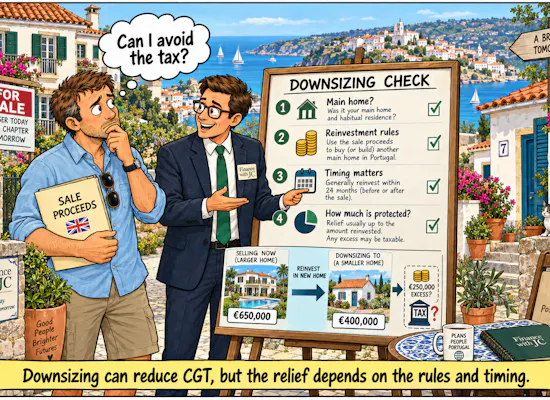
This matters particularly when downsizing. If you sell for €1 million and buy a new home for €600,000, you may think the remaining €400,000 is simply released equity. In reality, part of the capital gain may become taxable because you have not reinvested all the amount required for full relief.
There is also a valuable additional opportunity for some people who are retired or aged 65 or over. Instead of putting every euro into another property, they may be able to reinvest part of the proceeds into a qualifying life assurance, pension or Pan-European Personal Pension arrangement. Used correctly, this can potentially preserve more of the main-home relief while converting released property wealth into retirement income.
The important words are “used correctly”. The property calculation, tax return, product conditions and six-month deadline all have to line up.
The short answer
It may be possible to downsize a Portuguese main home without paying capital gains tax on the entire gain, but it is not automatic.
Broadly:
- Full relief may be available if the required net sale proceeds are fully reinvested in another qualifying main home.
- Partial relief may be available if only part of those proceeds is reinvested.
- If the seller or their spouse or civil partner is retired or at least 65, the amount not used for the replacement home may potentially be placed into a qualifying financial arrangement within six months.
- If the conditions are missed, the unrelieved part of the gain will generally enter the Portuguese income-tax calculation.
The relief is normally proportionate to the proceeds reinvested. It is not generally calculated by comparing the number of years the property was owned with the number of years it was occupied as the main home.
The rules are contained primarily in Article 10 of the Portuguese Personal Income Tax Code.
Why can downsizing create a tax problem?
Portugal's main-home relief is built around reinvestment.
The common misunderstanding is that the owner only needs to reinvest the profit. That is not how the standard calculation works.
The relevant reinvestment amount is generally the sale proceeds after deducting the outstanding balance of a loan originally taken out to acquire the property being sold.
Imagine that you:
- Sell your main home for €1,000,000.
- Repay a qualifying acquisition mortgage of €100,000.
- Buy a smaller main home for €600,000.
Your net sale proceeds for this purpose would normally be €900,000. Reinvesting €600,000 means you have reinvested two-thirds of the required amount, not all of it.
Subject to the full conditions, approximately two-thirds of the gain could therefore qualify for relief. The remaining third may be taxable.
This is why downsizing needs to be planned before the sale completes. Once the completion date has passed, the six-month clock for the retirement-related financial reinvestment route has already started.
How is a Portuguese property gain calculated?
Before considering reinvestment relief, the underlying capital gain must be established.
At a high level, the calculation starts with the disposal value and deducts the adjusted acquisition value and allowable costs.
The disposal value is usually the sale consideration. However, a higher value used for Portuguese property transfer tax purposes may sometimes prevail. The detailed rule is in Article 44.
The acquisition cost may be adjusted using official monetary coefficients when more than 24 months have passed between acquisition and sale. See Article 50.
Allowable amounts may include:
- Necessary costs connected with buying and selling the property.
- Estate-agent commission.
- Legal and registration expenses where permitted.
- Documented expenditure that increased the property's value during the preceding 12 years.
Invoices and proof of payment matter. A renovation may have cost a substantial amount, but that does not mean the Portuguese tax authority will accept an unsupported estimate. Article 51 sets out the treatment of expenses and improvement costs.
One particularly important distinction is that the mortgage does not normally reduce the capital gain itself. It affects the amount of sale proceeds that must be reinvested to obtain full main-home relief.
These are two separate calculations:
- What is the capital gain?
- What proportion of that gain qualifies for reinvestment relief?
Mixing them together is one of the easiest ways to produce a misleading estimate.
What qualifies as a Portuguese main home?
The property sold must have been used as the taxpayer's or their family's own permanent home.
Under the current rules, this is generally evidenced by the taxpayer's fiscal address being registered at the property during the 12 months before the sale or, where the replacement property was acquired first, before the earlier reinvestment.
There are limited exceptions for circumstances such as marriage, the start or end of a civil partnership, divorce or an increase in the number of dependants. These exceptions should be confirmed by a Portuguese tax specialist rather than assumed.
The 12-month condition should not be confused with a general time-apportionment calculation. It is principally a gateway into the relief.
This creates potential problems where someone:
- Owned the property for many years but never updated their fiscal address.
- Used it mainly as a holiday home.
- Rented it out until shortly before selling.
- Moved out and changed their fiscal address too early.
- Became non-resident before completion.
- Bought the replacement home before establishing the correct sequence of events.
The precise facts and dates need to be reviewed. Calling a property “my main home” is not enough if the available records point elsewhere.
How does the normal main-home reinvestment relief work?
The standard route allows qualifying net sale proceeds to be reinvested in:
- Another property that will be used exclusively as the taxpayer's or family's main home.
- Land on which a new main home will be built.
- Construction of a qualifying main home.
- The extension or improvement of another qualifying main home.
The replacement property can be in Portugal or another qualifying EU or EEA state where the required exchange of tax information exists.
The reinvestment can generally take place during the 24 months before the sale or the 36 months after it.
The taxpayer must also state their intention to reinvest, including the intended amount, in the Portuguese income-tax return for the year of sale.
Where another completed property is purchased, it must generally become the taxpayer's or family's home within 12 months of the reinvestment. Different registration and occupation deadlines apply where the money is used for land, building work, an extension or improvements.
The full statutory conditions are more important than the broad headline. A transaction can look like a straightforward sale and replacement but still fail because the declaration, timing, ownership or occupation requirements were not met.
What happens if I buy a cheaper home?
Buying a cheaper home is allowed, but it can produce partial rather than full relief.
Where only part of the required proceeds is reinvested, the tax exclusion generally applies to the corresponding proportion of the gain.
A simplified formula is:
Relieved gain = capital gain × qualifying reinvestment ÷ required net sale proceeds
The balance is the unrelieved gain.
This is best understood through an example.
Worked example: downsizing from €1 million to €600,000
Assume Maria and David are Portuguese tax residents and their property meets the main-home conditions.
They sell their home for €1,000,000. After applying the indexed acquisition value and allowable expenses, their calculated capital gain is €500,000.
They have €100,000 remaining on the mortgage originally used to buy the property. Their required net reinvestment amount is therefore €900,000.
They purchase a smaller main home for €600,000 using their own capital.
The qualifying reinvestment ratio is:
€600,000 ÷ €900,000 = 66.67%
The relieved gain would therefore be approximately:
€500,000 × 66.67% = €333,350
The remaining gain would be approximately:
€500,000 − €333,350 = €166,650
Ordinarily, 50% of that remaining property gain would be included in the Portuguese income-tax calculation. That would mean approximately €83,325 entering taxable income before considering the taxpayer's wider circumstances.
This is an illustration, not a tax calculation. Ownership shares, tax residence, other income, acquisition dates, deductible expenses and the exact source of the mortgage can all change the result.
Is Portuguese property capital gains tax a flat 28% for non-residents?
Not under the current rules for recent property sales.
For disposals from 1 January 2023, Portuguese real-estate gains realised by non-residents are generally subject to the same 50% inclusion rule used for residents. The taxable amount is compulsorily aggregated and Portugal's progressive income-tax rates apply.
For the purpose of determining the applicable rate, a non-resident's worldwide income is also taken into account under Article 22. This does not necessarily mean Portugal taxes all of that foreign income, but it can affect the rate applied to the Portuguese gain.
For 2026, the general rates run from 12.5% to 48%. An additional solidarity tax applies to taxable income above specified thresholds. The current bands are in Article 68, with the solidarity charge in Article 68-A.
Historic disposals may be subject to different rules. Older articles that still describe a flat 28% charge for non-resident property gains should not be relied on for a current transaction.
What is the special opportunity for retirees and people aged 65 or over?
Portugal provides an additional reinvestment route where the seller or their spouse or civil partner is demonstrably retired or at least 65 years old when the main home is sold.
Instead of reinvesting all the required proceeds in another main home, qualifying proceeds may potentially be used to acquire one or more of the following:
- A qualifying financial life assurance contract.
- An individual membership of an open pension fund.
- A contribution to Portugal's public capitalisation regime.
- A Pan-European Personal Pension Product.
The qualifying investment must generally be made within six months after the property sale.
Where a life assurance contract or open pension fund is used, it must be designed exclusively to provide regular periodic payments for at least ten years. The annual payment is limited to a maximum of 7.5% of the amount invested.
The seller must also declare the intention to make the reinvestment in the tax return for the year of sale.
This is not a blanket “over-65 CGT exemption”. It is a conditional reinvestment relief. If the reinvestment is not completed on time, the payment conditions are breached or regular payments stop, the previously relieved gain can become taxable.
Can I combine a smaller home with a qualifying retirement arrangement?
Potentially, yes. This is the most relevant planning opportunity for a downsizer.
Return to Maria and David's example. They have €900,000 of net sale proceeds requiring reinvestment and want to buy a €600,000 home.
If one of them satisfies the retirement or age condition, they might consider:
- €600,000 towards the replacement main home.
- €300,000 towards a qualifying retirement arrangement within six months.
Their combined qualifying reinvestment could then equal the €900,000 required amount. Subject to every condition being met, that could potentially preserve relief across the full gain.
But there is an important trade-off.
The €300,000 is not unrestricted cash available for holidays, gifts, renovations or unexpected spending. It has been committed to an arrangement designed to pay a regular income over at least ten years.
The decision is therefore not simply “pay tax or avoid tax”. It is a choice between different forms of wealth and access:
- More money tied up in property.
- Money committed to a structured retirement-income arrangement.
- Accessible capital outside the relief, potentially accompanied by a tax liability.
The right answer depends on the client's spending, other pensions, investment assets, emergency reserves, estate plan, health, family needs and willingness to accept investment risk.
Tax relief should support the retirement plan. It should not dictate it.
Does every life assurance or pension product qualify?
No. A product should never be assumed to qualify merely because it is described as a pension, bond, investment policy or retirement plan.
The statutory category, contractual payment terms and Portuguese tax treatment need to be confirmed before money is transferred.
Due diligence should consider:
- Written confirmation of the product's eligibility.
- Whether it must be Portuguese or can be issued elsewhere in the EU.
- The required commencement and frequency of payments.
- The minimum ten-year payment period.
- The 7.5% annual payment ceiling.
- What happens if the policyholder dies.
- Whether capital can be accessed early and the tax consequences of doing so.
- Investment choice and risk.
- Product, advice and fund charges.
- Currency exposure.
- Provider security and compensation arrangements.
- Tax treatment in any other country connected to the client.
A tax-efficient arrangement can still be unsuitable if it is expensive, inflexible or inconsistent with the client's retirement needs.
For a wider explanation of how tax, investment and residence decisions interact, read Capital Gains Tax for Expats and Cross-Border Financial Planning for British Expats.
Which mortgage can be deducted from the sale proceeds?
Article 10 refers to repayment of a loan contracted for the acquisition of the property being sold.
That wording matters.
Later equity release, unrelated borrowing, a business loan secured against the home or refinancing that included additional capital should not automatically be treated in the same way.
The lender's redemption statement shows the amount repaid, but the original loan agreement and refinancing history may be needed to establish how much is genuinely connected to the acquisition.
What if I am leaving Portugal after the sale?
The standard property route generally requires the replacement home to be in Portugal or another qualifying EU or EEA country.
This makes the destination important.
A Portuguese resident selling their home and moving to Spain may have a different reinvestment position from someone returning to the UK, moving to the UAE or relocating to the United States.
The timing of the move may also change the seller's tax residence in the year of disposal. Another country may obtain taxing rights under its domestic rules, with double-tax relief potentially available under the relevant treaty.
US citizens need particular care because the United States generally continues to tax citizens on worldwide income. The US main-home exclusion, exchange rates, ownership periods, filing status and foreign tax credits need to be coordinated with the Portuguese calculation.
Anyone returning to the UK should confirm their residence position for the disposal year and whether the UK may also tax the gain. Portuguese reinvestment relief does not automatically produce the same result in another country.
Cross-border advice is not just about reducing Portuguese tax. It is about avoiding a plan that works in Portugal but creates an unexpected liability somewhere else.
What deadlines matter?
The important dates should be placed on one timeline before the property is sold.
Before completion
- Confirm whether the property satisfies the main-home conditions.
- Verify the fiscal-address history.
- Estimate the adjusted gain and allowable costs.
- Confirm the qualifying acquisition mortgage.
- Decide how much will be used for the replacement property.
- Establish whether the retirement or age condition is satisfied.
- Obtain tax confirmation on any proposed financial arrangement.
In the year of sale
- Retain the completion statements and evidence of costs.
- Record the exact mortgage repayment.
- State the intention and amount to be reinvested in the Portuguese tax return.
Within six months after sale
- Complete any intended reinvestment through the retiree or over-65 financial-product route.
- Retain product documents and evidence of payment.
Within the property reinvestment period
- Complete the qualifying property reinvestment within the permitted period, generally 24 months before to 36 months after the sale.
- Satisfy the applicable registration, construction and occupation conditions.
Signing contracts without doing this work does not automatically destroy the relief. The concern is practical. By the time someone asks for help, their property budget may be fixed, the sale may have completed and the shortest deadline may already be running.
How should a Portugal downsizing review work?
A proper review should connect the tax calculation to the retirement plan.
1. Establish the facts
The first stage is to map the ownership, residence, mortgage and occupation history. Purchase and sale documents, mortgage statements, improvement invoices, ownership percentages, fiscal-address records, retirement evidence and replacement-property plans should be gathered early. This identifies whether the relief may be available and gives the Portuguese tax adviser the evidence needed for a reliable calculation.
2. Calculate the planning range
A Portuguese accountant or tax lawyer should confirm the gain, deductions, qualifying mortgage and estimated tax under each scenario.
The financial planner can then model the consequences of:
- Buying a more or less expensive replacement home.
- Keeping accessible cash and paying some tax.
- Using a qualifying retirement-income arrangement.
- Investing additional released capital outside the relief.
- Moving to another country.
3. Test the retirement plan
The question is not just how much tax can be saved. It is whether the client will have the right balance between home equity, accessible investments and reliable income.
Retirement Income Planning for Expats should include cash-flow modelling, investment risk, inflation, currency and expected spending throughout retirement.
4. Obtain tax and product confirmation
The Portuguese tax specialist should confirm the proposed tax treatment. Where a financial arrangement is being considered, its eligibility and contractual payment conditions should be documented before implementation.
5. Coordinate implementation
Completion proceeds, currency conversion, property payments, product applications and tax reporting need to work to the same timetable.
This is where advice adds value. The accountant, lawyer, estate agent, product provider and financial planner may each understand one part of the transaction. Someone still needs to join those parts together.
Should tax relief determine whether I downsize?
No. Downsizing is a retirement decision before it is a tax decision.
A smaller home may reduce running costs and release capital, but the plan must still provide enough accessible cash, sustainable income and flexibility. Currency, investment risk, future care, estate planning and the possibility of leaving Portugal also matter.
Saving the maximum tax is not a good result if it leaves someone short of flexible capital. The aim is the strongest overall retirement plan, not simply the smallest tax number.
For more on putting the wider plan together, read Retirement Planning for Expats and How to Retire Abroad.
Questions people also ask
Do I pay capital gains tax when selling my main home in Portugal?
Potentially. The gain is not automatically exempt merely because the property was your main home. Full or partial relief may be available when qualifying net sale proceeds are reinvested and the main-home, timing, declaration and occupation conditions are satisfied.
Do I only need to reinvest the profit from my Portuguese home?
No. The standard reinvestment test generally starts with the sale proceeds after deducting the outstanding loan originally used to acquire the property. That amount can be substantially higher than the capital gain.
Can I buy a cheaper home and still receive some relief?
Yes. If only part of the required proceeds is reinvested, a corresponding proportion of the gain may qualify for relief. The remaining part may be taxable.
Is there a Portuguese CGT exemption for people over 65?
There is not a blanket age-based exemption. However, if the seller or their spouse or civil partner is retired or at least 65, qualifying proceeds may potentially be reinvested into specified life assurance, pension, public capitalisation or PEPP arrangements within six months.
Frequently asked questions
How long do I have to reinvest after selling my Portuguese main home?
Property reinvestment can generally take place during the 24 months before the sale or the 36 months after it. The special financial reinvestment route for qualifying retirees and people aged 65 or over generally has a six-month post-sale deadline.
Can I reinvest in a home outside Portugal?
The standard relief can extend to another main home in Portugal or a qualifying EU or EEA country with the necessary exchange of tax information. A purchase in the UK, UAE or United States should not be assumed to qualify.
Does the replacement property need to become my main home?
Yes. The relief is not generally available simply because another property is purchased. The new property must satisfy the applicable main-home and occupation conditions.
Can I use a mortgage to buy the replacement home?
You can use a mortgage, but the debt-financed part should not automatically be counted as reinvestment of your own sale proceeds. The funding structure needs to be reviewed.
Does an offshore bond qualify for the over-65 relief?
Not automatically. The arrangement must fall within a qualifying statutory category and comply with the Portuguese payment conditions. Written confirmation should be obtained before investing.
What happens if I withdraw too much from the qualifying arrangement?
If payments exceed the permitted annual limit or regular payments are interrupted, the previously relieved gain may become taxable. The contractual terms and ongoing administration therefore matter.
What if my property was previously rented out?
Previous rental use does not produce a simple standard time-based apportionment. The current main-home status, fiscal-address history, timing and complete facts should be assessed by a Portuguese tax specialist.
Do non-residents pay a flat 28% on Portuguese property gains?
Not for current disposals under the post-2022 rules. Generally, 50% of the property gain is included and progressive rates apply, with worldwide income considered when determining the non-resident's rate.
Can a financial adviser calculate and approve my Portuguese tax relief?
The formal tax calculation and interpretation should be confirmed by a suitably qualified Portuguese accountant or tax lawyer. A cross-border financial planner can model the choices, advise on appropriate investments where authorised and coordinate the property, tax and retirement decisions.
Plan the transaction before the six-month clock starts
Downsizing can release a meaningful amount of capital, but the difference between sale proceeds, capital gain and qualifying reinvestment needs to be understood before the transaction is completed.
For retirees and people aged 65 or over, the ability to combine a smaller replacement home with an eligible retirement-income arrangement can be valuable. It can also be unsuitable if it restricts money the client may need to access.
The sensible approach is to calculate the options, test them against the retirement plan and have the Portuguese tax position confirmed before committing the proceeds.
If you are considering selling and downsizing your main home in Portugal, you can book a call to discuss the planning required and how the work can be coordinated with a Portuguese tax specialist.
This article is general information, not personalised tax, legal or investment advice. Portuguese tax treatment depends on individual circumstances and legislation can change. Obtain advice from a suitably qualified Portuguese tax professional before selling, reinvesting or entering into a financial arrangement.
You may also like