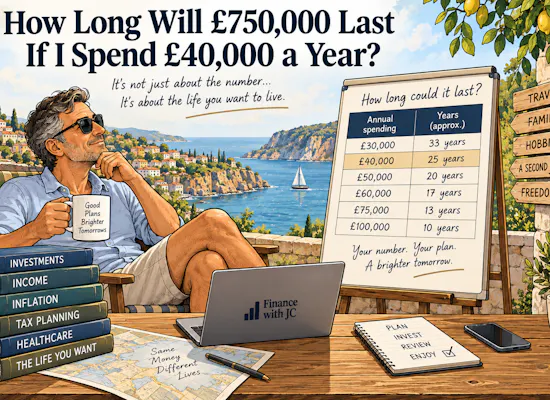
How Long Will £750,000 Last If I Spend £40,000 a Year?
At first glance, the maths looks easy.
£750,000 divided by £40,000 is 18.75.
So you might assume:
£750,000 will last just under 19 years.
But that is only true if:
- the money earns nothing
- your spending never rises
- there is no tax
- there are no fees
- you receive no other income
- you never change your spending
- there are no one-off costs
Real retirement planning does not work like that.
If the £750,000 remains invested, it may continue to grow.
But inflation may push £40,000 of spending higher every year.
Investment markets will rise and fall.
State Pension or other pension income may begin later.
You may spend more in the first decade of retirement and less later.
You may have property, cash, defined benefit pensions or a spouse’s pension.
You may also live abroad, introducing tax and currency considerations.
So the better question is not:
How many times does £40,000 fit into £750,000?
It is:
Can £750,000 support £40,000 of annual spending for the rest of my life without taking an unacceptable level of risk?
That is a retirement-planning question.
If you are trying to answer it properly, a useful starting point is retirement income planning for expats, where the pension, investments, tax, future income and spending all need to be modelled together.
People also ask
How many years will £750,000 last at £40,000 a year?
If you simply divide £750,000 by £40,000 and assume no investment return, inflation, tax or fees, the answer is 18.75 years.
In reality, the money could last considerably longer if it remains invested and earns positive returns, or considerably less long if spending rises with inflation, investment markets perform poorly or withdrawals are higher than expected.
Is £750,000 enough to retire?
It may be enough for some households but not others. The answer depends on retirement age, annual spending, housing, tax, investment returns, State Pension, other income, inflation and how long the money needs to last.
Is £40,000 a year too much to withdraw from £750,000?
£40,000 represents an initial withdrawal rate of around 5.33%. Whether that is sustainable depends on retirement length, investment returns, inflation, fees and whether withdrawals reduce when other income begins.
How much should I withdraw from a £750,000 pension?
There is no universally safe amount. The appropriate withdrawal should be based on your age, spending, tax, other pensions, investment risk, expected retirement length and ability to adjust spending.
Does State Pension change the answer?
Yes. If State Pension or other guaranteed income begins later, the £750,000 may only need to fund the full £40,000 during the early retirement years. Once other income starts, portfolio withdrawals may fall materially.
At a glance
- £750,000 divided by £40,000 equals 18.75 years, but this is not a realistic retirement forecast.
- £40,000 from £750,000 is an initial withdrawal rate of approximately 5.33%.
- Investment returns can extend the life of the portfolio.
- Inflation increases the future cost of maintaining the same lifestyle.
- Poor returns early in retirement can materially damage sustainability.
- State Pension, defined benefit pensions and other income can reduce later withdrawals.
- Tax means you may need to withdraw more than £40,000 to spend £40,000.
- Spending often changes during retirement rather than remaining flat.
- For expats, tax residence and currency can materially affect the calculation.
- The right answer comes from cash-flow modelling rather than simple division.
The short answer
If you have £750,000 and spend exactly £40,000 a year, with no growth and no inflation, it lasts:
18 years and 9 months.
But that scenario is not realistic.
A more useful range might look like this:
- with no real investment growth: roughly 18 to 19 years
- with positive real investment returns: potentially much longer
- with poor early returns and inflation-linked spending: potentially considerably less
- with State Pension or other income starting later: potentially 25 to 30 years or more
- with flexible spending and sensible investment management: potentially longer again
The important word is potentially.
No investment return is guaranteed.
That is why retirement planning should test several scenarios rather than promise one number.
£40,000 is a 5.33% starting withdrawal rate
This is an important number.
If you start with £750,000 and withdraw £40,000 in year one:
£40,000 ÷ £750,000 = 5.33%
That is your initial withdrawal rate.
A 5.33% starting withdrawal is not automatically unsustainable.
But it is more demanding than a lower withdrawal rate, especially for someone retiring early.
The key questions are:
- How old are you?
- How long might retirement last?
- Does £40,000 rise with inflation?
- Will State Pension start later?
- Are there other pensions?
- Is housing already paid for?
- Are you willing to cut spending after poor investment years?
- What investment risk are you taking?
- What tax applies?
- Is the £750,000 inside a pension, ISA, taxable account or mixture?
A 5.33% withdrawal for someone aged 75 with substantial guaranteed income is very different from 5.33% for someone retiring at 55 with no other assets.
Scenario 1: no growth, no inflation
Start with the simplest example.
You have:
- £750,000
- £40,000 annual withdrawals
- no investment growth
- no inflation
- no tax
- no fees
- no other income
Your capital lasts:
18.75 years.
If you retire at 60, the money runs out at around age 78 or 79.
If you retire at 55, it runs out around age 73 or 74.
That is clearly too simplistic for most retirement plans.
But it gives us the baseline.
Scenario 2: 3% annual return and fixed £40,000 spending
Now assume the portfolio earns 3% a year after costs and you continue withdrawing a fixed £40,000.
The pot lasts significantly longer because the remaining capital continues to grow.
But this scenario has a major weakness.
Your £40,000 spending does not increase with inflation.
If inflation averages 2.5%, then £40,000 in 20 years will buy much less than £40,000 today.
That means a fixed nominal withdrawal may look sustainable financially while your lifestyle steadily deteriorates in real terms.
Retirement planning should usually focus on maintaining purchasing power, not simply maintaining a nominal number.
Scenario 3: investment return and inflation-linked spending
This is more realistic.
Suppose:
- starting portfolio: £750,000
- first-year spending: £40,000
- spending increases with inflation
- portfolio remains invested
- returns vary year by year
Now the calculation becomes much more sensitive.
If long-term investment returns exceed inflation by a healthy margin, the portfolio may last for decades.
If returns are weak, fees are high or inflation stays elevated, the plan becomes much tighter.
This is why using a single assumed return such as “the portfolio will make 6% every year” is dangerous.
Markets do not deliver neat annual returns.
A retirement plan needs to survive the bad years too.
Sequence-of-returns risk
This is one of the most important concepts in retirement planning.
Imagine two retirees.
Both start with £750,000.
Both withdraw £40,000 a year.
Both achieve the same average investment return over 20 years.
But one experiences strong markets in the first five years.
The other experiences a major market fall immediately after retiring.
Their outcomes can be very different.
Why?
Because the second retiree is withdrawing money while the portfolio is already down.
That means more units need to be sold at depressed prices.
Those assets are no longer there when markets recover.
This is sequence-of-returns risk.
It is particularly dangerous in the first decade of retirement.
A good retirement strategy may therefore include:
- cash reserves
- diversified investments
- flexible spending
- lower withdrawals after market falls
- guaranteed income
- careful rebalancing
- delaying large discretionary expenditure
For anyone planning early retirement, this is one of the key issues within retirement income planning for expats.
Inflation changes £40,000 dramatically
Suppose inflation averages 2.5%.
If you need £40,000 today to maintain your lifestyle, you may need roughly:
- £45,000 in around five years
- £51,000 in around ten years
- £58,000 in around fifteen years
- £66,000 in around twenty years
The exact figures depend on inflation.
The point is that retirement spending cannot normally remain fixed forever.
If your plan assumes £40,000 every year for 30 years, it may underestimate what your lifestyle will actually cost.
This is particularly relevant if your spending includes:
- healthcare
- rent
- insurance
- travel
- school or family support
- property maintenance
- long-term care
Inflation should be built into the model.
Tax changes the number again
If you say:
“I need £40,000 a year.”
Do you mean:
- £40,000 before tax?
- or £40,000 in your bank account after tax?
That distinction matters.
If your £750,000 sits inside a pension, taxable pension withdrawals may need to be higher than £40,000 to leave £40,000 net.
If some money sits in an ISA, that part may be tax-free.
If you live overseas, the tax treatment may depend on your country of residence and the relevant double-tax treaty.
That means two retirees with identical £750,000 portfolios and identical spending needs can require different withdrawal amounts.
For expats holding UK pensions, UK pension drawdown while living abroad should be considered alongside the wider retirement model.
State Pension can change the picture materially
Suppose you retire at 60.
You need £40,000 a year.
At State Pension age, you begin receiving UK State Pension.
Your portfolio no longer needs to provide the full £40,000.
If State Pension eventually covers part of your annual spending, withdrawals from the £750,000 can fall.
The same applies if you have:
- a defined benefit pension
- spouse pension income
- rental income
- an annuity
- business income
- part-time work
- Social Security
- another country’s state pension
This creates a retirement income bridge.
The portfolio may need to work harder in the first decade, then less hard later.
That can make a £750,000 retirement plan far more sustainable than the simple 18.75-year calculation suggests.
A worked bridge example
Imagine you retire at 60 with £750,000.
You want £40,000 a year.
At 67, you expect £12,000 a year of State Pension and other guaranteed pension income.
Ignoring tax for simplicity:
Age 60 to 66
Portfolio withdrawal:
£40,000 a year
For seven years:
£280,000 of gross withdrawals before considering growth.
Age 67 onwards
Your guaranteed income provides £12,000.
The portfolio now needs to provide:
£28,000 a year.
That reduces the portfolio withdrawal rate materially.
This is why retirement cash-flow planning is more useful than applying one withdrawal percentage forever.
What if £750,000 includes your home?
This is critical.
There is a huge difference between:
£750,000 of investable assets
and:
£750,000 total net worth including a £500,000 home.
If the £750,000 includes:
- your main residence
- rental property
- business value
- illiquid assets
then much less may actually be available to fund £40,000 of annual spending.
Retirement planning should separate:
Lifestyle assets
Your home, cars and personal possessions.
Income-producing assets
Pensions, investments, cash and rental property.
Future assets
Possible downsizing proceeds, business sale proceeds or inheritances.
Do not assume every pound of net worth can fund retirement spending.
What if you own rental property?
A rental property may reduce the amount you need to draw from the £750,000.
But use the net rental income, not gross rent.
Deduct:
- mortgage costs
- agent fees
- repairs
- maintenance
- voids
- insurance
- tax
If you are approaching retirement and own UK property, read Should I Sell My UK Rental Property Before I Retire?.
The property should be judged by the income, diversification and liquidity it provides to the whole retirement plan.
What if you retire abroad?
This adds another layer.
You may have:
- £750,000 in sterling
- spending in euros
- income in dollars
- a pension in GBP
- property in the UK
- retirement in Dubai or Portugal
Now currency matters.
Imagine you need €45,000 a year.
Your sterling withdrawal depends partly on the GBP/EUR exchange rate.
If sterling weakens materially, you may need to withdraw more pounds to fund the same euro lifestyle.
The same applies to:
- AED
- USD
- ZAR
- AUD
- CHF
- other currencies
You do not need to predict exchange rates.
But you should understand which currencies your retirement depends on.
For UAE-based British expats, this should sit inside a broader retirement planning for British expats in the UAE.
Spending usually changes through retirement
One of the biggest mistakes in retirement modelling is assuming spending is flat.
Real retirement often moves through phases.
Go-Go years
Early retirement may involve:
- travel
- restaurants
- hobbies
- family visits
- experiences
- new cars
- property upgrades
Spending may be relatively high.
Slow-Go years
Later, spending on travel and leisure may decline.
Lifestyle becomes more local.
Discretionary spending may fall.
No-Go years
Later still, leisure spending may reduce further.
But healthcare and care costs may increase.
That means £40,000 may not be the right number forever.
A good financial plan models changing spending rather than assuming a perfectly flat line.
Five worked examples
Example 1: £750,000 and no other income
Sarah retires at 55.
She has £750,000 and wants £40,000 a year.
She has no other investments and State Pension will not begin for many years.
Her initial withdrawal rate is 5.33%.
This is possible, but the plan may be vulnerable to poor early returns and inflation.
She needs a strong cash reserve, disciplined spending and proper stress testing.
Example 2: £750,000 plus State Pension later
James retires at 60.
He needs £40,000 per year.
At 67, State Pension and a small defined benefit pension will provide £15,000 a year.
From age 67, the portfolio only needs to provide £25,000.
That materially improves sustainability.
For James, the answer may be much stronger than the simple 18.75-year calculation suggests.
Example 3: £750,000 with £30,000 spending
Mark has £750,000 but only needs £30,000 a year.
His initial withdrawal rate is 4%.
He owns his home outright and expects State Pension later.
His plan has considerably more resilience than someone withdrawing £40,000 or £50,000.
Example 4: £750,000 with £50,000 spending
Emma wants £50,000 a year.
That is an initial withdrawal rate of 6.67%.
She is 57 and has no other meaningful income until State Pension.
Her plan is far more sensitive to market falls, inflation and longevity.
She may need to reduce spending, delay retirement, work part-time or build more capital.
Example 5: Dubai-based retiree moving to Europe later
David lives in Dubai with £750,000 invested.
He spends £40,000 a year equivalent today but plans to retire in Spain in six years.
His plan needs to account for:
- current UAE spending
- future Spanish tax
- euro currency exposure
- healthcare
- inflation
- pension withdrawals
- future State Pension
The answer is not simply whether £750,000 lasts 19 years.
It is whether the assets can support two different retirement phases in two different countries.
Self-diagnostic: is £750,000 enough for your £40,000 lifestyle?
Score one point for each “yes”.
- I know whether £40,000 is before or after tax.
- I know my essential annual spending.
- I know my discretionary spending.
- I have included inflation.
- I know when State Pension begins.
- I know what other pensions or income will start later.
- I have modelled poor early investment returns.
- I have a cash reserve.
- I know the fees on my investments.
- I know the tax on future withdrawals.
- I know which currency I will spend in.
- I have allowed for healthcare, property and one-off costs.
Green: 9 to 12 points
You have enough information to start testing whether £750,000 can support the lifestyle.
Amber: 5 to 8 points
The plan may work, but there are important assumptions still missing.
Red: 0 to 4 points
Do not rely on the simple £750,000 ÷ £40,000 calculation. You need a proper retirement cash-flow plan.
Common mistakes
Dividing the pot by annual spending
Problem
£750,000 divided by £40,000 gives 18.75 years.
Why it matters
It ignores returns, inflation, tax and future income.
What to check
Use cash-flow modelling instead.
Assuming a fixed return
Problem
The plan assumes 5% or 6% every year.
Why it matters
Markets are volatile and early losses matter disproportionately.
What to check
Stress test different return sequences.
Ignoring inflation
Problem
£40,000 is assumed to stay £40,000 forever.
Why it matters
The cost of maintaining the same lifestyle usually rises.
What to check
Increase spending assumptions over time.
Forgetting later income
Problem
State Pension and defined benefit pensions are ignored.
Why it matters
Future guaranteed income may substantially reduce portfolio withdrawals.
What to check
Map income by age.
Ignoring tax
Problem
Gross withdrawals are confused with net spending.
Why it matters
You may need to withdraw more than £40,000 to spend £40,000.
What to check
Model after-tax income.
Treating all spending as essential
Problem
The plan assumes spending cannot change.
Why it matters
Flexible discretionary spending can protect the portfolio in bad markets.
What to check
Separate essential and lifestyle costs.
What to review before relying on £750,000
Retirement age
The younger you retire, the longer the capital may need to last.
Spending
Separate essential, lifestyle and one-off expenditure.
Investment strategy
Review asset allocation, volatility, expected returns, fees and sequence risk.
Other income
Include State Pension, defined benefit pensions, rental income, spouse income and other reliable sources.
Tax
Model net spending after pension tax and local taxation.
Inflation
Increase future spending rather than holding it flat.
Cash reserves
Decide how much spending should sit outside the investment portfolio.
Currency
Match assets and future income to the currencies you will actually spend.
Estate planning
Decide whether the objective is to spend the capital, preserve some of it, or leave a significant legacy.
What happens next
Step 1: confirm the £40,000 spending figure
Use real bank statements rather than estimates.
Step 2: separate essential and discretionary spending
Work out what could realistically be reduced after a poor investment year.
Step 3: map future income
Include State Pension, defined benefit pensions, rental income and other reliable sources.
Step 4: model inflation
Do not assume £40,000 buys the same lifestyle forever.
Step 5: stress test market falls
Test what happens if retirement begins just before a major market decline.
Step 6: model tax and currency
Focus on spendable income, not gross withdrawals.
Step 7: update the plan annually
Retirement is not a one-time calculation.
Spending, markets, tax, health and family circumstances change.
You may also like
Conclusion
If you have £750,000 and spend £40,000 a year, the simple mathematical answer is:
18.75 years.
But that is not the retirement-planning answer.
Once you include investment returns, inflation, tax, future State Pension, other income, changing spending and market risk, the range of outcomes becomes much wider.
The £750,000 could potentially support you for considerably longer than 19 years.
It could also run down faster than expected if:
- spending rises sharply
- investment returns are poor
- inflation is high
- tax is underestimated
- you retire early
- you suffer major one-off costs
- you refuse to adjust spending after market falls
The key question is not:
How long does £750,000 last if I spend £40,000?
It is:
Can £750,000 support the retirement lifestyle I want for the rest of my life, including the difficult scenarios?
If you are not sure whether your investments and pensions can sustainably provide £40,000 a year, book an introductory call with Josh Clancey.
FAQ
How long will £750,000 last at £40,000 a year?
With no growth, inflation, tax or fees, it lasts 18.75 years. In a real retirement plan, investment returns, inflation and future income can significantly change the result.
What percentage is £40,000 of £750,000?
£40,000 is approximately 5.33% of £750,000.
Is a 5.33% withdrawal rate sustainable?
It may be in some circumstances, particularly if withdrawals fall later when State Pension or other income begins. However, it may be aggressive for a long retirement with no other income.
How much investment return do I need?
There is no single required return. Sustainability depends on the return after inflation, tax and fees, and importantly on the sequence in which returns occur.
What happens if inflation is 3%?
Your £40,000 spending would need to increase over time if you want to maintain the same purchasing power.
Does State Pension make £750,000 more sustainable?
Yes. If State Pension or other guaranteed income begins later, the amount required from the portfolio can fall materially.
Is £750,000 enough to retire at 55?
Potentially, but the money may need to last 35 years or more. Spending, tax, other income and investment risk become especially important.
Should I keep some money in cash?
Many retirement plans benefit from a cash reserve, but the appropriate amount depends on spending, income security, investment risk and personal circumstances.
Does living abroad change the calculation?
Yes. Tax residence, double-taxation agreements, currency and the cost of living in your future retirement country can materially change the answer.