Should I Take My UK Pension Tax-Free Lump Sum If I Live Abroad?
Taking tax-free cash from a UK pension can feel like an obvious decision.
You have spent years building a pension.
You now live abroad.
You may be in a low-tax country.
And you may be able to access up to 25% of your pension as a tax-free lump sum, subject to the available lump sum allowance and scheme rules.
So why not take it?
Because “tax-free” does not automatically mean “best”.
For expats, taking a UK pension lump sum can affect more than today’s bank balance.
It can affect:
- future retirement income
- tax in your country of residence
- future UK tax if you return
- currency exposure
- pension investment growth
- estate planning
- liquidity
- family support
- debt decisions
- how long your pension needs to last
The key question is not:
Can I take my tax-free lump sum while living abroad?
In many cases, yes.
The better question is:
Will taking it now make my retirement plan stronger, or simply make today feel easier?
People also ask
Can I take my UK pension tax-free lump sum while living abroad?
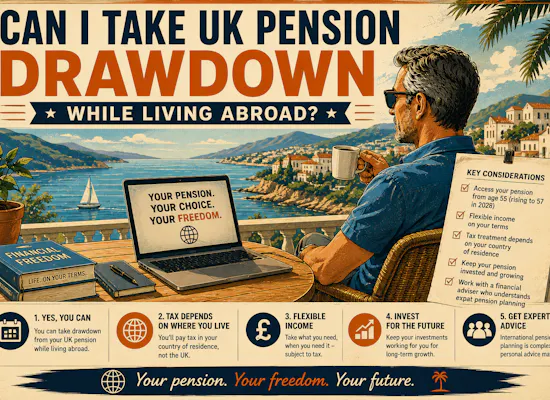
Usually, yes. Moving abroad does not normally prevent you from taking a pension commencement lump sum from a UK registered pension scheme, provided you meet the normal pension access rules and have enough available lump sum allowance.
Is my UK pension lump sum still tax-free if I live abroad?
It may be tax-free under UK pension rules, but your country of tax residence may treat the payment differently. The UK treatment, local treatment and any relevant double-tax treaty should be considered before the withdrawal.
Can I take 25% of my pension tax-free if I live in Dubai?
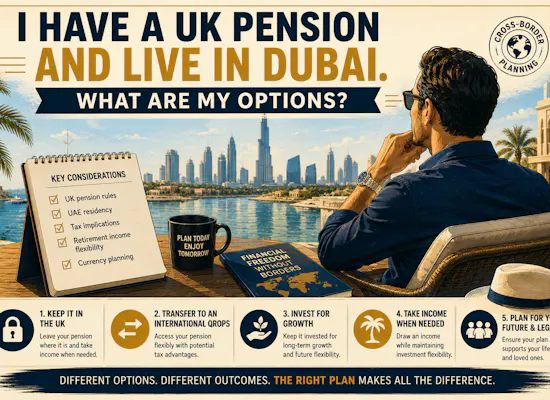
You may usually be able to take a UK pension commencement lump sum under the normal UK rules. The UAE currently does not levy personal income tax on individuals, but you should still check provider processes, your UK tax status and any future plans to move country.
Should I take my pension lump sum before returning to the UK?
Possibly, but timing matters. A standard pension commencement lump sum is treated differently from flexible drawdown withdrawals under the temporary non-residence rules. However, broader tax, residence, investment and retirement-income consequences still need reviewing.
What is the UK pension lump sum allowance in 2026?
The standard lump sum allowance for 2026/27 is £268,275. Some people may have a higher protected allowance or scheme-specific protection.
At a glance
- You can often take UK pension tax-free cash while living abroad.
- The standard UK lump sum allowance is £268,275 for 2026/27, although protection or scheme-specific rules can change the position.
- A tax-free pension commencement lump sum is not the same as free money. It is still part of your retirement capital.
- Tax-free under UK rules does not always mean tax-free where you live.
- For expats, timing can matter if you may move country or return to the UK.
- Taking the maximum available lump sum is not automatically the best strategy.
- The lump sum should have a specific role in your retirement plan.
- Tax-free cash, flexi-access drawdown and UFPLS do not all have the same tax treatment or planning consequences.
The short answer
You should usually take your UK pension tax-free lump sum only if it has a clear job to do.
That job might be:
- reducing expensive debt
- creating a cash reserve
- funding a retirement income bridge
- paying for a relocation
- helping family without damaging your own retirement
- reducing investment risk near retirement
- providing liquidity outside the pension
- funding a planned property purchase
- coordinating assets across currencies
- supporting estate planning
But taking it because “everyone takes 25%” is not a plan.
It is a habit.
And habits can be expensive in retirement.
A pension commencement lump sum can be valuable because it gives you flexibility.
But once the money leaves the pension, it may no longer benefit from the same investment wrapper, pension structure, discipline or potential estate-planning advantages.
The decision should improve the whole plan.
Not just the next 12 months.
What is the UK pension tax-free lump sum?
The tax-free lump sum is commonly called a pension commencement lump sum, or PCLS.
For many defined contribution pensions, you can usually take up to 25% of the amount being crystallised as tax-free cash, provided you have enough available lump sum allowance.
For 2026/27, the standard lump sum allowance is £268,275.
That does not mean every pension holder receives exactly 25%.
The actual amount can be affected by:
- protected tax-free cash
- historic lifetime allowance protection
- scheme-specific rules
- previous pension withdrawals
- prior benefit crystallisation events
- defined benefit scheme terms
- pension transfers
- whether you have already used some of your allowance
For some people, the available tax-free cash is higher than the standard amount.
For others, it may be lower because they have already taken pension benefits.
That is why you should confirm the figure with your provider before planning around it.
Why living abroad changes the question
If you still lived in the UK, the decision would already involve tax, income, investment risk and retirement planning.
Living abroad adds more moving parts.
You may:
- earn in AED, USD, EUR, SAR or another currency
- have a UK pension in sterling
- own UK property
- hold offshore investments
- support family in another country
- plan to retire in more than one location
- expect to return to the UK
- have a spouse with a different nationality or tax residence
- have children studying abroad
- be considering a move from Dubai to Europe, Australia, South Africa or Asia
That means the lump sum is not simply a UK pension issue.
It is a cross-border financial planning decision.
A British expat in Dubai may see a tax-free lump sum differently from someone living in Spain.
Someone planning to return to the UK in two years may need a different strategy from someone who has permanently settled in the UAE.
Someone retiring in euros may need a different approach from someone spending mainly in sterling.
The right answer depends on where your life is going next.
UK tax-free does not always mean locally tax-free
This point needs to be clear.
A pension commencement lump sum may be tax-free under UK pension rules.
But your country of residence may have its own rules.
Some countries tax pension lump sums.
Some treat lump sums differently from regular pension income.
Some double-tax treaties contain specific pension provisions.
Some treaties use different wording for periodic pension payments and non-periodic lump sums.
Some countries may require reporting even where no tax is ultimately due.
For UAE residents, the current absence of personal income tax can make a pension lump sum look particularly attractive.
But you should still think about:
- whether the pension provider will pay the lump sum without issue
- whether HMRC needs to be notified of your overseas status
- whether you are truly non-UK resident under the Statutory Residence Test
- whether you are likely to return to the UK
- whether you may move to another country later
- whether the lump sum will be converted into another currency
- whether it will be invested, spent or gifted
- whether bank source-of-funds evidence will be needed later
The tax position should be checked before money moves.
Not after.
The temporary non-residence distinction expats need to understand
This is a technical point, but it matters.
People who leave the UK temporarily can sometimes face UK tax on certain pension withdrawals when they later return.
Flexible drawdown withdrawals can be caught by the temporary non-residence rules in certain circumstances.
That includes relevant flexi-access drawdown withdrawals and some other flexible pension payments.
A standard pension commencement lump sum is generally not treated as a relevant withdrawal for these temporary non-residence rules.
That does not make the lump sum automatically the right decision.
But it does mean you should not confuse:
- pension commencement lump sum
- taxable flexi-access drawdown income
- uncrystallised funds pension lump sums
- ad hoc pension withdrawals
- overseas pension payments
They can have different tax outcomes.
If you are on a temporary overseas assignment, planning to return to the UK, or unsure about future residence, do not take large pension withdrawals based on a simple “Dubai has no income tax” assumption.
A proper UK pension transfer and retirement review for expats should consider the pension structure, the payment type and your residence timeline together.
The biggest mistake: taking the maximum automatically
The most common error is taking the full 25% simply because it is available.
That may feel sensible.
You may think:
- “I can invest it somewhere else.”
- “I may as well get it out while it is tax-free.”
- “I will need it eventually.”
- “I do not trust pension rules to stay the same.”
- “I can give some to the children.”
- “I can use it to pay down the mortgage.”
Those can all be valid reasons.
But they need to be tested.
If you take £150,000 tax-free from a £600,000 pension, the remaining pension is £150,000 smaller before any future growth or losses.
That may affect:
- long-term drawdown income
- retirement flexibility
- resilience during market falls
- the ability to delay taxable withdrawals
- estate planning
- future investment growth
- your spouse’s financial security
The lump sum may be tax-free.
But the opportunity cost is not free.
When taking the lump sum can make sense
There are circumstances where pension tax-free cash can materially improve the plan.
Clearing expensive debt
Paying off high-interest debt can create a strong and predictable financial benefit.
This may include:
- personal loans
- credit cards
- high-cost finance
- variable-rate debt
- debt in a currency you may not earn in during retirement
- property borrowing that creates unacceptable cash-flow pressure
The important question is whether clearing debt improves retirement resilience without leaving you cash-poor.
Building a retirement cash reserve
Cash can protect against bad timing.
If investment markets fall shortly after retirement, having a cash reserve may reduce the need to sell investments at depressed values.
For some people, tax-free cash can help create:
- 12 months of essential spending
- two to three years of planned withdrawals
- a relocation reserve
- a property repair reserve
- a fund for known family commitments
But cash should have a defined purpose.
Leaving large sums in cash indefinitely can allow inflation to erode spending power.
Creating a retirement income bridge
Tax-free cash can help bridge the gap between stopping work and other income beginning.
For example:
- State Pension starts later
- a defined benefit pension starts at 65
- business sale proceeds are not yet available
- a property sale is expected but not completed
- consulting income is uncertain
- you want to delay taxable pension income
This can be especially relevant for expats who stop working in the Gulf before deciding where they will retire permanently.
Reducing mortgage or property risk
Using the lump sum to reduce debt may make sense if the mortgage creates retirement pressure.
But consider:
- interest rate
- early repayment penalties
- liquidity after repayment
- currency of the loan
- whether the property is part of the retirement plan
- whether the debt is affordable from future income
- whether the pension money could be more valuable left invested
Debt reduction can create certainty.
But it should not leave you asset-rich and cash-poor.
Funding a planned relocation
Expats often underestimate the cost of moving country in retirement.
A move may involve:
- shipping
- property deposits
- legal fees
- visa costs
- healthcare
- school transitions
- temporary accommodation
- currency conversion
- travel
- tax advice
- furnishing a new home
A pension lump sum can provide flexibility for this stage of life.
But it should be part of a broader retirement plan for British expats in the UAE, not simply a source of spending money.
When leaving the money in the pension may be better
Sometimes the best decision is not to take the lump sum yet.
Leaving money in the pension may be preferable if:
- you do not need the cash
- the pension investments remain suitable
- you want long-term tax-deferred investment growth
- you are still working and contributing
- you are unsure where you will retire
- you may return to the UK
- you do not have a clear use for the money
- you are concerned about spending discipline
- you want to preserve flexibility for later
- the pension remains a useful estate-planning component
The money can still be accessed later, subject to the scheme rules and your available allowance.
Taking it early is not always a benefit.
Sometimes waiting gives you more options.
Should you invest the tax-free cash outside the pension?
Some people take tax-free cash and reinvest it.
That can be appropriate.
But it needs a reason.
You may want funds outside the pension because:
- you need more flexible access
- you are planning to buy property
- you want to diversify across wrappers
- you want to hold assets in a different currency
- you want liquidity for family support
- you want to manage future tax bands
- you want to coordinate assets with a spouse
- you need a reserve that is not locked into pension rules
But do not assume an offshore investment account, bank account or other wrapper is automatically superior to keeping money in the pension.
Compare:
- tax treatment
- charges
- access
- currency
- investment choices
- estate planning
- creditor protection
- reporting requirements
- future country of residence
- behavioural risk
The best investment is not necessarily the one outside the pension.
It is the one that gives the overall plan the best balance of growth, access, tax efficiency and control.
Can I use the lump sum to help children?
You can.
But first protect your own retirement.
Many expats want to use tax-free cash to help children with:
- university costs
- property deposits
- weddings
- business capital
- relocation
- medical support
- debt
That can be generous and meaningful.
But it can also create problems where:
- the gift weakens your own income security
- children receive unequal amounts
- the money is not documented
- the child divorces
- the gift conflicts with estate-planning intentions
- the recipient lives in a country with different tax rules
- the money is really a loan but everyone treats it as a gift
The first role of pension money is usually to provide for your own retirement.
Support for family should come after that is secure.
Five worked examples
Example 1: Dubai resident with no immediate need for cash
James is 58 and lives in Dubai.
He has a £700,000 SIPP, AED cash savings, no mortgage and no plans to stop work for another four years.
He can take up to £175,000 as tax-free cash, subject to his available allowance.
James does not need the money now.
If he takes it simply because it is available, he may move a substantial amount out of a long-term pension wrapper and into cash or an external investment account without improving his plan.
For James, waiting may be the better option.
Example 2: Expat using tax-free cash as a retirement bridge
Sarah is 60 and plans to leave Dubai next year.
Her State Pension and defined benefit pension will begin at 67.
She has a defined contribution pension worth £600,000.
Sarah may use some tax-free cash to fund the first years of retirement, while allowing her other pension assets to remain invested and delaying taxable income.
Here, the lump sum has a clear job.
It is an income bridge.
Example 3: Mortgage reduction without losing liquidity
David has a £500,000 pension and a £180,000 mortgage on a UK property.
He is considering taking £125,000 tax-free cash to reduce the mortgage.
The question is not simply whether debt reduction feels good.
He should compare:
- mortgage rate
- early repayment charge
- remaining term
- future rental income
- cash reserve after repayment
- expected retirement spending
- whether he may sell the property
- future currency needs
Paying down part of the mortgage may strengthen the plan.
Using all available tax-free cash and leaving no liquidity may not.
Example 4: Returning to the UK in three years
Emma lives in Abu Dhabi and expects to return to the UK in three years.
She is considering taking a pension commencement lump sum and drawing a large taxable amount from flexi-access drawdown before returning.
The ordinary tax-free lump sum and the flexible drawdown income should not be treated as the same thing.
The drawdown income may have temporary non-residence implications on return.
The decision needs residence, tax and retirement planning review before funds are withdrawn.
Example 5: Helping children too early
A couple takes £100,000 of tax-free pension cash to help their child buy a home.
They later realise their own retirement income is tighter than expected because inflation, healthcare and travel costs are higher than planned.
The gift was generous.
But it was made before their own plan was properly secured.
The problem was not helping family.
The problem was failing to test affordability first.
Common mistakes
Taking the maximum because it is available
Problem
The lump sum feels like a benefit that should be claimed immediately.
Why it matters
It may reduce future retirement income and investment flexibility.
What to check
Whether the lump sum has a specific and valuable role in your plan.
Assuming Dubai residence solves every tax issue
Problem
The absence of UAE personal income tax is treated as the whole answer.
Why it matters
UK tax administration, treaty treatment, future residence and temporary non-residence rules may still matter.
What to check
Your current residence position and likely future location before taking money.
Leaving the lump sum in cash indefinitely
Problem
Cash feels safe after pension money is withdrawn.
Why it matters
Inflation can reduce real spending power over time.
What to check
How much cash is genuinely needed and what the rest should do.
Reinvesting without comparing wrappers
Problem
The pension cash is moved into another investment account automatically.
Why it matters
The alternative may have higher charges, less favourable tax treatment or weaker estate-planning characteristics.
What to check
Why the external structure is better than retaining money in the pension.
Giving money away before securing retirement
Problem
The lump sum is used to help family before the retiree’s own future is secure.
Why it matters
You may create later financial dependency or reduce your own options.
What to check
Whether your retirement plan still works after the gift.
What to review before taking your lump sum
Your pension rules
Confirm:
- available tax-free cash
- remaining lump sum allowance
- protected tax-free cash
- pension access age
- scheme-specific rules
- whether you are crystallising all or part of the pension
- impact on future drawdown
- death benefit options
Your tax position
Review:
- UK tax residence
- current country of residence
- double-tax treaty treatment
- pension provider processes
- future moves
- temporary non-residence risk
- reporting requirements
- potential source-of-funds evidence
Your retirement income plan
Model:
- essential spending
- discretionary spending
- other pension income
- State Pension
- defined benefit income
- investments
- cash reserves
- property income
- inflation
- healthcare
- family support
- life expectancy
- market volatility
Your currency position
Identify:
- currency of pension assets
- currency of current spending
- currency of future retirement spending
- currency of debt
- currency of property costs
- currency of family support
Your estate plan
Check:
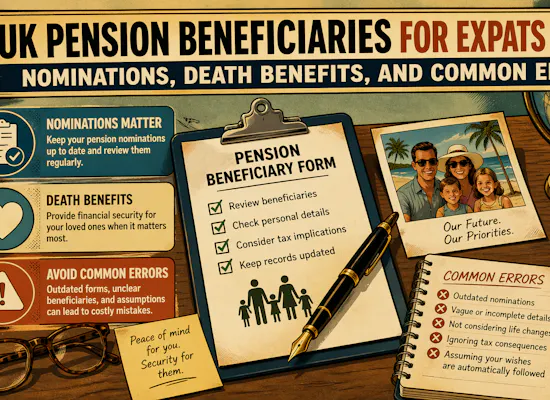
- pension beneficiaries
- expression of wish forms
- wills
- trusts
- spouse planning
- children and dependants
- inheritance tax exposure
- whether family members know where pension documents are held
You may also like
Conclusion
You can often take your UK pension tax-free lump sum while living abroad.
But the availability of tax-free cash is not the same as a reason to take it.
The right decision depends on what the money needs to do.
It may reduce debt.
It may create a retirement income bridge.
It may fund a relocation.
It may provide a cash reserve.
It may help family.
Or it may be better left inside the pension for now.
The key question is not:
Can I take my tax-free lump sum while living abroad?
It is:
Will taking it now make my long-term retirement plan stronger?
If you live abroad and are not sure whether to take, retain, invest or spend your UK pension tax-free cash, book an introductory call with Josh Clancey.
FAQ
Can I take my UK pension tax-free lump sum while living abroad?
Usually, yes. You can often take pension commencement lump sum benefits from a UK registered pension while overseas, subject to normal access rules, scheme rules and your available allowance.
Is the UK pension tax-free lump sum available at any age?
No. Most people need to be at least the normal minimum pension age, usually 55 in 2026. This is scheduled to rise to 57 for most people from 6 April 2028.
Is tax-free pension cash taxed where I live?
Potentially. UK tax treatment does not automatically determine the treatment in your country of tax residence. Local tax advice may be needed before withdrawal.
Can I take the lump sum before returning to the UK?
Possibly. But you should consider your residence timeline, future tax position and the distinction between pension commencement lump sums and flexible drawdown withdrawals.
Is it better to take the full 25% at once?
Not necessarily. Some people benefit from partial or phased access rather than taking the maximum lump sum immediately.
Does taking tax-free cash reduce my pension income later?
Yes. Taking money from the pension reduces the amount left invested to support future withdrawals, unless other factors offset that reduction.
Can I reinvest my tax-free pension lump sum?
Yes, but the alternative structure should be chosen carefully. Compare tax, access, investment risk, currency, charges and estate planning before moving money outside the pension.