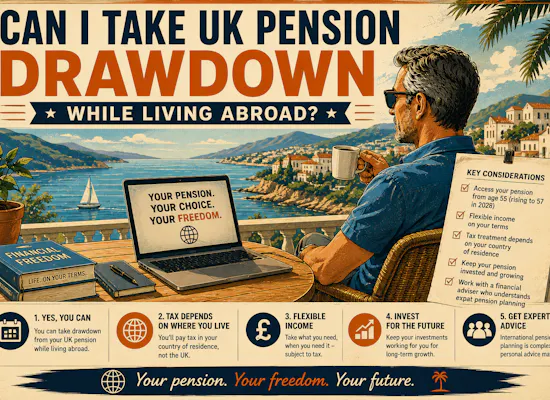
Can I Take UK Pension Drawdown While Living Abroad?
Your UK pension does not stop being available because you move abroad.
In many cases, you can take pension drawdown while living overseas.
But whether you should, how much you should take, where it is taxed, and whether it fits your wider retirement plan are separate questions.
That is where many expats get caught out.
They hear that they can access a UK pension from abroad and assume the decision is straightforward.
It rarely is.
You may live in Dubai, earn or spend in dirhams, hold a pension in sterling, have investments in US dollars and plan to retire somewhere else entirely.
You may also be considering a move back to the UK in a few years.
That means a pension withdrawal is not just an income decision.
It can affect:
- UK tax
- tax in your country of residence
- double-tax treaty claims
- future UK residence
- temporary non-residence rules
- currency exposure
- pension sustainability
- investment risk
- estate planning
- the income your family can rely on later
The question is not simply:
Can I take UK pension drawdown while living abroad?
The better question is:
Will taking drawdown now improve my wider retirement position, or create a problem later?
People also ask
Can I take drawdown from a UK pension while living overseas?
Usually, yes. Many UK pension schemes allow overseas members to access drawdown, subject to scheme rules, provider processes and the normal pension access rules. However, the provider may still deduct UK tax initially, and your tax residence, treaty position and future plans need to be considered.
At what age can I take UK pension drawdown abroad?
In 2026, the normal minimum pension age is usually 55. From 6 April 2028, it is scheduled to rise to 57 for most people, although some members may have a protected pension age or be eligible under ill-health rules.
Is UK pension drawdown tax-free if I live abroad?
Not automatically. You may be taxed by the UK, your country of residence, or both before double-tax treaty relief is applied. The position depends on the pension type, where you are tax resident, the treaty and whether HMRC has issued the correct tax treatment.
Can I take my UK pension drawdown gross in Dubai?
Potentially, but it is not automatic. The UAE does not currently levy personal income tax on individuals, yet the UK provider may still deduct PAYE until the correct HMRC and treaty process has been completed. The position depends on the pension and your individual tax circumstances.
Can I take pension drawdown abroad and then return to the UK?
You need to be careful. In certain temporary non-residence cases, flexible pension withdrawals taken while non-UK resident can be brought into charge when you return to the UK. This can be particularly relevant for people who leave the UK temporarily and later return.
At a glance
- You can often take UK pension drawdown while living abroad, subject to your pension scheme rules and normal access rules.
- In 2026, the normal minimum pension age is usually 55. It rises to 57 from 6 April 2028 for most people.
- Flexi-access drawdown can allow flexible withdrawals, but the amount you can take and the way tax is collected may still depend on your scheme.
- Living in a low-tax country does not automatically mean your UK pension drawdown is paid without UK tax.
- Your country of tax residence and any applicable double-tax treaty matter.
- If you may return to the UK, temporary non-residence rules can make large overseas drawdown withdrawals more complicated.
- Pension drawdown should be planned around income needs, currency, investments, tax, estate planning and future residence, not just current cash flow.
The short answer
Yes, you can often take pension drawdown from a UK pension while living abroad.
But you should not treat drawdown as a simple withdrawal from a savings account.
A pension is a long-term income asset.
Every withdrawal changes:
- the remaining pension fund
- the income available later
- the investment risk you are taking
- the tax position
- the currency position
- the potential inheritance position
- the resilience of your retirement plan
For expats, the key issue is sequencing.
You need to decide:
- When should pension withdrawals begin?
- Which account should provide income first?
- In which currency should you receive income?
- How much income is sustainable?
- Is the withdrawal tax-efficient where you live now?
- What happens if you move country later?
- Would taking drawdown now create tax problems if you return to the UK?
The answer may be to take drawdown now.
It may be to delay it.
It may be to take a small amount, not a large amount.
It may be to use a combination of pension income, cash and investments.
That is why the decision needs a plan.
What is pension drawdown?
Pension drawdown is a way of taking income from a defined contribution pension while leaving the remaining pension fund invested.
The most common structure is flexi-access drawdown.
Once pension funds are moved into flexi-access drawdown, you can generally decide how much income to take, subject to the scheme rules. There is no statutory minimum or maximum withdrawal amount under the flexi-access drawdown rules, but that does not mean any withdrawal level is sensible.
You may be able to:
- take tax-free cash first
- take regular monthly income
- take occasional lump sums
- vary income from year to year
- leave the remaining fund invested
- combine drawdown with other retirement income sources
Flexibility is useful.
But flexibility also creates risk.
If you take too much too early, the pension may not last as long as planned.
If you take too little and hold excessive cash, inflation may erode spending power.
If you draw in the wrong currency, exchange-rate movements may affect the real value of your income.
If you take large withdrawals shortly before returning to the UK, there may be tax consequences that were not obvious at the time.
When can I access UK pension drawdown?
In 2026, most people can normally access private pension benefits from age 55.
From 6 April 2028, the normal minimum pension age is due to rise to 57 for most people.
There are exceptions.
Some people may have:
- a protected pension age
- ill-health early access rights
- specific occupational pension rules
- a defined benefit pension with different retirement terms
- a scheme-specific right to access benefits earlier
You should not assume that every pension can be accessed at the same age.
For expats with several old workplace pensions, it is common for access dates and scheme rules to differ.
That is why a pension inventory matters.
The tax question: where is pension drawdown taxed?
This is usually the most important issue for expats.
The UK may tax pension income because it is paid from a UK pension provider.
Your country of residence may also seek to tax pension income.
A double-tax treaty may determine which country has the final taxing right, or how double taxation is relieved.
The practical difficulty is that the correct treaty outcome and the tax deducted by the pension provider are not always the same thing.
A UK provider may operate PAYE initially.
You may then need to take steps with HMRC to claim treaty treatment, apply for the appropriate tax code, or reclaim tax deducted.
The exact approach depends on your pension provider, your residence country and the treaty.
This is why “Dubai has no income tax” is not enough analysis.
A UAE resident may eventually receive UK pension income with little or no local tax cost, but that does not automatically mean the provider will pay the income gross from the first payment.
The tax administration matters.
The treaty matters.
Your UK residence history matters.
Your future plans matter.
Why temporary non-residence can matter
This is one of the biggest traps for UK expats.
Some people leave the UK, take large flexible pension withdrawals while abroad, then return to the UK a few years later.
They assume the withdrawals were outside UK tax because they were non-UK resident when they took them.
That may not always be the final result.
Temporary non-residence rules can apply in certain circumstances where someone leaves the UK for a limited period and later returns.
For relevant flexible pension withdrawals, the amount may be treated as taxable in the year of return.
The rules are technical and depend on residence history, the length of time abroad, the type of withdrawal and the amount taken.
The important practical point is simple:
Do not make large drawdown withdrawals while abroad if you may return to the UK without checking the temporary non-residence rules first.
This is particularly relevant for people who move to the UAE for a three, four or five-year assignment and then expect to return to the UK.
How much pension drawdown can I take abroad?
The pension scheme may allow flexibility.
Your financial plan should impose discipline.
The amount you take should depend on:
- age
- health
- total pension value
- other assets
- desired spending
- inflation
- future country of retirement
- investment risk
- tax
- currency needs
- spouse income
- property costs
- family support
- State Pension entitlement
- defined benefit income
- business or employment income
- estate planning objectives
A sensible withdrawal level is not determined by what the platform lets you take.
It is determined by what your retirement plan can support.
For example, a £1 million pension may support a very different income level for:
- a 56-year-old retiring permanently in Dubai
- a 67-year-old with State Pension and rental income
- a 60-year-old who plans to return to the UK in three years
- a couple with two children still in private education
- someone with a large mortgage
- someone with a spouse who has no pension provision
The number on the pension statement is not the answer.
The income plan is the answer.
Currency risk: your pension may be in sterling, but your life may not be
This matters a great deal for expats.
Your UK pension may be denominated in sterling.
But your retirement spending could be in:
- UAE dirhams
- US dollars
- euros
- South African rand
- Australian dollars
- Thai baht
- a mixture of several currencies
That means your pension drawdown strategy needs to consider currency, not just investment returns.
A British expat in Dubai may draw pension income in sterling but spend mainly in dirhams.
The dirham is pegged to the US dollar, so sterling movements against the dollar can affect spending power.
Someone planning to retire in Europe may have a different issue.
Someone who expects to divide retirement between the UK and South Africa may have another.
The goal is not to predict currencies.
The goal is to avoid accidentally relying on one currency when your future life requires another.
Should I take tax-free cash before drawdown?
You may be able to take tax-free cash when you access your pension.
For many defined contribution pensions, this is usually up to 25% of the relevant pension value, subject to the available lump sum allowance and any scheme-specific protections.
But taking tax-free cash is not automatically the right move.
It can be useful for:
- clearing expensive debt
- building a cash reserve
- funding a retirement income bridge
- supporting a relocation
- reducing investment risk
- paying for a property purchase
- helping family
- creating liquidity outside the pension
But it can also create problems if it is:
- taken without a clear purpose
- left in cash for too long
- spent too quickly
- withdrawn before a move back to the UK without tax review
- reinvested in a less suitable wrapper
- used in a way that weakens future income
The better question is not:
How much tax-free cash can I take?
It is:
What job should the tax-free cash do in my retirement plan?
Drawdown versus annuity for expats
Drawdown is not the only way to take pension income.
An annuity may offer guaranteed income for life.
For some expats, drawdown is attractive because it gives flexibility, death benefit control and investment access.
For others, an annuity may be useful because it provides certainty.
The decision depends on:
- desired income security
- appetite for investment risk
- spouse protection
- inflation needs
- health
- currency
- estate planning
- tax residence
- whether you want to manage a portfolio in retirement
Many retirement plans use a combination.
For example:
- guaranteed income for essential spending
- drawdown for flexible spending
- cash reserves for short-term needs
- investments for long-term growth
The right approach is not ideological.
It is practical.
Five examples
Example 1: Dubai resident taking regular drawdown
James is 61 and lives in Dubai.
He has a £900,000 SIPP, cash savings and no plans to return to the UK for at least ten years.
He wants £70,000 per year for living costs.
The key questions are not just whether the pension can pay £70,000.
They include:
- how the UK tax position will be handled
- whether £70,000 is sustainable after inflation
- what currency James will spend in
- whether he should take income monthly or annually
- whether cash should cover some spending in market downturns
- how the pension fits with later State Pension income
Example 2: Expat returning to the UK in three years
Sarah is 58 and lives in the UAE on a work contract.
She is considering taking £250,000 from drawdown because she currently has little or no local income tax.
But she expects to return to the UK in three years.
This is not simply a “tax-free UAE withdrawal” decision.
She needs to consider temporary non-residence rules, future UK residence, the effect on retirement income, investment sequencing and whether the money will genuinely be needed before return.
Example 3: Retiring in Europe
Mark lives in Dubai but plans to retire in Spain.
His pension is in sterling and his future spending will mainly be in euros.
He needs to decide how much sterling exposure he wants to retain, how tax will work after moving, whether drawdown income should be phased and whether some assets should be aligned with euro spending.
The drawdown question is really a currency and future-residence question.
Example 4: Defined benefit pension plus drawdown
Nadia has an index-linked defined benefit pension that will pay from age 65.
She also has a £500,000 defined contribution pension.
At 60, she wants to stop working in Abu Dhabi.
Her drawdown pension may be used as a five-year bridge until the defined benefit income begins.
This can work well if the withdrawals are planned, not improvised.
Example 5: Using cash before pension withdrawals
David has £750,000 in a pension and £150,000 in cash.
He is considering drawing heavily from the pension at 55 because he can.
But his retirement plan might be stronger if he uses a defined cash reserve for the first few years, lets the pension remain invested and draws less taxable income during market weakness.
The answer depends on tax, investment risk, currency and spending needs.
Common mistakes
Treating drawdown as free money
Problem
The pension platform allows flexible withdrawals, so people assume the money is simply available to spend.
Why it matters
Every withdrawal reduces the remaining retirement fund and can affect future income.
What to check
Model the impact of withdrawals over the rest of your life, not just the next year.
Assuming foreign residence removes UK tax automatically
Problem
People assume that living in a low-tax country means pension income will be paid gross.
Why it matters
The provider may still deduct PAYE, and treaty processes can be needed.
What to check
Confirm the tax position before taking the first withdrawal.
Ignoring a future move back to the UK
Problem
The expat takes large drawdown withdrawals while abroad and only later thinks about return.
Why it matters
Temporary non-residence rules can make certain withdrawals taxable on return.
What to check
Review UK residence plans before large or irregular withdrawals.
Taking too much too early
Problem
Flexibility makes it easy to withdraw more than the plan can sustain.
Why it matters
Early withdrawals create sequence-of-returns risk and reduce later flexibility.
What to check
Set a withdrawal strategy, cash reserve and review timetable.
Forgetting currency risk
Problem
The pension is in sterling but retirement spending is elsewhere.
Why it matters
Exchange-rate movements can change real spending power.
What to check
Map where you will spend money now and in later retirement.
What to review before taking drawdown abroad
Pension rules
Check:
- whether drawdown is available
- normal pension age
- protected pension age
- tax-free cash entitlement
- drawdown charges
- online access
- provider rules for overseas residents
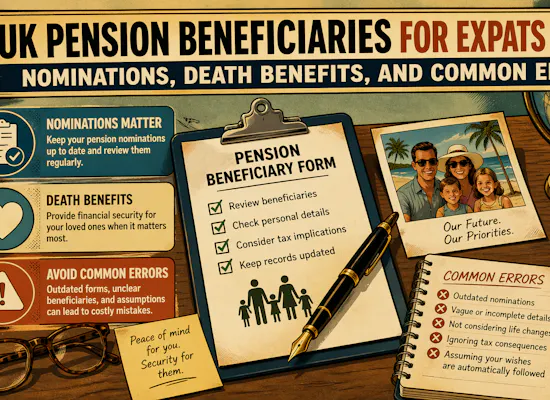
- beneficiary nominations
- death benefits
Tax position
Review:
- UK tax residence
- residence in your current country
- double-tax treaty treatment
- PAYE deduction process
- tax reclaim process
- temporary non-residence rules
- plans to return to the UK
- future country moves
Retirement income plan
Model:
- essential spending
- discretionary spending
- pension income
- State Pension
- defined benefit income
- investment withdrawals
- cash reserves
- inflation
- longevity
- investment volatility
- spouse income
- family support
Currency position
Identify:
- current spending currency
- future retirement currency
- pension currency
- investment currency
- property costs
- debts
- family support obligations
Estate planning
Review:
- beneficiary nominations
- will alignment
- spouse benefits
- children and dependants
- pension death benefit rules
- inheritance tax changes from 2027
- whether the family could access the information they need
You may also like
Conclusion
You can often take UK pension drawdown while living abroad.
But access is not the same as suitability.
The best drawdown strategy may involve regular income, occasional withdrawals, tax-free cash, a retirement bridge, an annuity, cash reserves or a combination of several approaches.
The answer depends on where you live now, where you will live later, how your pension is invested, what currency you need, how much income you need and whether you may return to the UK.
The key question is not:
Can I take drawdown abroad?
It is:
Will taking drawdown now make my retirement plan stronger?
If you are not sure how much pension drawdown to take, how it should be taxed, or how it fits with your wider retirement plan, book an introductory call with Josh Clancey.
FAQ
Can I access UK pension drawdown if I live abroad?
Usually, yes. Many UK pension schemes allow overseas members to access drawdown, subject to the scheme rules and normal pension access age.
Will my UK pension provider pay drawdown into an overseas bank account?
Some providers will, while others may require a UK bank account or have restrictions. Check your provider’s payment and residency rules before relying on a particular approach.
Is UK pension drawdown taxable in Dubai?
The UAE does not currently levy personal income tax on individuals. However, UK tax, treaty treatment and provider PAYE processes can still apply.
Can I take pension drawdown at 55 while living abroad?
In 2026, most people can normally access pension benefits from age 55. From 6 April 2028, the normal minimum pension age is scheduled to rise to 57 for most people.
Can I take pension drawdown abroad if I plan to return to the UK?
Potentially, but you should review temporary non-residence rules before making significant flexible withdrawals. In certain circumstances, relevant withdrawals can be taxed on return to the UK.
Is drawdown better than an annuity for expats?
Not automatically. Drawdown offers flexibility, while annuities offer certainty. The right answer depends on income needs, investment risk, tax, currency, health, spouse protection and estate planning.
How much pension drawdown is safe?
There is no universal safe percentage. A sustainable amount depends on age, total assets, spending, inflation, tax, investment strategy, future residence and other guaranteed income.