I Have a UK Pension and Live in Dubai. What Are My Options?
If you live in Dubai and still have a UK pension, you are not alone.
Many British expats in the UAE have old workplace pensions, personal pensions, SIPPs, defined benefit schemes, AVCs, or multiple small pension pots left behind in the UK.
Some know exactly what they have.
Many do not.
The problem is that moving to Dubai does not make your UK pension disappear. It also does not automatically mean you should transfer it, cash it in, ignore it, or move it offshore.
Your UK pension may still be one of your most important retirement assets.
The question is not:
Can I move my pension because I live overseas?
The better question is:
Which option gives me the best retirement outcome, after tax, charges, investment risk, currency, estate planning and future residence are considered?
That is where the decision becomes more complex.
If you live in Dubai, your main options are usually:
- leave the pension where it is
- consolidate pensions into a UK pension or SIPP
- transfer to an International SIPP
- transfer to a QROPS, where suitable and available
- take benefits from the pension when eligible
- use drawdown, annuity, lump sums or phased withdrawals
- review defined benefit transfer options, if relevant
- coordinate the pension with your wider retirement plan
The right answer depends on the pension type, your age, tax residence, future plans, charges, investment options, scheme guarantees and what you actually want retirement to look like.
People also ask
Can I keep my UK pension if I live in Dubai?
Yes. Moving to Dubai does not usually require you to move your UK pension. Many expats leave UK pensions in place, but they should still review charges, investment options, beneficiary nominations, retirement access and whether the scheme remains suitable.
Can I transfer my UK pension to a SIPP if I live in Dubai?
In many cases, yes. Some UK pension providers accept non-UK residents, while others restrict new accounts or transfers for overseas residents. A SIPP or International SIPP may give wider investment choice, flexible drawdown and consolidated administration, but it is not automatically the right answer.
Can I transfer my UK pension to a QROPS from Dubai?
Possibly, but QROPS transfers are more restricted than they used to be and can trigger tax charges if the rules are not met. HMRC guidance confirms that an overseas transfer charge can apply to certain transfers to qualifying recognised overseas pension schemes. The charge is 25% where it applies.
Is my UK pension taxed in the UAE?
The UAE does not currently levy personal income tax on individuals. However, UK tax and treaty rules still need to be considered. GOV.UK says you may be taxed on pension income by the country where you are resident, as well as by the UK, and a double-taxation agreement may affect where tax is paid.
Should I transfer my UK pension if I live in Dubai?
Not automatically. A transfer may improve flexibility, investment choice, currency options or administration. But it may also increase charges, lose guarantees, create tax issues or add complexity. The transfer should be justified by your retirement plan, not by the fact that you live overseas.
At a glance
- Living in Dubai does not mean you must transfer your UK pension.
- Your best option depends on pension type, charges, guarantees, investment choice, tax, currency and retirement goals.
- Defined contribution pensions, defined benefit pensions, SIPPs and QROPS should not be treated the same.
- UK tax-free lump sums are usually subject to UK pension rules, but local tax residence and future residence still matter.
- The UAE currently has no personal income tax, but UK and double-taxation treaty rules should still be checked.
- QROPS transfers can trigger a 25% overseas transfer charge if the conditions are not met.
- From 6 April 2027, most unused pension funds and death benefits are expected to be brought within the scope of UK inheritance tax.
- The right answer is rarely “transfer” or “do nothing”. The right answer is usually a structured pension review.
The short answer
If you have a UK pension and live in Dubai, you should first identify what type of pension you have.
That determines your real options.
A defined contribution pension is different from a defined benefit pension.
An old workplace pension is different from a modern SIPP.
A pension with guarantees is different from a basic investment pension.
A pension you plan to use in Dubai is different from a pension you plan to use after returning to the UK.
Before making any decision, you should review:
- pension type
- current value
- charges
- investment options
- performance
- retirement age
- guarantees
- transfer value
- death benefits
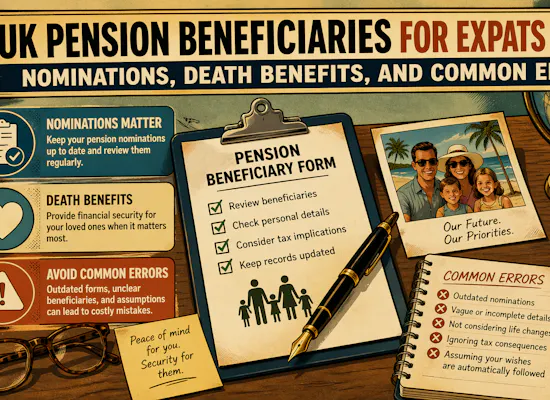
- beneficiary nominations
- access options
- tax position
- currency exposure
- future country of retirement
- whether the pension fits your wider financial plan
Only after that should you decide whether to leave it, consolidate it, transfer it, draw from it, or restructure it.
Option 1: Leave the pension where it is
Sometimes the best decision is to do nothing structurally.
That does not mean ignoring the pension.
It means keeping the existing pension after reviewing it properly.
Leaving the pension where it is may make sense if:
- charges are low
- investment options are suitable
- performance is reasonable
- the scheme has valuable guarantees
- the provider supports overseas members
- you do not need flexible drawdown yet
- the pension already fits your retirement plan
- transferring would add cost without clear benefit
This can be especially true for some occupational pensions or older schemes with protected features.
But “leave it where it is” should still be an active decision.
You should know:
- how the pension is invested
- what it costs
- what retirement options are available
- whether you can access it from overseas
- who is nominated to receive death benefits
- whether the provider has your current address
- whether online access and communication are working
- whether the pension matches your future currency needs
A pension can be left in the UK.
It should not be left forgotten.
Option 2: Consolidate old UK pensions
Many Dubai-based expats have several small pensions from previous UK employers.
Consolidation can make sense where it improves control, visibility, cost, investment choice and retirement planning.
Potential advantages include:
- fewer providers to manage
- clearer investment strategy
- easier beneficiary nomination review
- simpler drawdown planning
- potentially lower charges
- better online access
- more consistent currency and investment approach
But consolidation is not always right.
Before combining pensions, check whether any existing scheme has:
- guaranteed annuity rates
- protected tax-free cash
- protected pension age
- exit penalties
- defined benefit features
- with-profits guarantees
- loyalty bonuses
- employer-linked benefits
- valuable death benefits
The risk is that you transfer away from something valuable without realising it.
For expats, consolidation should not be a tidying exercise.
It should be a planning decision.
Option 3: Transfer to a UK SIPP or International SIPP
A SIPP, or Self-Invested Personal Pension, can offer more control and flexibility than some older pension arrangements.
An International SIPP may be designed for non-UK residents and internationally mobile clients.
Potential benefits may include:
- wider investment choice
- flexible drawdown
- clearer administration
- multi-currency investment options
- consolidated pension management
- online access
- adviser support
- beneficiary planning options
This can be useful for Dubai-based expats who want their pension aligned with a global investment strategy.
But a SIPP is not automatically better.
You need to compare:
- current pension charges
- SIPP platform costs
- adviser fees
- investment costs
- transfer costs
- available funds
- drawdown rules
- currency options
- pension protections
- death benefit treatment
- whether the provider accepts UAE residents
The key question is:
What problem is the SIPP solving?
If the answer is only “I live abroad”, that may not be enough.
If the answer is “I need better investment control, drawdown flexibility, currency options, clearer administration and a joined-up retirement income plan”, then it may be worth reviewing.
Option 4: Transfer to a QROPS
A QROPS is a Qualifying Recognised Overseas Pension Scheme.
Historically, QROPS were widely promoted to UK expats.
Today, they require much more careful analysis.
They may still be relevant in some cases, but they are not the default answer for someone living in Dubai.
Important issues include:
- overseas transfer charge
- scheme jurisdiction
- future country of residence
- tax treatment
- investment costs
- adviser costs
- regulatory protections
- pension access rules
- currency
- estate planning
- whether the scheme remains a QROPS
- what happens if you move country later
HMRC guidance confirms that transfers to a QROPS can be subject to the overseas transfer charge, and where it applies the charge is 25%.
That is a major risk.
A QROPS should usually only be considered where there is a clear planning reason and the tax position has been checked carefully.
The question is not:
Can I transfer to a QROPS?
The question is:
Why would a QROPS produce a better outcome than a UK pension, SIPP or International SIPP?
Option 5: Take your tax-free lump sum
If you are eligible to access your pension, you may be able to take tax-free cash under UK pension rules.
For many defined contribution pensions, up to 25% of the pension pot can usually be taken as a pension commencement lump sum, subject to the lump sum allowance and scheme rules.
But just because you can take it does not mean you should.
Your tax-free lump sum may be used for:
- debt repayment
- cash reserve
- retirement income bridge
- property purchase
- family support
- investment outside the pension
- relocation planning
- school fees
- estate planning
But it can also be wasted or taken too early.
For expats, there is an extra issue.
UK tax-free does not always mean tax-free everywhere. GOV.UK confirms that pension income may be taxed in the country where you are resident as well as by the UK, and that double-taxation agreements can affect where tax is paid.
Dubai residents may currently have a favourable local tax environment, but future moves can change the position.
Timing matters.
Option 6: Draw pension income while living in Dubai
If you are already at pension access age, you may be able to draw income from your UK pension while living in Dubai.
This could be through:
- flexi-access drawdown
- phased withdrawals
- UFPLS
- annuity
- defined benefit pension income
- a combination of lump sum and income
The tax position needs care.
The UK may withhold PAYE on pension income initially, and HMRC processes may be needed depending on the treaty position and provider approach.
For many UAE residents, the planning opportunity is that the UAE currently has no personal income tax. But the UK position, double-taxation agreement, provider processes, future residence and reporting should all be checked.
You should also consider:
- how much income is sustainable
- whether withdrawals are in GBP or another currency
- exchange-rate risk
- how pension income fits with other assets
- whether you may return to the UK
- whether you may move to a country that taxes pension income
- whether withdrawals affect estate planning
- whether large withdrawals create avoidable risks
The pension should not be treated like a bank account.
It is a retirement income asset.
Option 7: Buy an annuity
An annuity converts pension capital into guaranteed income, usually for life.
For some expats, this may be less attractive than drawdown because it reduces flexibility.
But it should not be dismissed automatically.
An annuity may be useful where someone wants:
- secure income
- less investment risk
- longevity protection
- simplicity
- income for a spouse
- reduced decision-making later in life
However, expats need to check whether annuity providers will accept their residence, bank details and personal circumstances.
You also need to consider:
- inflation protection
- spouse benefits
- guarantee periods
- currency
- health and lifestyle underwriting
- tax treatment
- loss of capital flexibility
- estate planning impact
Annuities are not right for everyone.
But for some retirement plans, guaranteed income has real value.
Option 8: Review a defined benefit pension carefully
Defined benefit pensions are different.
They promise a level of income based on scheme rules, usually linked to salary and service.
If you have a defined benefit pension, your options may include:
- leaving the pension in the scheme
- taking the scheme pension at retirement
- taking pension commencement lump sum plus reduced income
- transferring to a defined contribution arrangement
- reviewing spouse or dependant benefits
- checking inflation increases
- checking early or late retirement factors
Defined benefit transfers are high-risk and heavily regulated.
They may be suitable in some cases, but they should never be approached casually.
The value of a defined benefit pension is not just the transfer value.
It may include:
- guaranteed income
- inflation linkage
- spouse benefits
- scheme protections
- longevity protection
- reduced investment responsibility
A transfer may offer flexibility, death benefit control or currency/investment choice, but it may also give up valuable guarantees.
For a Dubai-based expat, the fact that you live abroad is not enough reason to transfer a defined benefit pension.
The decision needs detailed analysis.
Option 9: Review pension death benefits and estate planning
Pension planning is not only about retirement income.
It is also about what happens if you die.
This is especially important for expats with families across multiple countries.
You should review:
- expression of wish forms
- nominated beneficiaries
- spouse or dependant benefits
- death before age 75
- death after age 75
- whether children are minors
- whether trusts are relevant
- whether your will and pension nominations align
- whether your family knows where pensions are held
From 6 April 2027, the UK government has confirmed that most unused pension funds and death benefits will be brought within the value of a person’s estate for inheritance tax purposes.
That makes pension estate planning more important.
This does not mean pensions are suddenly bad.
It means the old assumption that pensions are always outside the inheritance tax calculation needs to be reviewed.
For Dubai-based expats with UK pensions, UK property, offshore assets and beneficiaries in different countries, this should be part of the pension review.
Option 10: Build a joined-up retirement income plan
This is the option that matters most.
Your UK pension should not be reviewed in isolation.
It should be connected to:
- cash savings
- offshore investments
- ISAs
- UK property
- business interests
- life insurance
- employer benefits
- State Pension
- spouse pensions
- future country of residence
- estate planning
- currency needs
- tax position
A Dubai-based expat may have income and assets in several currencies:
- AED income
- GBP pensions
- USD investments
- UK property
- EUR future retirement spending
- ZAR or AUD family support
That is why the answer is not simply “transfer” or “keep”.
The answer is a retirement strategy.
Five worked examples
Example 1: Multiple old workplace pensions
Sarah lives in Dubai and has four old UK workplace pensions worth £280,000 combined.
She has no idea how they are invested.
One has low charges and good fund options.
One has poor online access.
One has a protected feature.
One has high charges and limited investments.
The answer is not to consolidate everything automatically.
The answer is to review each pension, identify what should be kept, what could be transferred and what should not be touched.
Example 2: UK pension and future UK return
James has a £600,000 SIPP and lives in Dubai.
He plans to return to the UK in five years.
Taking large pension withdrawals in Dubai may appear attractive because the UAE has no personal income tax, but he needs to consider timing, UK tax residence, future income needs, exchange rates and whether withdrawals weaken his retirement plan.
The question is not whether Dubai is tax-efficient.
The question is how his pension withdrawals fit his full retirement timeline.
Example 3: Defined benefit pension
Mark has a defined benefit pension with a transfer value of £850,000.
He lives in Dubai and wants flexibility.
But the scheme offers inflation-linked income and spouse benefits.
A transfer could give more control, but it could also give up valuable guarantees.
This needs proper regulated advice.
Living abroad does not automatically make a transfer suitable.
Example 4: Large pension and estate planning
David is retired in Dubai with a £1.2 million pension, UK property and adult children in the UK.
From 2027, unused pension funds and death benefits are expected to be within the scope of inheritance tax.
David needs to review beneficiary nominations, drawdown strategy, spouse planning, UK property, liquidity and estate documents together.
The pension is not just a retirement asset.
It is now a major estate planning asset too.
Example 5: Expat unsure whether to use QROPS
Emma has been told that because she lives in Dubai, she should transfer to a QROPS.
That may or may not be right.
The review should compare:
- existing pension
- UK SIPP
- International SIPP
- QROPS
- charges
- tax
- overseas transfer charge
- currency
- drawdown
- death benefits
- future residence
A QROPS is not a default expat solution.
It is one possible option that needs to justify itself.
Self-diagnostic: is your UK pension Dubai-ready?
Score one point for each “yes”.
- I know exactly what type of UK pension I have.
- I know the current value of each pension.
- I know the charges on each pension.
- I know how each pension is invested.
- I know whether any pension has guarantees or protected features.
- I know my retirement access options.
- I know whether my provider supports overseas members.
- I know who is nominated to receive death benefits.
- I know how UK and UAE tax rules may affect withdrawals.
- I know whether a SIPP, International SIPP or QROPS would improve my position.
- I know how my pension fits with my wider retirement plan.
- I have reviewed the 2027 inheritance tax changes.
Green: 9 to 12 points
Your UK pension position may be reasonably well understood, although it should still be reviewed regularly and before major decisions.
Amber: 5 to 8 points
There may be gaps. You should review charges, investments, access options, tax, death benefits and retirement income planning.
Red: 0 to 4 points
Your UK pension may not be properly integrated into your Dubai-based financial plan. This should be reviewed as a priority.
Common mistakes
Assuming you must transfer because you live in Dubai
Problem
Many expats are told that moving abroad means they should move their pension.
Why it matters
A transfer may add cost, lose guarantees or create tax issues.
What to check
Compare the current pension against alternatives before moving anything.
Ignoring old workplace pensions
Problem
Old pensions are often left unmanaged.
Why it matters
They may have poor investments, old addresses, outdated beneficiaries or valuable guarantees.
What to check
List every pension and request current details.
Treating QROPS as the default answer
Problem
QROPS have historically been promoted heavily to expats.
Why it matters
Transfers can trigger tax charges and may not be better than a UK SIPP or International SIPP.
What to check
Ask exactly why QROPS is better in your case.
Taking tax-free cash without a plan
Problem
Tax-free cash feels attractive.
Why it matters
Taking it reduces the pension fund and may affect future income, estate planning and tax.
What to check
Give the lump sum a defined job before taking it.
Forgetting currency risk
Problem
Your pension may be in GBP, but your life may be in AED, USD or another currency.
Why it matters
Currency movement can affect spending power.
What to check
Match pension strategy to future spending currencies.
Ignoring estate planning
Problem
Pensions are often reviewed for income but not death benefits.
Why it matters
Beneficiary nominations, wills, trusts and inheritance tax rules can all interact.
What to check
Review pension death benefits alongside your estate plan.
What to review before making a decision
Pension type
Confirm whether you have:
- defined contribution pension
- defined benefit pension
- SIPP
- personal pension
- workplace pension
- AVC
- Section 32 policy
- pension with guarantees
Charges
Review:
- product charges
- platform charges
- fund charges
- adviser fees
- exit penalties
- transfer costs
- ongoing advice costs
Investment strategy
Check:
- asset allocation
- fund performance
- risk level
- currency exposure
- diversification
- drawdown suitability
- whether the investment strategy matches retirement timing
Tax position
Review:
- UK tax
- UAE tax
- double-taxation agreement
- future country of residence
- pension lump sums
- drawdown income
- State Pension
- inheritance tax
- death benefits
Currency
Ask:
- What currency is the pension invested in?
- What currency will I spend in retirement?
- Am I planning to return to the UK?
- Will I retire in Dubai, Europe, South Africa, Australia or somewhere else?
- Should some assets be aligned with future spending?
Estate planning
Review:
- expression of wish forms
- beneficiaries
- spouse benefits
- dependant benefits
- wills
- trusts
- guardianship
- death benefit taxation
- 2027 inheritance tax changes
What happens next
Step 1: Find every UK pension
Start by listing all pensions from previous employers, providers, advisers and platforms.
Step 2: Request full policy information
Ask for current value, charges, investment funds, transfer value, guarantees, death benefits, retirement options and beneficiary nominations.
Step 3: Categorise each pension
Separate pensions into:
- keep
- review further
- possible consolidation
- possible transfer
- do not transfer because of guarantees
Step 4: Build the retirement income plan
Work out what income you need, when you need it, in which currency, and from which assets.
Step 5: Compare options
Compare leaving the pension, consolidating, transferring to a SIPP, transferring to an International SIPP, considering QROPS, or drawing benefits.
Step 6: Review tax and estate planning
Check UK tax, UAE position, future residence, pension death benefits, inheritance tax and beneficiary planning.
Step 7: Act only when the reason is clear
Do not transfer, draw or restructure your pension until the planning reason is clear.
You may also like
Conclusion
If you have a UK pension and live in Dubai, your options are broader than simply “leave it” or “transfer it”.
You may be able to keep the pension where it is.
You may be able to consolidate old pensions.
You may be able to move to a SIPP or International SIPP.
You may be able to consider QROPS in limited circumstances.
You may be able to draw tax-free cash or retirement income.
You may need to review defined benefit guarantees.
You may need to update beneficiaries and estate planning.
But the right decision depends on your pension, your tax position, your future residence, your currency needs and your retirement goals.
The key question is not:
Can I move my UK pension?
The better question is:
Which pension option gives me the best retirement outcome as a Dubai-based expat?
If you live in Dubai and are not sure whether to leave, consolidate, transfer or draw from your UK pension, book an introductory call with Josh Clancey.
FAQ
Can I keep my UK pension if I live in Dubai?
Yes. You can usually keep a UK pension while living in Dubai. The question is whether the existing pension remains suitable for charges, investments, access, tax, currency and estate planning.
Can I transfer my UK pension to a SIPP while living in Dubai?
In many cases, yes, although provider rules vary. Some providers may not accept non-UK residents, while International SIPPs may be designed for expats.
Can I transfer my UK pension to Dubai?
Dubai itself is not usually where UK pensions are transferred. Some expats consider QROPS or International SIPPs, but these need careful review.
Is a QROPS better than a SIPP for Dubai expats?
Not automatically. QROPS can be useful in some circumstances, but charges, tax, overseas transfer rules, future residence and regulatory protections need careful comparison.
Will I pay UK tax on my pension if I live in Dubai?
This depends on the pension type, treaty position and HMRC processes. GOV.UK says double-taxation agreements can affect where pension tax is paid when you live abroad.
Can I take my UK pension tax-free in Dubai?
UK pension commencement lump sums may be tax-free under UK rules, subject to the lump sum allowance and scheme rules. But local tax residence and future residence should still be checked.
Should I transfer a defined benefit pension because I live overseas?
No. Living overseas is not enough reason on its own. Defined benefit pensions contain guarantees that may be valuable and should only be transferred after regulated advice.
What happens to my UK pension if I die in Dubai?
The pension scheme rules, beneficiary nominations, age at death, pension type and tax rules all matter. From 6 April 2027, most unused pension funds and death benefits are expected to be included in the estate for UK inheritance tax purposes.
How often should I review my UK pension as a Dubai expat?
At least every few years, and whenever you move country, change employer, approach retirement, consider withdrawals, transfer pensions, update your will, marry, divorce or have children.