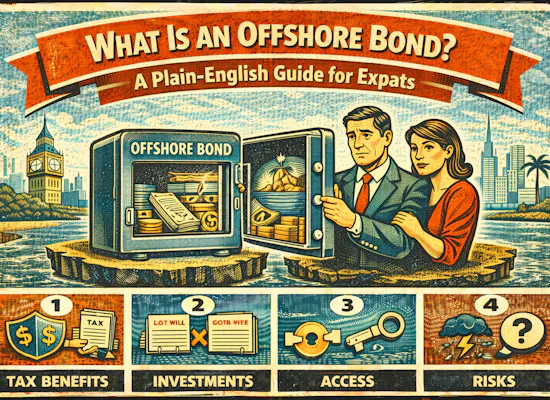
What Is an Offshore Bond? A Plain-English Guide for Expats (2026)
An offshore bond is a tax-efficient investment wrapper offered by international life insurance companies. It allows investors to hold a range of investments within a single structure while deferring tax on gains until withdrawals are made. Offshore bonds are commonly used by expats because they can simplify tax reporting, allow flexible investment portfolios, and support long-term international financial planning.
At a glance
- An offshore bond is an investment wrapper offered by international life insurance companies.
- The bond itself is not the investment. It holds underlying funds or portfolios.
- Offshore bonds allow tax deferral while investments grow inside the structure.
- They are commonly used by internationally mobile professionals.
- Investors can hold multiple funds inside a single bond.
- Withdrawals can be structured over time.
- The tax treatment depends on the investor’s country of residence.
- Offshore bonds can simplify reporting when living abroad.
- They are long-term planning tools rather than short-term investments.
People Also Ask
What is an offshore bond?
How do offshore bonds work for expats?
Are offshore bonds tax free?
What investments can be held inside an offshore bond?
Are offshore bonds a good investment for expats?
What are the disadvantages of offshore bonds?
How are offshore bonds taxed in the UK?
Can expats use offshore bonds?
What is an international investment bond?
Are offshore bonds regulated?
The investment structure many expats hear about but rarely understand
Offshore bonds are frequently mentioned in expat financial planning conversations, but many people are unsure what they actually are.
Some assume they are a specific investment. Others think they are a type of savings account or insurance policy.
In reality, an offshore bond is neither.
It is best understood as an investment wrapper. The wrapper holds underlying investments such as funds, ETFs, or managed portfolios.
What I often see with expats is that offshore bonds appear confusing at first because they combine several concepts at once: investments, tax deferral, and life insurance regulation.
Once you understand the structure, the concept becomes much simpler.
Understanding the basic structure of an offshore bond
An offshore bond is usually issued by an international life insurance company based in jurisdictions such as:
- Isle of Man
- Dublin (Ireland)
- Luxembourg
The investor contributes money into the bond.
That money is then invested in underlying assets chosen by the investor or their adviser.
These assets might include:
- global equity funds
- multi-asset portfolios
- managed portfolios
- ETFs or model portfolios
The bond itself simply acts as the legal structure that holds those investments.
This means the performance of the bond depends entirely on the underlying investments inside it.
Why expats in the Middle East often use offshore bonds
Offshore bonds are particularly common in expat financial planning for several reasons.
Many internationally mobile professionals move between jurisdictions throughout their careers. Managing investments across different tax systems can become complicated.
An offshore bond can sometimes simplify this.
Common reasons expats use offshore bonds include:
- tax deferral while investments grow
- simplified reporting when living abroad
- portability when relocating to another country
- access to internationally diversified portfolios
For example, a professional working in the UAE may hold investments inside an offshore bond while living in a zero-income-tax jurisdiction.
If they later move to another country, the tax treatment may change depending on the rules in that jurisdiction.
This is why offshore bonds should always be considered as part of broader cross-border planning.
Five worked examples with numbers
Example 1: UAE employed professional
Situation
A British professional living in Dubai invests £400,000.
The hidden risk
They assume the investment structure itself determines returns.
The numbers
If the portfolio grows at 5 percent annually, the investment could reach approximately £650,000 after ten years.
The planning logic
Investment returns depend on the underlying portfolio, not the wrapper.
A clean solution approach
Use an offshore bond to hold a diversified global portfolio.
Takeaway
The bond is simply the structure holding the investments.
Example 2: Business owner
Situation
An entrepreneur invests £1 million after selling part of their company.
The hidden risk
They need flexible withdrawals over time.
The numbers
If they withdraw £40,000 annually, they can structure withdrawals while investments remain invested.
The planning logic
Offshore bonds allow flexible withdrawal structures.
A clean solution approach
Use the bond as a long-term investment wrapper with planned withdrawals.
Takeaway
Offshore bonds can support structured withdrawals.
Example 3: Relocation scenario
Situation
An expat expects to move from Dubai to Europe within ten years.
The hidden risk
Different tax rules may apply when residency changes.
The numbers
Investment gains inside the bond may remain tax deferred until withdrawals occur.
The planning logic
Tax outcomes depend on residency at the time withdrawals are made.
A clean solution approach
Coordinate the investment structure with relocation plans.
Takeaway
Residency matters more than the bond itself.
Example 4: Estate planning scenario
Situation
A couple invests £800,000 in a long-term portfolio.
The hidden risk
They assume investments automatically pass efficiently to beneficiaries.
The numbers
Estate planning structures may affect how assets transfer.
The planning logic
Investment wrappers can be integrated with estate planning.
A clean solution approach
Review beneficiary planning alongside investment structures.
Takeaway
Offshore bonds are often used alongside estate planning.
Example 5: Wrong fit scenario
Situation
An investor plans to access the money within three years.
The hidden risk
Offshore bonds are generally designed for long-term investment.
The numbers
Charges and tax rules may reduce flexibility in the short term.
The planning logic
Investment structures should match time horizon.
A clean solution approach
Consider alternative structures for short-term goals.
Takeaway
Offshore bonds are not suitable for every situation.
Checklist: How to evaluate this properly
- Understand the underlying investments
- Review charges and fees
- Assess your investment time horizon
- Consider future residency changes
- Understand withdrawal rules
- Review tax treatment in your country of residence
- Check regulatory protection
- Ensure the structure fits your financial plan
What gets overlooked
- Investment strategy inside the bond
- Charges across different providers
- Tax rules when relocating
- Estate planning implications
- Currency exposure
- Withdrawal planning
How to stress test what you already have
- Review the underlying investment portfolio
- Check charges and adviser fees
- Confirm jurisdiction of the bond provider
- Review portability if you move countries
- Assess tax implications in future residency
- Confirm beneficiary arrangements
- Evaluate investment diversification
- Review the long-term strategy
Common mistakes
- Assuming offshore bonds are tax free
- Confusing the bond with the investment
- Ignoring underlying portfolio risk
- Choosing unsuitable investments
- Using the structure for short-term goals
- Not reviewing charges
- Ignoring residency tax rules
- Following marketing claims without analysis
- Failing to integrate with estate planning
- Not reviewing investments regularly
Common objections
Objection
“Offshore bonds are only for the very wealthy.”
Emotional logic
People assume international structures are complex.
Practical risk
Avoiding useful structures can limit planning flexibility.
Next step
Understand how the structure actually works.
Objection
“Offshore bonds are tax free.”
Emotional logic
The word offshore creates unrealistic expectations.
Practical risk
Tax treatment depends on residency and withdrawals.
Next step
Understand tax rules before investing.
Decision framework
- Define your investment time horizon
- Identify your residency plans
- Review investment strategy
- Evaluate tax treatment in your jurisdiction
- Compare charges and providers
- Consider estate planning implications
- Decide whether the structure supports your long-term plan
If you only do 3 things this week
- Understand what investments are inside the bond
- Review charges and fees
- Confirm tax treatment in your country of residence
Self diagnostic
Answer yes or no.
Do you understand what an offshore bond actually is
Do you know the investments held inside the bond
Do you understand the charges
Do you understand the tax rules in your jurisdiction
Is the investment time horizon long term
Do you review the investment strategy regularly
Do you understand withdrawal rules
Have you reviewed estate planning implications
Do you understand relocation risks
Do you review your financial plan regularly
Total possible points: 12
Green 9–12
Amber 5–8
Red 0–4
What to do next based on score
Green
Keep it boring and maintain annual reviews.
Amber
Stress-test, adjust funding, and simplify.
Red
Redesign the plan before time increases cost.
FAQ
Quick definitions
Offshore bond: an international investment wrapper offered by a life insurance company.
Investment wrapper: a legal structure that holds investments inside it.
Tax deferral: delaying tax until withdrawals occur.
What is an offshore bond?
An offshore bond is an investment wrapper that holds underlying investments such as funds or portfolios.
Are offshore bonds tax free?
No. Tax treatment depends on the investor’s country of residence.
What investments can be held inside offshore bonds?
Many offshore bonds can hold diversified investment portfolios including funds and managed portfolios.
Are offshore bonds suitable for expats?
They can be useful for internationally mobile investors but must be evaluated in the context of tax rules and long-term plans.
Are offshore bonds regulated?
Yes. Offshore bonds are issued by regulated life insurance companies in jurisdictions such as the Isle of Man or Ireland.
What happens next
Clarify objectives and liabilities
Identify your long-term investment goals and financial priorities.
Quantify gaps and constraints
Understand investment amounts, timelines, and risk tolerance.
Structure and documentation alignment
Ensure the investment structure aligns with tax and residency considerations.
Underwriting or implementation review
Evaluate suitable providers and investment portfolios.
Ongoing review triggers and cadence
Review investments regularly as residency and financial circumstances change.
Conclusion
Offshore bonds are often misunderstood because they combine investment and tax concepts within a single structure.
In simple terms, they are investment wrappers that can hold diversified portfolios while providing tax deferral.
For expats, they can sometimes simplify international financial planning.
However, the structure itself does not determine investment performance or tax outcomes. Those depend on the underlying investments and the investor’s residency.
Understanding how the structure works is the first step in deciding whether it fits into a long-term financial plan.
Review whether an offshore bond fits your financial plan
If you are living abroad and want to understand whether an offshore bond actually fits into your financial planning strategy, it is worth reviewing the structure before making decisions.
Many expats are introduced to offshore bonds without fully understanding how they work, how they are taxed, or how they fit within a wider financial plan.
If you would like to explore whether this structure makes sense for your situation, you can review your options here:
Review your investment strategy
Compliance note
This article is educational information and does not constitute financial advice.
You may also like
The best investment strategy for expats: simple, diversified, and portable
Retirement planning for expats: how to build income across borders
The biggest financial mistakes expats make before leaving the UK
References
https://www.moneyhelper.org.uk
https://www.fca.org.uk
About the Author
Josh Clancey, Chartered MSCI, DipPFS,CertPFS (Securities-DM), Cert CII (MP), EFA
Josh Clancey advises internationally mobile professionals across the Middle East, the United Kingdom, and the United States on pensions, investments, protection, and cross-border retirement planning.
Josh is a cross-border financial planner and Regional Head of Technical and Private Wealth Adviser at Skybound Wealth. Josh has authored articles for The National, Money Marketing, Financial Times and Lexis Nexis. Based in Dubai, he works primarily with globally mobile professionals, entrepreneurs, and senior executives who have financial interests spanning multiple countries.
Many of the people Josh advises have built wealth across different jurisdictions. This often includes UK pensions, US retirement accounts, international investments, property, and business interests, which means financial decisions must be coordinated carefully across different tax systems and regulatory frameworks.
Josh specialises in helping clients connect the moving parts of their financial lives so their plan remains clear, efficient, and resilient regardless of where they live or work in the future.
His work regularly involves advising on:
- UK pensions and retirement planning for expats
- cross-border financial planning
- international investment structuring
- life insurance and critical illness protection
- estate planning across jurisdictions
Through his website and by working at Skybound, Josh publishes practical guides designed to help expats understand the financial decisions that often become more complex once they live or work abroad.
His goal is simple: to help internationally mobile professionals make confident financial decisions and build retirement plans that work wherever life takes them.
Work with Josh
If you are an internationally mobile professional looking to review your pensions, investments, or retirement strategy across multiple jurisdictions, you can schedule a conversation here:
https://calendly.com/joshclancey