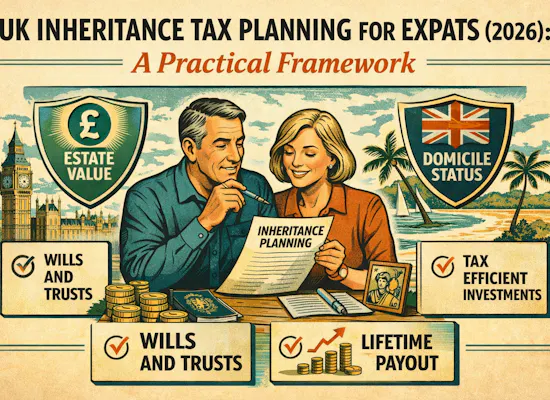
UK Inheritance Tax Planning for Expats (2026): A Practical Framework
UK inheritance tax planning for expats starts with four checks: where your assets sit, whether overseas assets are in scope under the post-6 April 2025 long-term UK residence rules, whether gifts still count, and whether your family would have cash to pay tax without a forced sale. The framework is practical before it is technical.
At a glance
- Start with exposure, not products or structures.
- UK-situs assets can stay inside UK inheritance tax even after you leave.
- Since 6 April 2025, overseas assets can also be in scope if you are a long-term UK resident for IHT purposes.
- The standard IHT rate is 40% above available allowances in many cases.
- The nil-rate band remains £325,000 and the residence nil-rate band remains up to £175,000, subject to conditions.
- Gifts can work, but only if they are genuinely given away and documented properly.
- Good IHT planning is as much about liquidity and executability as tax reduction.
- Pension planning now also needs a 2027 lens, because most unused pension funds and death benefits are due to come into scope for IHT from 6 April 2027, while registered death-in-service benefits are set to remain outside.
People Also Ask
- Does UK inheritance tax apply if I live abroad?
- What triggers UK inheritance tax for expats in 2026?
- Are overseas assets caught by UK IHT after leaving the UK?
- How do gifts work for UK expats and inheritance tax?
- Will pensions still sit outside inheritance tax?
- How should UAE-based expats plan for UK IHT properly?
The expensive part is usually not the tax
The most common mistake I see is treating inheritance tax like a purely technical problem to solve later. It is rarely just that. For expats, the real damage often comes from a chain of smaller failures: wrong assumptions about what is in scope, gifts that were never truly effective, outdated beneficiary nominations, and not enough cash in the right place when the family needs it.
I’m Josh, a financial planner specialising in expats in the Middle East. I join the dots across pensions, investments, tax, currency, insurance, and estate planning. I’m authorised to advise across the Middle East, the UK and the USA, framed around continuity when families move.
Here is the balanced view. Not every expat needs aggressive IHT planning. If your estate is modest, most of your wealth sits in clean pension structures, and your family situation is simple, the answer may be basic housekeeping rather than elaborate structuring. But if you have UK property, meaningful non-pension wealth, gifts, trusts, or a likely return to the UK, doing nothing is often a planning decision in disguise.
The practical framework is simple.
- Identify what is exposed to UK IHT now.
- Separate UK-situs assets from overseas assets.
- Check whether overseas assets are in scope under the long-term UK residence rules from 6 April 2025.
- Review gifts, trust history, and whether you still benefit from anything you say you gave away.
- Test liquidity, because the tax is one problem and the cashflow is another.
That approach sounds basic. In practice, it is where most of the value sits.
Why expats in the Middle East need to think differently
A UK-resident family with UK assets and UK executors has one kind of IHT problem. A British family in Dubai with UK property, UAE cash, offshore investments, and children or heirs in more than one country has a different one.
What I see in practice is that Middle East expats often have stronger savings power and weaker default estate coordination. High earnings can create big non-pension balances quickly. Those balances may sit in AED, USD, GBP and investment platforms across jurisdictions. That creates a planning issue before you even get to tax.
The rules matter too. The standard IHT rate remains 40%, the nil-rate band remains £325,000, and the residence nil-rate band remains up to £175,000 where the conditions are met. Unused nil-rate band and unused residence nil-rate band can also transfer between spouses or civil partners, which is why some couples can pass up to £1 million free of IHT if the structure and residence conditions line up.
The post-6 April 2025 change is the part many expats still underestimate. For IHT, the system moved from a domicile-based approach to a long-term UK residence framework. Broadly, if you have been UK resident for at least 10 out of the previous 20 tax years, overseas assets may be in scope, and there can still be a tail after you leave. The length of that tail varies with your residence history.
That means “I left the UK, so my overseas assets are outside IHT” is no longer a safe shortcut.
Five worked examples with numbers
Situation
A 47-year-old British in-house lawyer in Dubai owns a London flat worth £900,000 with a £250,000 mortgage, holds £600,000 in UAE and offshore investments, and has £750,000 in UK pensions.
The hidden risk
She assumes the pensions solve the estate issue and the UK property is just one line on the balance sheet.
The numbers
UK property net equity is £650,000. Her non-pension assets outside the UK total £600,000. If her overseas assets are out of scope but the UK property remains exposed, there may still be a material UK IHT bill depending on ownership, allowances and spouse position. At a 40% headline rate above allowances, a bad liquidity setup can still create a six-figure cash demand.
The planning logic
The first job is not a product recommendation. It is confirming what is inside the estate, what is outside, and where the family would get sterling liquidity.
A clean solution approach
Map UK-situs assets, confirm ownership structure, update pension nominations, and ring-fence accessible GBP liquidity rather than assuming the family can sell property smoothly under pressure.
Takeaway
For a UAE-employed expat, the tax problem and the liquidity problem are often different problems.
Situation
A 55-year-old law firm partner with a UAE holding company has £2.8 million of investable wealth outside pensions and expects to retire back to the UK in five years.
The hidden risk
He believes offshore assets are permanently outside UK IHT because he currently lives abroad.
The numbers
If he satisfies the long-term UK residence test for IHT, his non-UK assets may still be exposed even while abroad, or remain exposed for a tail period after departure. On £2.8 million, even partial unexpected exposure is too large to leave untested.
The planning logic
For partners and owners, timing matters. Residence history, planned return date and asset location can all affect whether a pre-return planning window exists.
A clean solution approach
Build a residence timeline, stress-test return scenarios, review trust history, and avoid assuming that offshore equals excluded.
Takeaway
Business owners and partners usually need timeline planning, not just asset planning.
Situation
A British couple in Abu Dhabi gave £400,000 to two adult children over the last six years to help with deposits and school fees for grandchildren.
The hidden risk
They think “we gifted it, so it has gone”.
The numbers
Potentially exempt transfers can fall out of account after seven years, but gifts still need evidence and can fail if they are not genuine or if the donor still benefits. Regular gifts from surplus income can also be exempt, but only if they form part of normal expenditure, come from income rather than capital, and leave the donor with enough income to maintain their usual standard of living.
The planning logic
The problem is often documentation. Families know what they intended, but the estate later cannot prove it cleanly.
A clean solution approach
Keep a gift log, preserve bank evidence, document regularity for surplus-income gifts, and stop calling something a gift if you still control it.
Takeaway
Relocation does not remove the need to evidence lifetime planning properly.
Situation
A widowed expat in Bahrain has a £1.4 million estate, including a UK property, offshore portfolio and cash, but most liquidity is in AED accounts and the will is old.
The hidden risk
The estate may be solvent but operationally weak.
The numbers
Even where allowances soften the final bill, a family can still face probate delays, valuation costs, legal fees and tax deadlines. If the estate needed to raise even £150,000 to £250,000 quickly, having most liquidity in the wrong jurisdiction or currency could create avoidable stress.
The planning logic
Estate or liquidity planning is often the missing layer in IHT conversations.
A clean solution approach
Update wills, align beneficiaries, create an executor pack, and hold enough accessible liquidity in the currency most likely to be needed first.
Takeaway
An estate can look wealthy and still be fragile.
Situation
A 38-year-old single expat in Doha has £350,000 in pensions, £110,000 in cash and investments, no children, no property, and no likely taxable estate issue today.
The hidden risk
Friends tell him he needs complex trust and insurance planning now.
The numbers
On these facts, the real planning need is basic nomination hygiene, a will if appropriate, and a future review trigger if wealth, relationship status or UK property exposure changes.
The planning logic
This is the wrong fit for elaborate IHT planning today.
A clean solution approach
Keep records clean, review after major life changes, and do not buy complexity before the estate warrants it.
Takeaway
Not every expat needs a structure. Many need a framework and a calendar reminder.
A practical inheritance tax planning framework for expats
How it works in practice
Start with four buckets: UK-situs assets, overseas assets, pension assets, and anything already gifted or settled. Then test each bucket against current IHT rules, not against old assumptions.
The key moving parts
The standard IHT threshold remains £325,000. The residence nil-rate band remains up to £175,000 where a qualifying residence passes to direct descendants, and it tapers away for estates above £2 million. Spouse and civil partner transfers are often central, and unused nil-rate band and residence nil-rate band can often transfer to the survivor.
From 6 April 2025, whether your overseas assets are in scope depends on the long-term UK residence framework rather than the old IHT domicile test. Broadly, if you have been UK resident for at least 10 out of the previous 20 tax years, you may be a long-term UK resident for IHT, and there may be an after-you-leave tail before overseas assets fall out of scope.
Gifts still matter. Potentially exempt transfers can work if you survive seven years. Regular gifts out of surplus income can be exempt without a seven-year wait, but only when the conditions are properly met and evidenced. Taper relief can reduce tax on certain chargeable gifts if death is more than three years later, but people often overestimate how much that solves.
Trusts remain useful in the right cases, but they are not a universal answer. Since 6 April 2025, foreign settled property and excluded property treatment also interact with long-term UK residence status in a way that needs proper review.
Trade-offs
The more control you keep, the less likely planning is to work as intended. The more aggressive the structure, the more administration and ongoing review it usually needs. The cleaner route is often slower and less glamorous: orderly gifting, proper documentation, aligned nominations, and enough liquidity.
What can go wrong
People forget the residence timeline. They keep benefiting from gifted assets. They assume pensions are permanently outside IHT without checking the upcoming 2027 position. They build something tax-aware but family-unfriendly. Or they leave planning so late that the only options left are expensive, constrained, or medically underwritten.
When it is not suitable
If your estate is modest, your wealth is concentrated in pension assets, and your family situation is simple, full-scale IHT planning may be disproportionate. In those cases, basic estate coordination may produce more value than a sophisticated tax structure.
Checklist: How to evaluate this properly
- Build an asset map by jurisdiction, owner and wrapper.
- Separate pension wealth from non-pension wealth.
- Review your UK residence history over the last 20 tax years.
- Check whether your estate is relying on the residence nil-rate band and whether the conditions really apply.
- Keep a documented gift register, not a vague family memory.
- Test whether the survivor would have cash access within 30 to 90 days.
- Review wills alongside beneficiary nominations rather than as separate projects.
- Re-test the plan before any move back to the UK.
- Check whether your current plan still works if pensions enter the IHT conversation from April 2027.
What gets overlooked
- UK property can stay exposed long after people mentally “leave” the UK.
- The wrong executor can make a decent plan slow and expensive.
- AED liquidity does not automatically solve a GBP tax bill.
- Family loans are often undocumented and create confusion on death.
- Gifts to children can be tax-efficient but administratively weak.
- A second marriage or blended family can quietly change everything.
- Joint ownership can help or hinder depending on the asset and the objective.
- Trusts that are never reviewed can drift from solution to problem.
- The best tax answer can still be the wrong family answer.
How to stress-test what you already have
- Portability if you move from UAE to UK or elsewhere
- Jurisdiction risk across UK, UAE and offshore holdings
- Beneficiary alignment on pensions, insurance and investment accounts
- Currency risk if liabilities are likely to arise in GBP
- Charges and drag inside wrappers and structures
- Documentation quality and where originals are kept
- Counterparty risk on banks, platforms, trustees and insurers
- Review cadence at least annually
- Residence history evidenced clearly enough for future executors
- Gift evidence and whether any reservation of benefit exists
- Trust deeds and letters of wishes still reflecting reality
- Liquidity available without forced sale
- Pension strategy reviewed in light of the announced 2027 IHT change
- Family understanding of who does what after death
Common mistakes
- Assuming non-residence ends UK IHT.
Why it matters: UK assets can remain exposed, and overseas assets may still be in scope under long-term UK residence rules. - Thinking the nil-rate band changed materially in 2026.
Why it matters: planning based on the wrong threshold distorts decisions. The main bands remain £325,000 and up to £175,000 for the residence nil-rate band. - Assuming gifts always work after seven years.
Why it matters: poor evidence or retained benefit can wreck the plan. - Leaving UK property unreviewed.
Why it matters: it is often the asset that keeps families inside the IHT conversation. - Ignoring survivor liquidity.
Why it matters: tax efficiency is not enough if the family cannot access cash. - Treating wills as the whole estate plan.
Why it matters: nominations, ownership and practical authority often matter just as much. - Forgetting trust administration after setup.
Why it matters: stale structures create drift and future friction. - Failing to update spouse and family assumptions.
Why it matters: transfer rules and exemptions depend on facts, not intentions. - Assuming pensions can be ignored forever.
Why it matters: most unused pension funds and death benefits are due to come into scope for IHT from 6 April 2027. - Waiting until repatriation.
Why it matters: planning windows often narrow once residence changes and time pressure arrives.
Common objections
Objection
“I live in Dubai now, so UK inheritance tax is not my issue.”
Emotional logic
Distance feels like disconnection.
Practical risk
UK assets can still be in scope, and overseas assets may not be automatically outside the net under the post-2025 rules.
Next step
List assets by situs first, then test residence history.
Objection
“My estate is mostly outside the UK.”
Emotional logic
Overseas location sounds protective.
Practical risk
That may be wrong if you meet the long-term UK residence test for IHT.
Next step
Build a 20-year residence timeline before concluding anything.
Objection
“I’ll just gift assets to the children.”
Emotional logic
Gifting feels straightforward and generous.
Practical risk
It only works if the gift is real, documented and not still enjoyed by you.
Next step
Review every large gift against evidence and ongoing benefit.
Objection
“My will deals with all of this.”
Emotional logic
A signed document feels complete.
Practical risk
Wills do not fix beneficiary errors, liquidity gaps or cross-border execution friction.
Next step
Review wills, nominations and account access as one system.
Objection
“My pensions are outside inheritance tax.”
Emotional logic
That used to be a comforting rule of thumb.
Practical risk
From 6 April 2027, most unused pension funds and death benefits are due to come into scope for IHT, so old assumptions may age badly.
Next step
Add a 2027 pension review to your estate planning timetable.
Objection
“Trusts are only for the very wealthy.”
Emotional logic
Trusts sound expensive and overcomplicated.
Practical risk
Some families ignore useful options because they only see extremes.
Next step
Assess the job first, then the structure. Sometimes the answer is a trust. Sometimes it is not.
Objection
“I will deal with it if we move back.”
Emotional logic
Later feels easier.
Practical risk
A return to the UK often reduces flexibility and increases urgency.
Next step
Model the pre-return and post-return position now.
Objection
“This is all tax planning. My family will work it out.”
Emotional logic
The family feels adaptable.
Practical risk
Most of the pain lands on survivors through delay, confusion and forced decisions.
Next step
Create an executor pack and a liquidity plan, not just a tax idea.
Decision framework
- Identify every asset and liability by owner and jurisdiction.
- Separate UK-situs assets from overseas assets.
- Confirm your likely IHT exposure under current long-term UK residence rules.
- Review spouse position, nil-rate band use and residence nil-rate band conditions.
- Audit all gifts, loans, trusts and retained benefits.
- Review pension nominations and the 2027 IHT implications.
- Model liquidity needs for the first year after death.
- Decide whether the answer is gifting, restructuring, trust planning, insurance, better documentation, or simply keeping the plan clean.
- Re-test the framework after any move, marriage, divorce, birth, inheritance or business exit.
If you only do 3 things this week
- Build a one-page asset map by country, owner and wrapper.
- Write out your last 20 tax years of UK residence history.
- List every material gift and whether you still benefit from any of it.
Self-diagnostic
Give yourself 1 point for each yes. Total possible points: 12.
- Do you know which of your assets are UK-situs?
- Do you know your UK residence history for the last 20 tax years?
- Have you checked whether overseas assets may still be in scope for IHT?
- Do you know the current nil-rate band and residence nil-rate band rules?
- Have you reviewed whether your estate could actually use the residence nil-rate band?
- Do you keep a proper log of gifts and family loans?
- Have you checked whether you still benefit from anything you gifted away?
- Are your wills and beneficiary nominations aligned?
- Do your executors or family know where the key documents are?
- Do you have liquidity in the right jurisdiction and currency?
- Have you reviewed pensions in light of the announced 2027 change?
- Do you review the estate plan at least annually?
Green 9–12
Amber 5–8
Red 0–4
What to do next based on score
Green
Keep it boring and maintain annual reviews.
Amber
Stress-test, adjust funding, and simplify.
Red
Redesign the plan before time increases cost.
FAQ
Quick definitions
Nil-rate band: the standard amount chargeable to IHT at 0%, currently £325,000.
Residence nil-rate band: an extra allowance of up to £175,000 when a qualifying home passes to direct descendants, subject to conditions.
Long-term UK resident: the post-6 April 2025 IHT test based on UK residence history, replacing the old IHT domicile basis for overseas assets.
Potentially exempt transfer: a lifetime gift that can fall out of IHT if the donor survives seven years.
Excluded property: certain property outside the UK IHT net, subject to detailed rules.
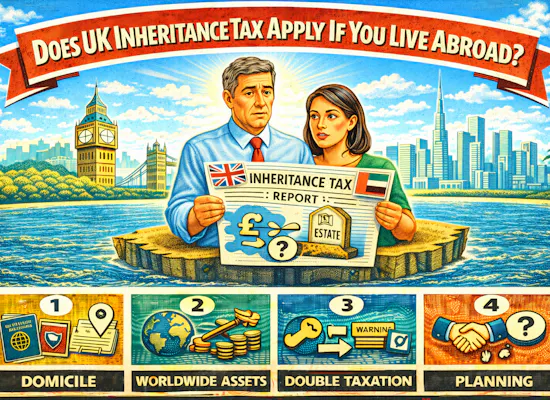
Does UK inheritance tax still apply if I live abroad?
Yes, it can. Living abroad does not automatically switch off UK inheritance tax. UK-situs assets can remain in scope even if you have left the UK, and overseas assets may also be relevant under the long-term UK residence rules from 6 April 2025. For expats, the right question is not where you live now. It is what assets you hold, where they sit, and what your residence history looks like.
What is the UK inheritance tax rate in 2026?
The standard rate is 40%. That rate usually applies to the part of the taxable estate above available allowances and exemptions. The important planning point is that the headline rate is only one part of the picture. Ownership, spouse position, reliefs, gifts and liquidity all affect the real outcome. Families often focus on the rate when the actual issue is scope and execution.
What are the main IHT allowances for expats in 2026?
The core allowances remain the same. The nil-rate band is £325,000 and the residence nil-rate band is up to £175,000 where the conditions are met. For married couples and civil partners, unused allowances can often transfer to the survivor. That is why some estates can still reach a combined £1 million before IHT becomes payable, but only if the residence and family conditions are actually satisfied.
How do the long-term UK residence rules affect expats?
They matter more than many people realise. From 6 April 2025, IHT exposure on overseas assets moved to a residence-based framework for long-term UK residents. Broadly, if you have been UK resident for at least 10 of the previous 20 tax years, your overseas assets may still be in scope, and there can be a tail after you leave. That is why older “non-dom” shorthand no longer works cleanly for IHT planning.
Are gifts still an effective IHT planning tool for expats?
Yes, but only when used properly. Potentially exempt transfers can still move value out of the estate if you survive seven years. Regular gifts out of income can also be very powerful. The catch is evidence. Gifts need to be genuine, and income-based gifting needs a clear pattern, income source and proof that your own standard of living remained intact. Bad records often ruin otherwise sensible planning.
What is “normal expenditure out of income”?
It is a useful but often misunderstood exemption. Gifts can be exempt if they form part of your normal expenditure, come from income rather than capital, and leave you enough income to maintain your usual standard of living. This is attractive for affluent expats helping children or paying education costs, but it needs documentation. HMRC looks for pattern and evidence, not family intention alone.
Do UK pensions still sit outside inheritance tax?
For 2026 planning, usually yes, but that is no longer the end of the conversation. The government has confirmed that most unused pension funds and death benefits are due to come into scope for IHT from 6 April 2027. Registered death-in-service benefits are intended to remain outside scope. So pensions are still important, but expats should stop assuming the current treatment lasts unchanged forever.
Do I need a trust for inheritance tax planning?
Not always. Trusts can be useful where control, family protection, timing or specific tax objectives justify them. They are not a universal answer and they do bring administration, complexity and review obligations. For some expats, systematic gifting and cleaner beneficiary planning achieve more with less friction. The right question is what problem the trust is solving and whether that problem genuinely exists.
Does owning UK property keep me inside IHT?
Often yes. UK property is one of the clearest reasons expats remain exposed to UK inheritance tax. Even when other wealth is offshore, a UK home or buy-to-let can keep part of the estate firmly inside the UK IHT conversation. That is why many expat estates are “partly simple, partly not”. The property is usually the asset that stops casual assumptions from working.
Can I rely on my will to solve inheritance tax problems?
No, not on its own. A will is important, but it does not replace asset-location planning, beneficiary nominations, trust review, or liquidity management. In many cross-border estates, the operational pain point is not legal intention. It is access. Who can act, who can pay, and how quickly money can move usually matters just as much as the tax result itself.
What should UAE-based expats prioritise first?
Start with clarity. Build an asset map, confirm UK residence history, list gifts and loans, and check how much liquidity the family could access quickly in GBP if needed. After that, review wills, nominations and any trust arrangements. Many UAE-based expats jump too quickly to structures. In practice, the biggest gains usually come from fixing visibility, documentation and sequencing before tax engineering.
When is complex IHT planning not worth it?
When the estate is still relatively modest, family circumstances are straightforward, and most wealth sits in pension assets with clean nominations. In those cases, a complicated structure can create more cost and admin than value. The better route may be simple estate coordination, regular gifting where appropriate, and annual reviews. Complexity should be earned by the facts, not by anxiety.
What happens next
Clarify objectives and liabilities
Decide whether the real objective is reducing tax, improving family control, increasing liquidity, protecting children, or preparing for a future return to the UK.
Quantify gaps and constraints
Work out what is exposed now, which assumptions depend on residence history, and where the plan breaks under time pressure.
Structure and documentation alignment
Make sure wills, nominations, ownership, gifts, loans and trust documents point in the same direction.
Underwriting or implementation review
Review whether insurance, trust administration, asset restructuring or gifting programmes are actually practical and proportionate.
Ongoing review triggers and cadence
Revisit the plan annually and after any move, marriage, divorce, birth, inheritance, health event or business exit.
Conclusion
For expats, inheritance tax planning is rarely about finding one magic structure. It is about building a plan that still works when life has crossed borders, currencies, wrappers and legal systems.
The real risk is not just paying tax. It is leaving your family with an avoidable mix of tax, delay, poor liquidity, outdated documents and unclear authority at exactly the worst time.
A practical framework fixes that. Know what is exposed. Understand the post-2025 residence rules. Clean up gifts and nominations. Plan liquidity before the estate needs it. Then review the whole system before any move changes the answer again.
If you want a second opinion on whether your current estate plan is actually fit for purpose across borders, book a call. I help expats connect tax, pensions, investments, insurance, currency and estate planning into one joined-up strategy before small planning gaps become expensive family problems.
Compliance note
This is general information, not personal financial, tax or legal advice. Inheritance tax outcomes depend on residence history, asset location, family structure, ownership, and the exact rules in force when action is taken or death occurs.
You may also like
UK IHT for Expats Explained: Triggers and First Checks
Nil Rate Band and Residence Nil Rate Band for Expats (2026)
Estate Planning for Expats (2026): Wills, Guardianship, Assets