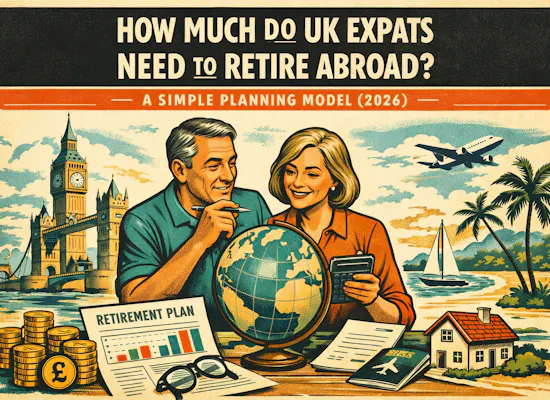
How Much Do UK Expats Need to Retire Abroad? A Simple Planning Model (2026)
Most UK expats should start with annual spending, subtract secure income like State Pension, then gross up for tax, fees, inflation and currency risk. The remaining income gap can be converted into a target capital figure using a cautious withdrawal rate. That gives you a planning number, not a promise.
At a glance
- Start with spending, not with your pension pot.
- Build two budgets: essential and lifestyle.
- Subtract secure income first.
- Add tax, fees, inflation and FX friction back in.
- Convert the remaining gap into capital using a cautious drawdown rate.
- Stress-test for relocation, health costs, and survivor income.
- Review annually, and again before any move.
People Also Ask
- How much income do UK expats need to retire abroad in 2026?
- Is £500,000 enough for a UK expat to retire overseas?
- Do UK expats get the full State Pension abroad?
- How should UAE residents calculate retirement income in GBP and AED?
- What withdrawal rate is realistic for expats retiring abroad?
- How do taxes and currency affect a UK expat retirement plan?
The number is rarely one number
The biggest mistake I see is people asking, “What pot do I need?” before asking, “What life am I trying to fund?” I’m Josh, a financial planner specialising in expats in the Middle East. I join the dots across pensions, investments, tax, currency, insurance, and estate planning. I’m authorised to advise across the Middle East, the UK and the USA, framed around continuity when families move.
A simple planning model works well, but only if you accept that retirement abroad is a moving target. The goal is not perfection. The goal is to get to a number that is robust enough to survive inflation, market falls, moves between countries, and a few bad decisions.
For most UK expats, the model is this:
- Work out annual spending in the country you expect to retire in.
- Split that into essential spending and discretionary spending.
- Subtract secure income such as State Pension, DB pensions, rental surplus, or annuities.
- Add back friction costs such as tax, adviser fees, fund costs, and currency conversion losses.
- Convert the remaining annual gap into a target capital figure.
As a rough planning guide, many expats use a 3.5% to 4.0% drawdown range for flexible portfolios. At 4%, a £40,000 annual income gap implies about £1,000,000 of investable capital. At 3.5%, the same gap implies roughly £1,143,000. That gap between “possible” and “prudent” matters.
Why expats in the Middle East need to think differently
A UK-based retirement model often breaks down once you live in Dubai, Abu Dhabi, Doha or Riyadh for a decade and then retire somewhere else.
What I see in practice is that expats in the Gulf often have stronger earnings, weaker default pension structures, and more cross-border complexity. You may have UK pensions, UAE cash, USD investments, a property in Britain, school fee obligations for younger children, and parents in another country who may need support later.
Three issues make the difference.
First, your future spending currency may not match your asset currency. A couple who save heavily in GBP but retire in Portugal or Thailand will feel FX moves differently from someone staying in the UAE. AED, GBP and USD interact in ways that can either cushion or increase pressure.
Second, portability matters more than performance. A product that looks acceptable while you are in the UAE can become awkward if you move back to the UK, head to Europe, or need cleaner reporting for a future tax return.
Third, secure income is often overestimated. The full new UK State Pension for 2026/27 is £241.30 a week, or about £12,548 a year. Helpful, yes. Enough on its own, rarely. Also, annual increases depend on where you live. Some countries receive uprating, some do not.
Five worked examples with numbers
Situation
A 46-year-old British solicitor in Dubai wants to retire at 60 in Spain. She expects one-person retirement spending of £36,000 a year in today’s terms.
The hidden risk
She assumes her current savings rate is enough because her salary is high.
The numbers
Projected full State Pension from 67: £12,500 a year. Personal pension at 60: £420,000. ISA and offshore investments by 60: £310,000. Total investable assets at retirement: £730,000. Income gap before State Pension age: £36,000 a year. At 4%, she would need £900,000. At 3.5%, around £1,029,000.
The planning logic
She is close, but not there yet, especially for the seven-year bridge before State Pension starts.
A clean solution approach
Increase savings by £2,500 a month, target 8% nominal growth assumptions with caution, and ring-fence three years of planned withdrawals in lower-volatility assets by age 58.
Takeaway
High income does not remove the maths. Timing between retirement age and pension age is often the real gap.
Situation
A 52-year-old UAE business owner plans to retire at 62, split between Dubai and the UK, with household spending of £85,000 a year.
The hidden risk
He counts business sale proceeds before they exist.
The numbers
Current pensions: £600,000. Investment accounts: £450,000. UAE business estimated value: £1.8 million, but illiquid. Rental net income: £18,000 a year. His target gap after rent is £67,000. At 3.5%, required capital is about £1.91 million. Excluding the business, he has £1.05 million.
The planning logic
He is not underfunded if the business exits well. He is underprepared if the sale is delayed, discounted, or taxed differently than expected.
A clean solution approach
Build a pre-exit retirement floor from pensions and liquid assets alone. Treat the business as upside until heads of terms are signed.
Takeaway
For partners and owners, liquidity matters more than spreadsheet net worth.
Situation
A British couple, both 58, plan to leave Abu Dhabi and return to the UK at 63. They want £52,000 a year after tax.
The hidden risk
They assume UAE tax-free thinking continues after repatriation.
The numbers
Combined pensions and investments: £1.25 million. Expected two State Pensions from 67: about £25,000 a year combined if full records are achieved. Required income from capital at 63 to 67: £52,000 a year. From 67 onwards, gap falls to roughly £27,000. Capital may be sufficient, but only if withdrawal sequencing and tax timing are managed properly.
The planning logic
Their retirement is affordable, but the move changes tax treatment, allowance planning, and portfolio structure.
A clean solution approach
Start repatriation planning 12 to 18 months before moving. Review residency, wrappers, asset location, and whether withdrawals should happen before or after UK tax residence resumes.
Takeaway
Relocation risk is not just emotional. It changes the after-tax value of the same portfolio.
Situation
A 64-year-old widower in Bahrain has £900,000 in pensions and investments and wants to help two adult children while keeping his own retirement secure.
The hidden risk
He has income assets but weak estate liquidity and outdated beneficiary nominations.
The numbers
His own spending need is £42,000 a year. State Pension covers £12,500. Remaining gap is £29,500. At 4%, capital needed is about £738,000. On paper he is fine. But most of the assets are invested for growth, and there is no immediate liquidity plan on death or incapacity.
The planning logic
A retirement plan can look healthy while the estate plan is fragile.
A clean solution approach
Update beneficiary forms, create a cross-border will review, keep a cash reserve for administration costs, and stress-test survivor access to accounts.
Takeaway
Retirement sufficiency and family executability are not the same thing.
Situation
A 41-year-old UK expat in Doha wants to retire at 50 with £70,000 a year and currently has £280,000 invested.
The hidden risk
He is using an aggressive online calculator and assuming 8% real returns.
The numbers
At a 4% withdrawal rate, he would need £1.75 million. At 3.5%, £2 million. Even with £6,000 monthly contributions for nine years, he is unlikely to reach that safely without a major lifestyle adjustment or later retirement.
The planning logic
This is the wrong fit for early retirement right now.
A clean solution approach
Reframe the goal to partial financial independence at 50, full retirement at 57 to 60, or reduce target spending materially.
Takeaway
A plan is still useful when the answer is “not yet.”
A simple retirement abroad planning model for UK expats
How it works in practice
Take your annual spending target in the retirement country, add a contingency line, subtract secure income, and divide the remainder by a cautious withdrawal rate.
The key moving parts
Country of retirement. Age you stop working. Age secure pensions begin. Tax rate on withdrawals. Currency of spending. Inflation. Platform and fund costs. Family support. Healthcare. Housing.
Trade-offs
Higher spending needs more capital. Lower withdrawal rates improve resilience but increase the target number. More guaranteed income reduces portfolio pressure but usually reduces flexibility.
What can go wrong
Using today’s UAE cost base for a future UK or European retirement. Forgetting inflation. Counting inheritances or business sale proceeds too early. Ignoring sequence risk in the first decade. Forgetting that retirement often comes in phases, not one flat spending line.
When it is not suitable
If most of your wealth is tied up in a business, if you expect a major inheritance, if your retirement country is undecided, or if you have complex DB transfer or US tax exposure, a simple model needs upgrading.
Checklist: How to evaluate this properly
- Build two budgets, not one: baseline and preferred.
- Separate bridge years before State Pension starts.
- Test the plan in the currency you will actually spend.
- Include property maintenance, travel back to family, and private healthcare.
- Check whether your retirement country uprates the UK State Pension.
- Model survivor income for the first death, not just joint life.
- Review beneficiary nominations separately from your will.
- Treat employer benefits as temporary unless contractually guaranteed.
What gets overlooked
- End of service gratuity is often spent mentally before it is received.
- Cash held in one currency can quietly distort risk.
- Children may still be financially dependent in your early retirement years.
- Provider servicing can worsen after relocation.
- Tax reporting can become harder after a move even if tax itself stays low.
- A paid-off home does not remove all housing costs.
- Large one-off expenses matter more than average monthly budgeting.
- Retirement abroad can later become retirement somewhere else.
How to stress-test what you already have
- Portability across future jurisdictions
- Jurisdiction risk of each wrapper
- Beneficiary alignment on every pension and policy
- Currency risk against future spending
- Charges at product, fund and advice level
- Documentation and asset mapping
- Counterparty risk and provider strength
- Review cadence at least annually
- Liquidity for 2 to 3 years of spending
- Tax treatment on withdrawal, not just on growth
- Survivor income adequacy
- Healthcare and long-term care assumptions
Common mistakes
- Using gross income instead of net spending need.
Why it matters: the gap looks smaller than it is. - Assuming 25% tax-free cash solves the plan.
Why it matters: it may create a short-term cushion, not a lifelong income solution. - Ignoring inflation after age 75.
Why it matters: retirement often lasts longer than people model. - Overweighting property.
Why it matters: yield, liquidity and maintenance risk can all disappoint. - Treating State Pension as guaranteed at the same real value everywhere.
Why it matters: location affects uprating. - Not checking National Insurance record.
Why it matters: missing years can reduce valuable secure income. - Leaving scattered pensions untouched.
Why it matters: poor visibility leads to poor decisions. - Counting business equity as retirement cash.
Why it matters: valuation is not liquidity. - Forgetting spouse or partner planning.
Why it matters: one death can break a “jointly affordable” plan. - Chasing returns to close a savings gap.
Why it matters: risk cannot reliably replace discipline.
Common objections
- Objection
“I’ll sort this out five years before retirement.”
Emotional logic
Retirement still feels far away.
Practical risk
Late fixes are expensive because contribution time, tax years and compounding have already been lost.
Next step
Build the first version now, even if it is rough. - Objection
“My property will cover it.”
Emotional logic
Property feels tangible and safe.
Practical risk
Liquidity, vacancy, repair costs and tax can all reduce usable income.
Next step
Model net income after costs, not estate-agent optimism. - Objection
“I’ll just work longer.”
Emotional logic
Future earning power feels like a safety net.
Practical risk
Health, burnout or redundancy may decide otherwise.
Next step
Plan for optional work, not required work. - Objection
“The State Pension will do most of it.”
Emotional logic
A guaranteed income feels reassuring.
Practical risk
It often covers only a portion of the target, and may not fully uprate abroad.
Next step
Check your NI record and use the actual forecast. - Objection
“I don’t know where I’ll retire yet.”
Emotional logic
Why plan when the destination is unclear?
Practical risk
Indecision delays wrapper, tax and currency decisions.
Next step
Model three likely destinations and use the highest required number. - Objection
“My adviser or provider will tell me when I’m ready.”
Emotional logic
Delegation feels efficient.
Practical risk
Not all providers do cross-border cashflow planning properly.
Next step
Ask for a written retirement income model with assumptions. - Objection
“I earn enough, so I’m probably fine.”
Emotional logic
High income creates confidence.
Practical risk
Lifestyle inflation often grows faster than retirement assets.
Next step
Measure savings rate against target gap. - Objection
“This is too complicated.”
Emotional logic
Complexity creates avoidance.
Practical risk
Unmanaged complexity compounds.
Next step
Start with one page: assets, liabilities, spending, secure income.
Decision framework
- Define your likely retirement locations.
- Set annual essential and preferred spending.
- Confirm when each secure income stream starts.
- Calculate the income gap before and after pension age.
- Translate the gap into capital using a prudent range.
- Stress-test tax, inflation, FX and market falls.
- Review structure, wrappers and beneficiary nominations.
- Decide whether the answer is save more, spend less, work longer, or derisk smarter.
If you only do 3 things this week
- Check your State Pension forecast and NI record.
- Write down your likely retirement spending in one currency.
- List every pension, investment account and beneficiary nomination in one place.
Self-diagnostic
Give yourself 1 point for each “yes”. Total possible points: 12.
- I know my likely retirement country or shortlist.
- I know my annual retirement spending target.
- I have separated essential from discretionary spending.
- I know when my State Pension starts.
- I have checked my NI contribution record.
- I know the current total value of all pension pots.
- I know the charges on my main retirement assets.
- I know the currency I will spend in.
- I have modelled at least one market downturn.
- My beneficiary nominations are current.
- My spouse or family could find every key document.
- I review the plan at least once a year.
Green 9–12
Amber 5–8
Red 0–4
What to do next based on score
Green
Keep it boring and maintain annual reviews.
Amber
Stress-test, adjust funding, and simplify.
Red
Redesign the plan before time increases cost.
FAQ
Quick definitions
State Pension: the UK government pension based on your National Insurance record.
Drawdown: taking flexible income from invested pension assets.
Secure income: income that is contractually or state-backed, such as State Pension or DB pension.
Withdrawal rate: the percentage of capital you draw each year to fund spending.
FX risk: the risk that currency moves reduce your real spending power.
Is £500,000 enough for a UK expat to retire abroad?
Sometimes, but only for lower spending targets. A pot of £500,000 may support around £17,500 to £20,000 a year under a cautious drawdown range before tax, depending on charges and portfolio design. That can work if housing is already sorted and State Pension later covers part of the gap. It is much less likely to work for a couple expecting frequent travel or private healthcare.
How much annual income should a single UK expat target in retirement?
It depends on lifestyle and location, but a useful starting range is £25,000 to £45,000 a year. UK retirement benchmarks suggest wide variation between minimum, moderate and comfortable living. For expats, the right number changes with rent, healthcare, and travel back to family. Start with your own budget, then compare it to those broad lifestyle anchors.
How much should a couple retiring abroad aim for?
Many couples underestimate spending because they assume every cost halves when shared. Some do, many do not. A practical planning range is often £40,000 to £70,000 a year for a comfortable but not extravagant retirement, excluding major care costs. Travel, housing, healthcare and family support tend to explain most of the difference between “fine” and “tight”.
Do UK expats get the full State Pension abroad?
Yes, if they qualify, but annual increases depend on where they live. You can claim the UK State Pension overseas if you have sufficient National Insurance history. The important catch is uprating. Some countries receive annual increases and some do not. That is why the same State Pension can hold value well in one location and gradually erode in another.
What is a reasonable withdrawal rate for expats retiring abroad?
For planning, 3.5% to 4.0% is a sensible working range for many flexible portfolios. Lower rates usually give more resilience, especially where retirement could last 30 years or more. A higher rate may still work in some cases, but it leaves less room for inflation, poor early returns, or currency shocks. It is a guide, not a guarantee.
Should UK expats budget in pounds or local currency?
Budget in the currency you expect to spend. That keeps the plan honest. You can still translate back into GBP for pension decisions, but the first draft should reflect real-life spending power. For Middle East expats, this often means thinking in AED now and GBP or EUR later. That transition is exactly where many plans become distorted.
Is the UK State Pension enough on its own for retirement abroad?
Usually not. The 2026/27 full new State Pension is about £12,548 a year. That can be a useful foundation, especially for couples with two full entitlements, but it rarely covers a full retirement lifestyle on its own. It works best as the secure base layer under private pensions, investments, rental income or part-time work.
Should I include property in my retirement number?
Yes, but carefully and only in the right category. Your main home may reduce housing costs, but it does not automatically create spendable income. Buy-to-let property can contribute if you use net income after voids, tax, repairs and management costs. Property value by itself is not retirement income. Liquidity matters as much as market price.
How do I plan if I might move back to the UK later?
Model the return before it happens. A move back to the UK can change tax treatment, reporting, wrapper suitability and the spending line itself. What looked efficient in the UAE may become less clean after repatriation. In practice, I would build a current-country version and a repatriation version, then compare the two before any irreversible decisions.
Is early retirement realistic for UK expats in the Gulf?
Often yes, but not automatically. Higher Gulf earnings can accelerate retirement funding, especially when taxes are lower and savings discipline is good. The problem is that high income often brings high spending and delayed decision-making. Early retirement usually works for people who save intentionally, control lifestyle inflation, and build portable structures well before they need them.
What happens if markets fall just after I retire?
This is one of the biggest risks. Poor returns in the first few retirement years can permanently damage a drawdown plan because you are selling assets while prices are weak. The usual answer is not panic. It is better planning: keep a liquidity reserve, avoid over-withdrawing, and make sure essential spending does not rely entirely on volatile assets.
How often should I review my retirement abroad plan?
At least annually, and whenever life changes materially. A relocation, promotion, divorce, inheritance, business sale, child starting university, or major market move should all trigger a review. What I see in practice is that annual reviews keep small issues small. Miss three or four years, and the course correction usually becomes much more expensive.
What happens next
Clarify objectives and liabilities
Decide where you may retire, what lifestyle you want, and what obligations continue.
Quantify gaps and constraints
Measure the income gap honestly and identify what could block the plan.
Structure and documentation alignment
Make sure pensions, investments, beneficiaries and estate documents actually work across borders.
Underwriting or implementation review
Check whether any insurance, wrapper, provider or transfer decisions are still suitable.
Ongoing review triggers and cadence
Review annually and after any move, exit, inheritance, health event or major tax change.
Conclusion
The question is not really “How much do I need?” It is “How much do I need for the life I want, in the place I am likely to end up, after friction, tax and time have taken their share?”
For UK expats, the cost of getting retirement planning wrong is rarely obvious at the start. It usually shows up later through tax drag, weak portability, avoidable currency risk, poor sequencing, or a plan that no longer works once your family or residence changes.
The right approach is not to chase a perfect forecast. It is to build a retirement plan that is clear, portable and resilient enough to work across borders.
If you already have pensions, investment accounts or legacy structures in place, the next step is to review whether they still fit where you live now, where you may retire later, and what income they can realistically deliver.
If you want help pressure-testing your current plan, get in touch. I help expats in the Middle East and globally mobile families connect pensions, investments, tax, currency, insurance and estate planning into one joined-up strategy, so you can make decisions with more clarity and fewer expensive mistakes.
Compliance note
This is general information, not personal financial, tax or legal advice. Cross-border retirement outcomes depend on your residence, domicile, asset structure, pension type and timing.
You may also like
Can I retire?
Pension transfers: what expats should know
Moving from UAE to UK
Estate planning for expats 2026: wills, guardianship, cross-border assets