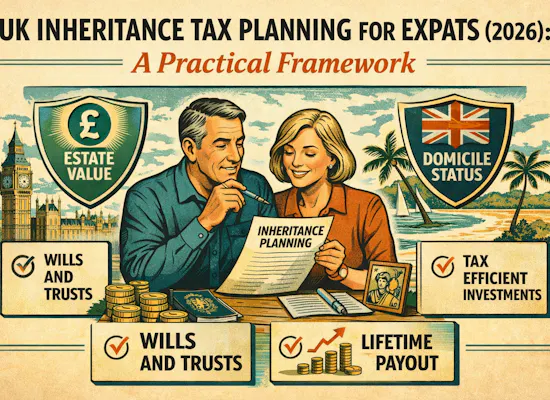
UK IHT for Expats Explained (2026): What Triggers It and What to Check First
UK inheritance tax can still apply after you leave the UK. In 2026 the key triggers are UK-situs assets, your status under the post-6 April 2025 long-term UK resident rules for overseas assets, and common anti-avoidance rules like gifts with reservation. First check your UK ties history, asset location, gift history, beneficiary planning, and liquidity for tax.
At a glance
- UK assets can remain within UK IHT regardless of where you live.
- Since 6 April 2025, overseas assets can be in scope under long-term UK resident rules.
- Leaving the UK does not necessarily switch IHT off immediately.
- Gifts can still be dragged back into IHT via the 7-year rule and reservation-of-benefit rules.
- Pensions and beneficiary planning can be a major IHT and liquidity lever.
- UK property ownership structure affects control, probate friction, and survivorship outcomes.
- Currency and liquidity planning matters because IHT is usually due quickly.
- The first step is a clean asset map and a timeline of residence, gifts, and intentions.
People Also Ask
Does UK inheritance tax apply if I live abroad?
What triggers UK inheritance tax for expats in 2026?
Do UK assets stay within IHT if I’m non-resident?
How long after leaving the UK can I still be caught by IHT?
Are gifts made while abroad subject to UK IHT?
Do I need a UK will or a UAE will for IHT planning?
UK IHT for expats in 2026: why people get caught
If you are a UK expat, inheritance tax is one of the easiest risks to misunderstand because it feels like a UK-only problem.
Many people assume: “I’m not UK resident, so UK inheritance tax is not my issue.”
In practice, IHT is triggered by a mixture of asset location, your UK history, and anti-avoidance rules that are designed to stop “simple” workarounds.
I’m Josh, a financial planner specialising in expats in the Middle East. What I see in practice is that IHT problems are rarely caused by one big mistake. They are caused by a chain of small assumptions:
- you keep UK property and think it is just “a home base”
- you make gifts but continue to benefit from the assets
- you assume pensions sit outside everything without checking nominations and death benefit direction
- you do not plan liquidity, so the family has to sell assets at the worst moment
- you rely on a will, but the real bottleneck is access and executability across borders
Balanced judgement upfront: you do not need “complex IHT planning” if your estate is modest and your assets are mainly pensions with clean beneficiaries. But you do need to understand what triggers IHT and what to check first, because the cost of ignoring it is usually paid by your family, not you.
What triggers UK IHT for expats in 2026
This is the simplest way to frame it:
- UK-situs assets can keep you in scope
- Overseas assets can be pulled into scope under long-term UK resident rules introduced from 6 April 2025
- Gifts and anti-avoidance rules can drag assets back into your estate
- The practical trigger is often liquidity, not law
Let’s unpack each.
UK-situs assets: the always-on trigger
Some assets are UK-situs, meaning the UK can have a claim to IHT on those assets regardless of where you live.
In plain English: leaving the UK does not magically detach UK assets from UK tax.
For most expats, the biggest UK-situs items are:
- UK property
- certain UK investments and bank accounts
- business interests with UK situs characteristics
Even if overseas assets end up outside the UK net, UK assets are often still in it.
Overseas assets and the long-term UK resident rules
From 6 April 2025, HMRC guidance explains that the IHT scope for non-UK assets moved from a domicile-based approach to a long-term UK resident approach. Under this framework, overseas assets can be subject to IHT if you meet the long-term residence conditions, and there can be a “tail” period after you leave the UK. (This is a big change in how many expats have historically thought about IHT.)
References are at the bottom.
For 2026 planning, the practical takeaway is:
- You must know your UK residence history over the relevant lookback period.
- You must know whether you fall into a category where overseas assets can be pulled into IHT.
- You must understand that leaving the UK does not necessarily remove overseas assets from scope immediately.
This matters most for:
- high earners who lived in the UK for a long time before moving to the UAE
- people who leave in their 40s or 50s with significant overseas investment portfolios
- families with multi-jurisdiction assets (UK property, UAE banking, offshore investments, US accounts)
Gifts: the “7-year rule” is not the whole story
Gifts are a core IHT planning tool, but expats often over-simplify them.
Yes, the 7-year rule and the concept of potentially exempt transfers matter.
But common “expat traps” include:
- making a gift then continuing to benefit from the asset (gift with reservation of benefit)
- gifting an asset but effectively retaining control or enjoyment
- gifting property but still using it rent-free when you visit the UK
- using informal arrangements that look like gifts but behave like retained ownership
The pattern that causes pain is simple: the gift is real in your mind, but not real in HMRC’s eyes because you still benefit.
Pensions: often outside the estate, but not outside the plan
Pensions are a major lever in expat estate planning because many UK pensions can fall outside the estate for IHT purposes and can be directed via beneficiary nominations.
The trap is assuming “pensions are automatically outside IHT” and then never checking:
- beneficiary nominations
- expression of wish forms
- whether you have multiple schemes with different nominations
- whether your estate planning and pensions point to the same people
- whether the family has liquidity while waiting for benefits to be processed
In practice, good pension governance can reduce IHT exposure and massively improve executability, but only if it is maintained.
Why expats in the Middle East need to think differently
UK expats in the UAE and wider Middle East face three IHT realities that are different to a UK-resident family:
- Asset location becomes fragmented
You might have UK property, UK pensions, UAE cash, offshore investments, and perhaps assets in another country where you previously worked. The IHT risk is not just a number, it is the complexity of execution. - Liquidity can be in the wrong place
IHT is a cash tax. If the family’s liquidity is mainly in UAE accounts but the taxable assets are UK-situs, you can create a timing and transfer problem at exactly the wrong moment. Currency also matters: if liabilities are GBP and cash is AED, you want a deliberate plan. - Cross-border execution is slower
Probate, banking, and provider processes take longer when the family is overseas. Delays create forced sales and poor decisions. The “best” IHT plan is often the one that makes things easy for the survivor, not the one with the fanciest structure.
Five worked examples with numbers
Example 1
Situation
A British couple move to Dubai. They own a UK buy-to-let worth £650,000 with a £250,000 mortgage, and have £900,000 in investment accounts outside the UK. Total UK pensions are £700,000. They assume IHT is now “not relevant”.
The hidden risk
UK property remains a UK-situs asset and can create IHT exposure. The bigger risk is liquidity. The mortgage does not remove IHT. The estate may still owe tax but have limited GBP liquidity.
The numbers
- UK property value: £650,000
- Mortgage: £250,000
- Net equity: £400,000
- Non-UK investments: £900,000
- Pensions: £700,000
- Assume taxable estate exposure in the UK includes at least the UK-situs property equity and some UK assets. If the net taxable estate for IHT purposes were £500,000 after allowances, 40% is £200,000.
- If the family’s liquid GBP outside pensions is only £50,000, the funding gap forces borrowing or selling.
The planning logic
The first problem is not optimisation. It is mapping what is in scope and planning liquidity in the right currency.
A clean solution approach
- Build an asset map by situs and ownership.
- Confirm pension nominations so pensions can provide fast liquidity if needed.
- Build a GBP liquidity buffer aligned to likely tax and property costs.
Takeaway
IHT planning fails when the family cannot access cash quickly in the right currency.
Example 2
Situation
A long-term UK resident leaves for the UAE in 2026 with £3m of overseas investments and assumes those overseas assets are outside UK IHT forever.
The hidden risk
Under the post-6 April 2025 framework, overseas assets can remain within scope under long-term residence rules and for a period after leaving. The risk is assuming “overseas assets equal outside UK IHT” without checking the long-term resident position.
The numbers
- Overseas investments: £3,000,000
- If overseas assets were within IHT scope and the taxable amount above allowances were £2,500,000, 40% is £1,000,000.
- Even if this is reduced through exemptions and planning, the scale of exposure is large enough that the first step must be clarity.
The planning logic
For high-net-worth expats, the risk is misunderstanding the new scope rules and planning from the wrong baseline.
A clean solution approach
- Review UK residence history against the long-term resident definition and “tail” logic.
- Create a multi-year plan: what changes over time after leaving.
- Use pensions, gifting strategy, and ownership structures with a joined-up approach rather than ad hoc moves.
Takeaway
The biggest IHT mistake is planning from an assumption that is no longer true.
Example 3
Situation
A family gift a UK property to adult children before leaving the UK, but continue to use it for holidays rent-free when visiting.
The hidden risk
This is a classic gift-with-reservation pattern. The asset can be treated as still part of the parents’ estate because they continued to benefit.
The numbers
- Property gifted: £800,000
- If treated as still in the estate, potential IHT at 40% can be £320,000, subject to allowances and other factors.
- The family believes they “solved IHT” but created a bigger future dispute and tax risk.
The planning logic
A gift is only effective if you genuinely give up benefit, or you structure it correctly.
A clean solution approach
- Avoid informal “gift but still use it” arrangements.
- If gifting property, plan the ongoing usage properly.
- Document intention and structure with professional advice.
Takeaway
The reservation-of-benefit rules catch people who make gifts that are not real in practice.
Example 4
Situation
A UAE-based couple have £1.5m in UK pensions with outdated beneficiary nominations, and the rest of the wealth is in UAE cash and an offshore portfolio. They believe pensions will “look after the family” in a crisis.
The hidden risk
Pensions can be powerful, but only if nominations are correct and the provider processes are understood. If nominations point to an ex-spouse, or if documentation is missing, death benefit processing can be delayed.
The numbers
- UK pensions: £1,500,000
- Family monthly spend in UAE: AED 45,000
- Six-month continuity reserve needed: AED 270,000
- If pension death benefits take 4 months to process and the family has only AED 50,000 accessible liquidity, the family is forced into poor short-term decisions.
The planning logic
Executability and liquidity are part of estate planning. The will is not enough.
A clean solution approach
- Update nominations across every scheme.
- Build an executor pack with provider contacts and policy numbers.
- Hold a continuity reserve across more than one access route.
Takeaway
Pension governance is a first-order IHT and family resilience lever.
Example 5
Situation
A 30-year-old expat reads about IHT and immediately builds complex trust structures despite having a £450,000 total estate, most of which is pension wealth and a modest UK property share.
The hidden risk
This is the wrong fit scenario. Complexity becomes the risk, fees increase, and the plan becomes harder to maintain. The real priority should be beneficiaries, wills, ownership structure, and liquidity.
The numbers
- Total wealth: £450,000
- Pension proportion: £250,000
- UK property share: £150,000
- Other assets: £50,000
- The likely immediate IHT exposure may be low depending on allowances and structure. The bigger benefit comes from governance and executability.
The planning logic
The right plan matches the scale of the problem.
A clean solution approach
- Prioritise beneficiary alignment, a clean will plan, and documentation.
- Use complexity only if the estate size and goals justify it.
Takeaway
Most expats need clarity and governance before they need structures.
UK IHT for expats in 2026: how to approach it in practice
How it works in practice
A high-quality IHT plan for an expat is usually built in this order:
- Clarify scope
What is potentially in scope, based on asset location and long-term residence status? - Map ownership and beneficiaries
Who owns what, how it passes, and whether pensions and policies point to the right people. - Plan liquidity
How the tax and costs are paid without forced selling. - Apply planning tools
Gifting, trust strategies where appropriate, pension strategy, and ownership adjustments.
If you skip step 1 and start with “solutions”, you risk building the wrong plan.
The key moving parts
Allowances and bands
IHT is applied after allowances. The nil rate band and residence nil rate band can be relevant depending on your family and property position. The practical point is that allowances interact with asset structure and who inherits.
Spouse and civil partner planning
Spousal exemptions can remove IHT on transfers between spouses, but only if correctly structured and documented, and if the recipient’s own IHT position is also planned.
Gifting strategy
Gifts can work, but timing and benefit retention matters. “Give it away but still use it” is the trap.
Property ownership
How UK property is owned can affect:
- survivorship
- who controls the asset
- probate friction
- how the estate is administered
Pensions and beneficiary governance
For many expats, the single highest ROI step is to:
- consolidate scattered pensions where appropriate
- update nominations
- align pension strategy with the estate plan and family cashflow needs
Relocation and repatriation risk
Your long-term plan must tolerate moving again and potentially returning to the UK. A structure that only works for “UAE forever” can become brittle.
Trade-offs
- Keep UK property vs simplify: UK property can preserve optionality but increases UK situs exposure and admin friction.
- Gifting early vs maintaining control: gifting reduces future estate size but you must genuinely give up benefit.
- Complex structures vs maintainability: complex plans fail when they are not reviewed and kept current.
- Tax optimisation vs family resilience: the best plan is often the one that keeps the survivor stable, not just the one that minimises theoretical tax.
What can go wrong
- Planning based on outdated domicile assumptions instead of the post-6 April 2025 framework.
- Gifts that are pulled back into the estate because benefit was retained.
- Pensions and wills pointing to different people.
- Not enough liquid cash to pay tax and costs on time.
- Cross-border admin delays forcing rushed asset sales.
When it is not suitable
You should not rely on a generic article if you have:
- a large estate and multiple jurisdictions
- business ownership, partnerships, or family investment companies
- complex trust history
- US connections or multiple citizenships
- significant gifting already done without documentation
Checklist: How to evaluate this properly
- Do I know which assets are UK-situs and which are not?
- Do I know whether overseas assets could be within scope under long-term UK resident rules?
- Have I mapped ownership, survivorship, and beneficiaries across all major assets?
- If I died tomorrow, how would my spouse access cash within weeks?
- Are there gifts in the last 7 years, and did I retain any benefit?
- Do my wills, pension nominations, and insurance nominations align?
- If I keep UK property, do I have a liquidity plan for IHT and costs?
What gets overlooked
- People plan the tax but not the liquidity, and liquidity is what breaks families.
- “Pensions are outside the estate” becomes a lazy assumption that masks outdated nominations.
- UK property ownership structure is often misunderstood, especially for blended families.
- Expats underestimate how long cross-border admin takes.
- Families optimise for the UAE today and ignore likely future moves.
- Gifts are often informally done without clear records, valuations, or intention notes.
How to stress-test what you already have
- Portability: does the plan still work if you move again or return to the UK?
- Jurisdiction risk: what changes if another country taxes inheritance differently?
- Beneficiary alignment: do pensions, policies, and wills point to the same outcomes?
- Currency risk: do you have GBP liquidity for UK costs and tax, not only AED cash?
- Charges: are you paying for complexity you will not maintain?
- Documentation: can your executor find every account, policy, and key document quickly?
- Counterparty risk: will providers service and pay out smoothly to overseas beneficiaries?
- Review cadence: do you review nominations, wills, and asset map annually?
- Liquidity: can the estate pay IHT and costs without forced selling?
- Property risk: does UK property create admin and tie risk that undermines other goals?
Common mistakes
- Assuming leaving the UK switches IHT off.
Why it matters: UK assets can remain in scope and overseas assets may be in scope under long-term resident rules. - Planning from old domicile rules without checking the post-6 April 2025 framework.
Why it matters: your baseline assumption may be wrong. - Not building an asset map by situs and ownership.
Why it matters: you cannot manage what you cannot see. - Making gifts but keeping the benefit.
Why it matters: assets can be dragged back into the estate. - Treating the 7-year rule as the only gifting rule.
Why it matters: reservation-of-benefit and other rules can override. - Outdated pension beneficiary nominations.
Why it matters: pensions may pay to the wrong people or be delayed. - No liquidity plan in GBP for UK tax and costs.
Why it matters: IHT is usually time-sensitive and can force sales. - Overcomplicating structures too early.
Why it matters: complex plans fail when they are not maintained. - Ignoring cross-border execution friction.
Why it matters: overseas families face slower admin and more provider checks. - Treating property as “just an investment” without estate execution planning.
Why it matters: property can be the hardest asset to administer and fund.
Common objections
Objection
“Leaving the UK means IHT is no longer my problem.”
Emotional logic
You want a clean break from UK rules.
Practical risk
UK assets can remain in scope, and overseas assets may still be in scope depending on your UK history.
Next step
Map assets by situs and confirm your long-term residence position before assuming anything.
Objection
“I’m in the UAE, so inheritance tax does not exist.”
Emotional logic
No local income tax makes it feel like a tax-free life.
Practical risk
UK IHT is about UK rules and assets, not UAE income tax.
Next step
Treat the UAE as your operating base, but stress-test UK-situs exposure and liquidity.
Objection
“I’ve written a will, so I’m done.”
Emotional logic
A will feels like a completed tick-box.
Practical risk
Executability depends on beneficiaries, asset location, and liquidity, not just the will document.
Next step
Align nominations, create an executor pack, and ensure cash access for the survivor.
Objection
“Pensions are outside IHT, so we don’t need to review them.”
Emotional logic
You want a simple rule that reduces admin.
Practical risk
Outdated nominations and slow processing can create the worst possible timing problem for the family.
Next step
Review beneficiary nominations across every pension and consolidate where it improves control.
Objection
“I’ll just gift the UK house to the kids and still use it.”
Emotional logic
You want to keep the lifestyle benefit while reducing tax.
Practical risk
Gift-with-reservation rules can bring the asset back into your estate.
Next step
Do not use informal arrangements. Get advice and structure the plan properly.
Objection
“We’re not wealthy enough for IHT planning.”
Emotional logic
You want to avoid complexity and cost.
Practical risk
The first steps are governance and executability, which are valuable at most wealth levels.
Next step
Start with asset mapping, beneficiaries, and liquidity, then decide if deeper planning is needed.
Objection
“Complex trusts are the only real solution.”
Emotional logic
You assume sophistication equals safety.
Practical risk
Complexity increases maintenance risk and can create unintended outcomes if not managed.
Next step
Use the simplest tool that achieves the goal, then review annually.
Objection
“We can deal with this later.”
Emotional logic
IHT planning feels unpleasant and easy to postpone.
Practical risk
Time is a key input for gifts, records, and orderly planning, and the cost of delay is paid by the family.
Next step
Do a 60-minute first-check review now and set a planning timeline.
Decision framework
- Build an asset map by location, ownership, and value, including pensions.
- Identify UK-situs assets and estimate the potential UK estate exposure.
- Review your UK residence history and assess long-term resident scope risk for overseas assets.
- Review your gift history for the last 7 years and check for retained benefit issues.
- Confirm wills and cross-border estate execution approach for UK and UAE realities.
- Audit beneficiary nominations across pensions, employer death benefits, and insurance.
- Build a liquidity plan to fund tax and costs without forced selling, in GBP where needed.
- Only then consider planning tools: gifting strategy, trust structures where appropriate, ownership changes, and pension strategy.
- Set review triggers: relocation, repatriation, marriage, divorce, new child, major asset purchase, large gifts.
If you only do 3 things this week
- Create a one-page asset map showing what is UK-situs and what is overseas.
- Review and update pension and insurance beneficiary nominations.
- Build a liquidity plan in GBP for UK costs and tax timing risk.
Self-diagnostic
Score 1 point for each “Yes”. Total possible points: 12
- I can list all UK-situs assets and their approximate values.
- I understand whether overseas assets could be in scope under long-term UK resident rules.
- I have a written timeline of UK residence history relevant to IHT scope.
- I have a record of gifts made in the last 7 years, with valuations and dates.
- I have checked whether any gifts involve retained benefit or continued use.
- My wills are up to date and reflect cross-border execution needs.
- Beneficiary nominations are up to date across all UK pensions and employer benefits.
- I have an executor pack with account lists, contacts, and documents.
- I have a GBP liquidity plan to cover tax and property costs if needed.
- I have stress-tested the plan for relocation and repatriation risk.
- I have reviewed UK property ownership structure and its estate implications.
- I have a review cadence and trigger list for life and asset changes.
Green 9–12
Amber 5–8
Red 0–4
What to do next based on score
Green
Keep it boring and maintain annual reviews.
Amber
Stress-test, adjust funding, and simplify.
Red
Redesign the plan before time increases cost.
FAQ
Quick definitions
Inheritance Tax (IHT): A UK tax that can apply on death and certain lifetime transfers.
UK-situs assets: Assets treated as located in the UK for UK tax purposes, such as UK property.
Nil rate band: The portion of an estate that can be taxed at 0% before IHT applies.
Residence nil rate band: An additional band that can apply in certain home-to-direct-descendants situations.
Potentially exempt transfer (PET): A gift that may fall outside IHT if the donor survives 7 years.
Gift with reservation of benefit (GWR): A rule that can bring a gifted asset back into the donor’s estate if they still benefit.
Probate: The legal process of administering an estate after death.
Beneficiary nomination: An instruction to a pension or insurer about who should receive benefits.
Does UK inheritance tax apply if I live abroad?
Often, yes. UK-situs assets can remain in scope regardless of residence, and overseas assets may be in scope depending on your UK history under the post-6 April 2025 long-term resident framework. The practical first step is to map assets by location and understand whether overseas assets could be exposed. Many expats only discover this after a death, which is the worst time to learn it.
What triggers UK IHT for expats in 2026?
The main triggers are UK-situs assets, long-term UK resident scope for overseas assets, and anti-avoidance rules that pull assets back into the estate. Gifts that look clean on paper can still be caught if you retain benefit. The correct approach is a scope check first, then beneficiary and liquidity planning. Most problems come from assumptions, not from intentional wrongdoing.
Do UK assets stay within IHT if I’m non-resident?
UK assets can remain within IHT because the UK can still tax UK-situs assets. Non-residence does not automatically remove UK property from the UK IHT conversation. In practice, UK property is the most common “always on” trigger for expats. This is why UK property decisions and ownership structure matter in expat planning.
How long after leaving the UK can I still be caught by IHT?
It depends on your UK history and the long-term resident framework introduced from 6 April 2025. HMRC guidance and professional commentary indicate that overseas assets can remain in scope for a period after departure in some cases. The practical answer is to treat the years after leaving as a transition period, not a clean cut. If you have significant overseas wealth, clarify scope early and plan in phases.
Are gifts made while abroad subject to UK IHT?
They can be, depending on timing and circumstances. The 7-year rule matters, but so do rules like gift with reservation of benefit. A gift that you still benefit from can be treated as part of your estate even years later. Keep a formal record of gifts, dates, values, and whether you retained any benefit. Informal arrangements are where families get hurt.
If I gift my UK home to my children, does that remove IHT?
Not necessarily. If you continue to use the property or benefit from it, the gift can be caught under reservation-of-benefit rules. Even if you do not use it, other factors such as timing, documentation, and the wider estate position matter. Property gifts are high-stakes because they are visible, valuable, and emotionally loaded. Get advice before acting and avoid “gift but still use it” arrangements.
Are pensions included in my estate for IHT?
Often pensions can sit outside the estate and be directed via nominations, but you should not assume outcomes without checking. The practical risk is outdated nominations and slow processing, which creates liquidity problems. Review every scheme’s beneficiary position and keep an executor pack with provider contacts. Pensions can be a major planning tool, but only if governed properly.
What should I check first if I’m worried about IHT?
Start with a one-page asset map and a UK history timeline. Identify UK-situs assets, check your overseas asset position under the long-term resident framework, then review gifts and retained benefit risks. After that, audit beneficiaries and liquidity. This gives you clarity quickly without jumping into complex structures. Most people skip straight to solutions and miss the real trigger.
Do I need a UK will, a UAE will, or both?
It depends on where your assets and dependants are, and how you want execution to work. Many expats keep UK wills for UK assets and ensure local execution planning for UAE realities, especially where guardianship or local assets are involved. The real goal is execution speed and certainty, not document quantity. Align wills with beneficiaries and liquidity so the plan works in practice.
Can life insurance help with IHT?
Yes, it can help fund the liability and protect the family from forced selling. The role of insurance is often liquidity, not avoidance. The key is structuring and beneficiary direction so proceeds arrive fast and do not create avoidable friction. If you have UK property and a tight liquidity profile, insurance can be a practical tool. Match the cover to likely tax and cost timing risk.
What if my estate is mostly UK property and pensions?
This is common for UK expats. UK property can be a key IHT driver while pensions can be a key liquidity and planning lever. The priority is to align pensions, beneficiaries, and the family’s access plan, then decide what to do about property. You want to avoid an estate that is property-heavy but cash-poor. That is the forced sale scenario.
What is the simplest “good” IHT plan for most expats?
Clarity, beneficiaries, and liquidity. Create an asset map, keep nominations up to date, and build a liquidity plan in the right currency. If gifting is relevant, do it properly with records and without retained benefit. Review annually and after major life events. Simple, maintained plans usually outperform complex plans that get ignored.
What happens next
Clarify objectives and liabilities
We define what you want to happen to wealth, who should receive what, and what the survivor needs in practical cash terms. We also identify UK-situs exposure and the role of UK property, pensions, and overseas investments.
Quantify gaps and constraints
We quantify potential IHT exposure under realistic assumptions, and we identify liquidity gaps and timing risk. We also map constraints: provider servicing, cross-border execution, and the long-term resident scope question for overseas assets.
Structure and documentation alignment
We align wills, beneficiaries, and ownership structure so the plan is coherent. We build the executor pack and ensure key accounts and policies are mapped, accessible, and properly directed.
Underwriting or implementation review
If insurance is needed for liquidity, we review underwriting and structure so proceeds arrive quickly and support the family plan. If gifting or trust tools are relevant, we implement with clear records and ongoing maintenance rules.
Ongoing review triggers and cadence
We set an annual review, plus triggers for marriage, divorce, new children, relocation, repatriation, large gifts, property changes, and pension consolidation. IHT planning works when it is kept current.
Stress-test your IHT exposure before it becomes a family problem
If you are a UK expat with UK property, pensions, and overseas assets, the fastest way to reduce risk is a joined-up review that clarifies scope, beneficiaries, liquidity, and execution.
Book an inheritance tax stress test call
Conclusion
UK inheritance tax for expats is not a topic to “sort later”, because the planning inputs are time, clarity, and maintenance.
In 2026, the key triggers are UK-situs assets, the long-term UK resident framework for overseas assets introduced from 6 April 2025, and common anti-avoidance rules that pull assets back into the estate when gifts are not clean in practice.
Start with what to check first: asset map, UK history, gifts, beneficiaries, and liquidity. Then build a plan that your family can execute quickly across borders. The best IHT plan is the one that works on the worst day, not the one that looks best on paper.
Compliance note
This article is general educational information, not personalised tax, legal, or regulated financial advice. IHT scope and outcomes depend on your facts, UK history, asset location, and rule changes. Take professional advice before making gifts, trust decisions, property ownership changes, or major estate planning actions.
You may also like
Legacy Planning for Expats - A Guide
Estate Planning for Expats - Wills, Guardianship and Cross Border Planning
What happens if you die without a will?
References
https://www.gov.uk/guidance/inheritance-tax-if-youre-a-long-term-uk-resident
https://www.gov.uk/inheritance-tax
https://www.gov.uk/inheritance-tax/gifts
https://www.gov.uk/inheritance-tax/passing-on-your-home
https://www.gov.uk/guidance/inheritance-tax-deemed-domicile-rules
https://www.taxadvisermagazine.com/article/scope-inheritance-tax-new-residence-based-system
https://www.saffery.com/insights/articles/inheritance-tax-reforms-for-uk-non-doms/
https://www.gov.uk/tax-on-your-private-pension
https://www.gov.uk/guidance/check-uk-residence-status