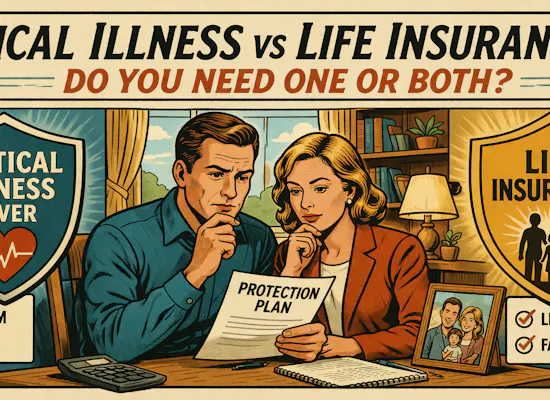
Critical Illness vs Life Insurance (2026): Do You Need One or Both?
Life insurance protects your family if you die. Critical illness cover pays you a lump sum if you are diagnosed with a specified serious illness that meets the policy definition. Many expats need both because they solve different problems. The right answer depends on dependants, debt, earnings risk, and whether employer cover actually follows you abroad.
At a glance
- Life insurance and critical illness cover are not substitutes.
- Life insurance is for death. Critical illness is for surviving a serious diagnosis.
- Many expats need both if they have family, debt, or concentrated earnings risk.
- Employer cover in the GCC is often temporary and not a full solution.
- Medical insurance does not replace either policy.
- The right amount of cover depends on purpose, not guesswork.
- Bad structuring can leave gaps even when premiums are being paid.
People Also Ask
- What is the difference between life insurance and critical illness cover?
- Do I need both life insurance and critical illness cover as an expat?
- Is critical illness cover worth it for UK expats in Dubai?
- Does employer insurance in the UAE give enough protection?
- Can critical illness cover replace income protection?
- Should life insurance be written into trust for UK expats?
The real question is what financial problem you are trying to solve
Most people compare life insurance and critical illness cover as if they are competing products. They are not. They are designed for different events, pay different people, and solve different risks.
I’m Josh, a financial planner specialising in expats in the Middle East. I join the dots across pensions, investments, tax, currency, insurance, and estate planning. I’m authorised to advise across the Middle East, the UK and the USA, framed around continuity when families move.
Here is the balanced view. Some people absolutely need one or both. Others buy the wrong policy because the product sounded familiar, the premium looked cheap, or a bank bundled it into a mortgage conversation. The aim is not to own every type of cover. The aim is to make sure the right money appears at the right time for the right reason.
Life insurance pays if you die during the policy term. Critical illness cover usually pays a tax-free lump sum if you are diagnosed with a specified serious illness or medical condition that meets the wording and severity threshold in the policy. That distinction matters because the cash is needed at very different moments.
If your family would struggle financially if you died, life cover is the starting point. If your main worry is surviving cancer, a stroke, or a heart attack and needing capital to reduce pressure while you recover, critical illness becomes highly relevant. In many expat households, both risks exist at once.
Why expats in the Middle East need to think differently
What I see in practice is that British expats in Dubai, Abu Dhabi and the wider GCC often assume they are more protected than they really are.
That usually happens for four reasons:
- They confuse medical insurance with financial protection.
- They assume employer cover continues if they change firms, become partners, or leave the region.
- They underestimate how quickly income can stop after a health event.
- They do not check whether an old UK policy still works cleanly once they live abroad.
Medical insurance is useful, but it pays medical bills within policy limits and terms. It does not usually replace income, clear a mortgage, fund school fees, or create breathing room if your career pauses for 18 months.
GCC employment adds another layer. In some cases, long periods off work can lead to income disruption much faster than people expect. For high earners, partners and business owners, the loss is not only salary. It can include bonus, drawings, profit share, and future progression.
Cross-border issues matter too. A product that was fine when you lived in London may become clumsy if you are now UAE resident, have dependants in two countries, and expect to retire somewhere else later. Portability, claims process, beneficiary structure, and trust planning all need proper attention.
Five worked examples with numbers
- Situation
A 39-year-old British senior associate in Dubai has two children, a £620,000 UK mortgage, and annual family spending of £95,000. Her firm provides death in service of four times salary, equal to £520,000.
The hidden risk
She assumes employer death cover fully solves the problem and has no personal protection in place.
The numbers
Mortgage £620,000. School fee runway wanted for three years: £90,000. Household runway for two years: £190,000. Total family protection need on death: about £900,000 before existing assets. Employer cover of £520,000 leaves a clear shortfall. A separate level term life policy of £400,000 to £500,000 would close it.
The planning logic
Employer cover is helpful, but it is linked to the job. It may not follow her if she changes firm or takes time out.
A clean solution approach
Keep the employer benefit, add personal life cover, and review beneficiary and trust structuring so proceeds reach family quickly.
Takeaway
If other people rely on your income, life insurance is usually the first layer.
- Situation
A 45-year-old law firm partner in Abu Dhabi has no large mortgage but needs £18,000 a month to support family spending and schooling.
The hidden risk
He thinks life insurance matters more than illness because he is healthy and has assets.
The numbers
Emergency fund £120,000. Investment portfolio £350,000. If he survives a major illness and cannot work properly for 18 months, potential cash need could still exceed £200,000 after using cash reserves. A critical illness policy of £250,000 would create flexibility without forcing asset sales at the wrong time.
The planning logic
Death is not the only financially damaging event. A serious diagnosis can trigger treatment travel, lower productivity, and poor decisions under pressure.
A clean solution approach
Retain moderate life cover for dependants, but add critical illness sized to create 12 to 24 months of breathing room.
Takeaway
For high earners, critical illness often protects future optionality, not just bills.
- Situation
A 51-year-old British business owner in Qatar wants to protect both household and company continuity.
The hidden risk
He tries to use one personal policy to solve family, debt and business exposure together.
The numbers
Personal annual family need: £80,000. Business debt guaranteed personally: £300,000. Key person exposure estimated at £400,000. One £500,000 personal life policy would not solve all three problems. The risks should be split between personal life cover, critical illness cover, and business protection.
The planning logic
Personal protection and business protection should not be blurred. Otherwise, one claim may leave another gap.
A clean solution approach
Use personal life cover for family, critical illness for personal liquidity, and separate business cover for debt or key person risk.
Takeaway
When one person drives both household income and company value, “one policy” is usually false efficiency.
- Situation
A British couple aged 58 are preparing to leave the UAE and return to the UK within two years. They have adult children, low debt, and £1.6 million of pensions and investments.
The hidden risk
They assume they no longer need protection because retirement assets are substantial.
The numbers
Estate expected to exceed available nil-rate bands. They want a liquidity pool of £250,000 to help with tax, administration and family flexibility if one dies first. A whole-of-life or later-life planning conversation may be relevant, but only if cost, trust structure and purpose are clear.
The planning logic
Not all life cover is income replacement. Sometimes it is estate liquidity or intergenerational planning.
A clean solution approach
Review whether life insurance is being used for family income, estate liquidity, or not needed at all. Do not force an old protection idea into a later-life planning problem.
Takeaway
The purpose of cover changes as wealth, age and residency change.
- Situation
A 34-year-old single solicitor in Riyadh, no children, no mortgage, good savings, strong future earnings.
The hidden risk
Friends tell him to buy both life insurance and critical illness because “everyone should have protection.”
The numbers
Cash reserve £70,000. No dependants. No debt. Employer medical cover is strong. His real risk is loss of earnings, not death-related family hardship. Life insurance may have limited immediate value. Critical illness may be useful, but income protection may be the better priority if available and suitable.
The planning logic
Not everyone needs both. Sometimes the right answer is neither, or a different protection product first.
A clean solution approach
Focus on cash reserves, career risk, and income replacement before buying life cover by default.
Takeaway
Protection should match exposure, not fashion.
Critical illness vs life insurance in practice
How it works in practice
Life insurance usually pays your beneficiaries if you die during the term. Critical illness usually pays you if you are diagnosed with a listed condition that meets the policy wording. Many combined policies exist, but you need to understand whether a critical illness payout reduces or ends the life cover.
The key moving parts
Dependants. Debt. Savings. Employer benefits. Health history. Jurisdiction. Portability. Trust structure. Whether you need capital, income replacement, or legacy liquidity. Whether the illness definitions are actually strong enough. Whether the policy remains suitable if you move country again.
Trade-offs
Life insurance is usually cheaper per pound of cover because death is the insured event. Critical illness is often more expensive because claims are more likely and definitions matter. Combined plans can be efficient, but they can also hide a trade-off. If a critical illness claim pays first, the death cover might reduce or disappear depending on structure.
What can go wrong
People buy critical illness when what they really need is income protection. People assume “covers cancer” means all cancer, when definitions and severity still matter. People rely on employer death in service without checking whether it ends when they leave. People think private medical insurance solves the same problem. It does not. People also forget disclosure quality. Poor or incomplete medical disclosure can become a claims issue later.
When it is not suitable
Life insurance may not be a priority if no one depends on your income and there is no estate liquidity need. Critical illness may be poor value if you already have strong assets, no debt pressure, and your bigger risk is long-term income loss rather than a one-off capital need. In some cases, income protection should be prioritised ahead of critical illness.
Checklist: How to evaluate this properly
- Decide the exact job of each policy before looking at premiums.
- Check employer benefits and whether they stop on resignation, partnership, or relocation.
- Separate family protection from business protection.
- Calculate how much cash would actually be needed after a serious diagnosis.
- Review whether your old UK cover remains valid and practical while abroad.
- Check whether life cover should sit in trust for speed and estate planning reasons.
- Compare policy definitions, not just price.
- Review cover after marriage, children, mortgage changes, partnership, or repatriation.
What gets overlooked
- Medical insurance and critical illness are not doing the same job.
- A family can survive medically but still be financially exposed.
- School fees are often forgotten in protection planning.
- Drawings and bonus income may vanish faster than salary.
- A combined policy may reduce death cover after a critical illness claim.
- Estate liquidity can matter even when retirement assets are strong.
- Old nomination forms and trust wording can undermine good intentions.
- International claims servicing and policy administration quality matter more than people think.
How to stress-test what you already have
- Portability if you move from UAE to UK or elsewhere
- Jurisdiction risk of insurer and product structure
- Beneficiary alignment with current family intentions
- Currency risk if liabilities are in GBP and income is in AED or USD
- Charges relative to the real value of cover
- Documentation kept in one accessible place
- Counterparty risk and insurer financial strength
- Review cadence at least annually
- Whether life cover is written into trust where appropriate
- Whether critical illness definitions match what you think you bought
- Whether combined plans leave a gap after first claim
- Whether employer cover duplicates or fails to replace personal cover
- Whether business liabilities are wrongly mixed with personal protection
- Whether disclosure records are complete and accurate
Common mistakes
- Buying life insurance because it is cheaper.
Why it matters: cheap cover is not useful if the real risk is surviving illness and losing financial flexibility. - Buying critical illness instead of income protection because it feels simpler.
Why it matters: critical illness is capital, not ongoing salary replacement. - Assuming medical insurance covers the same ground.
Why it matters: treatment funding is not the same as family protection or debt relief. - Not checking if the policy still works overseas.
Why it matters: servicing, underwriting and claims can become harder across borders. - Using one policy for household and business risks.
Why it matters: one claim can solve the wrong problem and leave another exposed. - Accepting the cheapest policy definitions.
Why it matters: weak definitions can create disappointment exactly when you need certainty. - Never reviewing cover after becoming a partner or owner.
Why it matters: income structure and liabilities usually change. - Ignoring trust planning on life cover.
Why it matters: proceeds may be slower to access or fall into the estate unnecessarily. - Guessing the amount of cover.
Why it matters: over-insuring wastes money and under-insuring creates a false sense of safety. - Assuming existing assets remove all protection need.
Why it matters: liquidity, timing and emotional pressure still matter.
Common objections
Objection
“I already have medical insurance.”
Emotional logic
That feels like a complete safety net.
Practical risk
It helps with treatment, not with replacing income, clearing debt, or supporting family after death.
Next step
Separate treatment risk from cashflow risk and family risk.
Objection
“My firm gives me death in service.”
Emotional logic
Employer cover feels free and sufficient.
Practical risk
It is job-linked and may disappear at exactly the wrong time.
Next step
Ask what happens if you resign, relocate, or become a partner.
Objection
“I’m healthy, so critical illness is unnecessary.”
Emotional logic
Good current health feels like low future risk.
Practical risk
Underwriting is often easiest before health changes, not after.
Next step
Consider whether you want the option while you can still obtain it cleanly.
Objection
“I only need life cover because that’s what mortgages require.”
Emotional logic
Debt is the most visible liability.
Practical risk
Surviving a serious diagnosis can still damage cashflow even if the mortgage is manageable.
Next step
Model 12 to 24 months of reduced work after illness.
Objection
“Critical illness is too expensive.”
Emotional logic
The premium feels high compared with term life cover.
Practical risk
You may reject a product that solves a real capital gap.
Next step
Right-size the sum assured instead of dismissing the whole category.
Objection
“I don’t want too many policies.”
Emotional logic
Simplicity feels efficient.
Practical risk
Oversimplifying can mix separate risks that need different solutions.
Next step
Define the job of each policy first, then simplify intelligently.
Objection
“My savings will cover it.”
Emotional logic
Cash and investments feel flexible.
Practical risk
Using long-term assets in a health crisis can force poor timing and reduce future security.
Next step
Decide how much of your own capital you are willing to risk.
Objection
“I’ll fix this when I move back to the UK.”
Emotional logic
Future planning feels easier after relocation.
Practical risk
Health, underwriting and structure may all be worse later.
Next step
Review it while options are still broader.
Decision framework
- Identify who is financially affected if you die.
- Identify what happens financially if you survive a serious illness.
- Check what your employer already provides and when it stops.
- Decide whether the problem is death protection, illness liquidity, income replacement, estate liquidity, or business continuity.
- Price life cover and critical illness separately before considering combined plans.
- Review portability, trust planning, and beneficiary structure.
- Compare definitions and claim logic, not just premium.
- Align cover with debt, family needs, and cash reserves.
- Recheck the plan after any career, health, or residency change.
If you only do 3 things this week
- List your dependants, debts, and key financial obligations.
- Ask HR exactly what cover you have and when it ends.
- Review whether your current policies still fit where you live now.
Self-diagnostic
Give yourself 1 point for each yes. Total possible points: 12.
- Do you know what financial problem your life cover is solving?
- Do you know what financial problem your critical illness cover is solving?
- Have you checked your employer benefits in writing?
- Do you know whether your medical insurance excludes or limits key conditions?
- Could your family manage financially if you died this year?
- Could you manage financially if you survived a serious diagnosis and worked less for 12 months?
- Do you know whether your current policy remains suitable while overseas?
- Have you reviewed beneficiary nominations and trust arrangements?
- Have you separated personal and business protection needs?
- Do you know whether your combined policy reduces cover after one claim?
- Have you reviewed your cover in the last 12 months?
- Do you know the exact sum assured and policy term on each plan?
Green 9–12
Amber 5–8
Red 0–4
What to do next based on score
Green
Keep it boring and maintain annual reviews.
Amber
Stress-test, adjust funding, and simplify.
Red
Redesign the plan before time increases cost.
FAQ
Quick definitions
Life insurance: pays out on death during the term of the policy.
Critical illness cover: pays a lump sum on diagnosis of a specified serious condition that meets policy wording.
Income protection: pays ongoing income if you cannot work due to illness or injury.
Medical insurance: pays eligible treatment costs, not family or income protection needs.
Trust: a legal arrangement that can help direct life insurance proceeds efficiently.
What is the main difference between life insurance and critical illness cover?
Life insurance pays on death, while critical illness usually pays on diagnosis. That is the core distinction. Life cover is mainly about protecting dependants, debt obligations, or estate liquidity. Critical illness is more about giving you capital while you are alive and dealing with a serious health event. They solve different risks, so choosing between them starts with the problem, not the product label.
Do I need both life insurance and critical illness cover?
Many expats do, but not everyone. If you have dependants and also want financial flexibility after a serious diagnosis, both can make sense. If nobody depends on your income, life cover may matter less. If your bigger vulnerability is illness rather than death, critical illness may be more relevant. The right answer depends on family, debt, savings and employer cover.
Is critical illness cover worth it for UK expats in Dubai?
It often is when a serious diagnosis would create a cash gap. That can happen even with strong medical insurance. In Dubai, many high earners have expensive lifestyles, school fees, and job-linked benefits that may not last. Critical illness can create breathing room without forcing asset sales or rushed decisions. It is usually most valuable where illness would disrupt income, not only treatment access.
Is life insurance still important if I already have good assets?
Sometimes yes. Assets do not always equal immediate usable cash. Life insurance can still be helpful where your wealth is tied up in property, pensions, business interests, or long-term investments. It can also be relevant for estate liquidity or family simplicity. The question is whether your family would need fast cash at the wrong time, not just whether you look wealthy on paper.
Can critical illness cover replace income protection?
No, not fully. Critical illness is usually a lump sum for specific defined conditions. Income protection is designed to replace income if illness or injury stops you working. Many people buy critical illness because it is easier to understand, but that can leave a gap. If your main concern is maintaining earnings, income protection is often the better first conversation.
Does medical insurance make critical illness cover unnecessary?
Usually no. Medical insurance helps with treatment costs, hospitals and approved care. Critical illness is about wider financial consequences like time off work, debt reduction, travel, household support or just creating options. You can have excellent medical cover and still be financially exposed after a serious diagnosis. They are complementary, not interchangeable.
Should life insurance be written into trust?
Often yes, especially for family protection. A trust can help life policy proceeds reach beneficiaries more efficiently and may support better estate planning. It is not automatic and needs proper legal and tax consideration, particularly for expats with cross-border family arrangements. But ignoring trust planning is one of the most common weaknesses in otherwise sensible life cover arrangements.
Can I keep my UK life insurance after moving abroad?
Sometimes, but you should not assume it. Some policies continue smoothly, others may have servicing or practical limitations. The key issue is not only whether the contract remains in force. It is whether the structure, beneficiaries, trust planning, currency and claims process still fit your new life. A quick review after relocation is usually worthwhile.
What illnesses does critical illness cover actually include?
It depends on the insurer and the policy wording. In the UK market, there are minimum standards around major conditions like cancer, heart attack and stroke, but definitions and severity still matter. Not every diagnosis triggers a payout. This is why comparing policy definitions is more important than comparing marketing headlines. “Covered” and “claimable” are not always the same thing.
What if I am single with no children?
You may not need life insurance right now. If no one depends on your income and there is no debt or estate planning need, life cover might be low priority. Critical illness could still matter if you want a capital buffer after a serious diagnosis. In many single-person cases, strong cash reserves and income protection deserve attention before traditional life cover.
Should business owners handle this differently?
Yes, very often. A business owner may need personal life cover, personal critical illness cover, and separate business protection. Household needs, business debt, key person exposure and shareholder arrangements should not be lumped together carelessly. Good planning separates the jobs clearly. Otherwise, one event can expose both family and company at the same time.
How much cover should I actually buy?
Start with purpose, not round numbers. For life cover, think about debt clearance, family runway, education costs and ongoing income needs. For critical illness, think about how much cash would reduce stress after diagnosis. That might be 12 to 24 months of spending, a mortgage reset, or a combination. The right amount is usually calculated, not guessed.
What happens next
Clarify objectives and liabilities
Define whether the priority is family income, debt clearance, illness liquidity, business continuity, or estate planning.
Quantify gaps and constraints
Measure what employer benefits, cash reserves and existing policies already cover, and where they clearly do not.
Structure and documentation alignment
Check policy ownership, beneficiaries, trusts, portability and whether the paperwork still matches your family and residency position.
Underwriting or implementation review
Review medical disclosure, insurer quality, policy definitions and whether a combined or separate structure is actually cleaner.
Ongoing review triggers and cadence
Revisit the plan annually and after marriage, children, relocation, partnership, business sale, health changes, or repatriation.
Conclusion
For most expats, this is not a choice between two similar products. It is a decision about which financial shock you are most exposed to, and whether your current arrangements would actually hold up under pressure.
Life insurance protects the people who depend on you if you die. Critical illness protects you if you survive a serious diagnosis and need capital fast. In many Middle East expat households, both risks exist, and employer benefits only partially fill the gap.
The cost of getting this wrong is usually not visible when everything is going well. It shows up when salary stops, family need cash quickly, or an old policy turns out not to solve the real problem you thought it covered.
If you want help reviewing whether your current protection is actually fit for purpose across borders, book a call. I help expats connect insurance, pensions, investments, tax, currency and estate planning into one joined-up strategy, so protection works when it is supposed to.
Compliance note
This is general information, not personal financial, tax or legal advice. Insurance suitability depends on health, jurisdiction, policy wording, ownership structure and your wider financial plan.
You may also like
A Guide to International Insurance for Expatriates
Key Person Insurance Explained (2026): Cost, Cover, Payouts
Estate Planning for Expats (2026): Wills, Guardianship, Assets
Estate planning: what happens if you die without a will?